
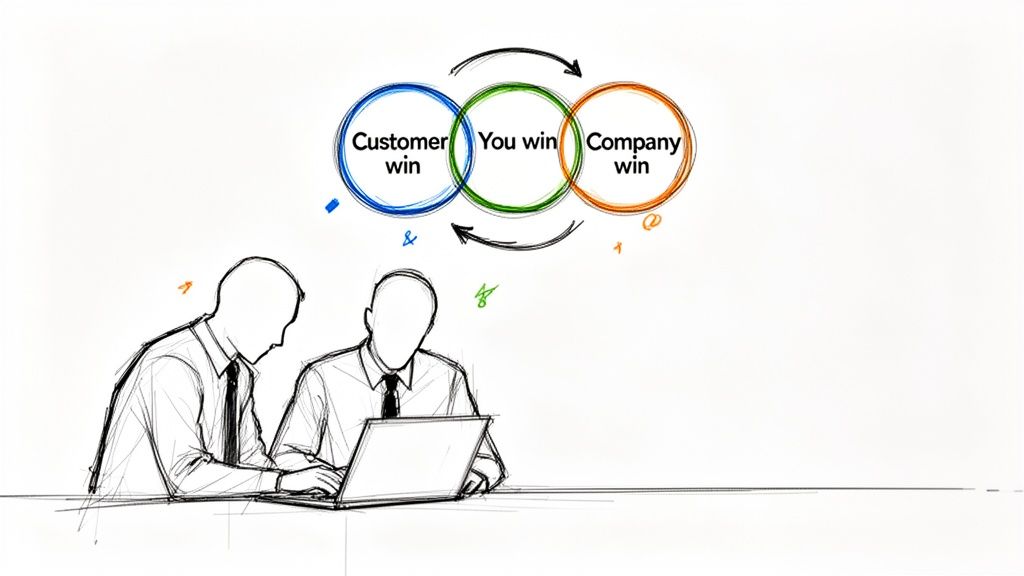
The standard product demo is inefficient. Sales reps often present a long list of features, hoping one will appeal to the prospect. A win-win-won demo is different. It is a structured conversation designed to achieve three clear outcomes: a win for the customer who finds a solution, a win for the sales rep who advances the deal, and a win for the company that builds a reliable pipeline.
This guide provides a step-by-step process to shift from a one-way presentation to a collaborative, problem-solving session.
Rethinking the Sales Demo
Most sales demos are product tours. They follow a predictable script that lists features, many of which are not relevant to the prospect's daily work. This approach often leads to disengaged prospects and stalled deals.
The win-win-won demo focuses the conversation on the prospect's challenges, goals, and desired outcomes instead of product features.
The Three Required Outcomes
To be successful, every demo must achieve three distinct goals. If one is missed, the demo has not succeeded.
A Win for the Customer: The prospect leaves the call with a clear path to solving their specific problem using your solution. They feel understood.
A Win for You: You achieve your call objective. This could be securing a meeting with a decision-maker, getting approval for a technical review, or confirming a timeline for next steps.
A Win for Your Company: The deal moves forward, contributing to a more accurate sales forecast. A successful demo measurably improves win rates.
Actionable Principle: Stop presenting features. Start building solutions with the prospect. When a prospect sees you as a partner in solving their problem, they are more likely to recognize the value you offer.
This table shows the shift in focus from a product-centered pitch to a customer-centered conversation.
Traditional Demo vs. Win-Win-Won Demo
Stage | Traditional Demo Focus | Win-Win-Won Demo Focus |
|---|---|---|
Opening | Company & product introduction. | Set a collaborative agenda; confirm the prospect's main challenges. |
Discovery | Ask general qualifying questions. | Use specific questions to find the root causes and business impact of problems. |
Presentation | Show as many features as possible. | Show only the two or three features that directly solve the prospect's stated problems. |
Closing | Ask "Any questions?" and hope for a next step. | Summarize the value and agree on clear, mutual next steps. |
The win-win-won approach is a dialogue, not a monologue. It makes the prospect an active participant.
By using the prospect's own words to describe their problems and connecting them to your solution's value, you build trust and show you are invested in their success. To learn more about structuring these discovery conversations, see this guide on the SPIN selling methodology.
The goal is to make the demo a working session where you solve a problem together. The sale becomes a natural outcome of that process.
How to Prepare for a Winning Demo
A successful demo depends on the preparation done before the call. Research and discovery are essential for creating a tailored solution instead of a generic product tour. This preparation helps you build a strong value hypothesis.
A value hypothesis is a clear statement of how your solution will solve a specific, high-priority problem for the prospect. Every piece of information you gather should be used to develop and refine this hypothesis.
Step 1: Research the Prospect's Business
Effective research involves more than a quick look at the prospect's website. You need to understand their business, industry pressures, and common terminology. The goal is to connect your product’s functions to their real-world challenges.
Research Checklist:
Company Information: Review recent news, press releases, and annual reports. Are they hiring for specific roles? Did they recently receive funding or launch a new initiative? These events often create problems that need solving.
Stakeholder Roles: Use LinkedIn to research everyone attending the meeting. Note their titles and responsibilities. A VP of Sales cares about different metrics than a frontline sales manager.
Industry Trends: Understand what is happening in their sector. For example, if selling into Brazil, you should know the market has high digital adoption. Mobile connectivity penetration is at 102%, indicating a tech-savvy audience that expects efficient tools. You can find more insights into Brazil's digital landscape on datareportal.com.
This level of preparation allows you to use their language, which builds immediate credibility.
Step 2: Use Discovery to Identify Pain Points
Discovery is not just a qualification checklist. It is an opportunity to uncover the specific pain points that will form the narrative of your demo. Your role is to guide the conversation from a surface-level issue to its tangible business impact.
Example Discovery Questions:
"Can you walk me through your team's current process for [specific task]?"
"What are the main bottlenecks you experience with that approach?"
"If you could change one thing about that process, what would it be and why?"
"What is the business impact of not solving this problem in the next six months?"
Workflow Tip: Use the prospect's exact words and scenarios from the discovery call in your demo. This is the most effective way to show you listened and that your solution is relevant to their work.
Step 3: Set a Clear Call Objective
Every demo needs a specific purpose. Before the call, define what a "win" means for both you and the prospect. It is not always about closing the deal immediately; it is about moving to the next logical step.
A strong call objective is mutual and precise.
Weak Objective: "Show them the product."
Strong Objective: "Confirm our automated reporting feature solves their team's 10 hours of weekly manual data entry, and secure a follow-up meeting with their Head of Operations to discuss implementation."
This clarity helps you direct the demo with purpose, focusing only on what is necessary to achieve the objective. It turns a presentation into a strategic action that advances the deal.
How to Structure an Effective Demo
An unstructured demo can quickly become a monologue about features, causing the prospect to lose interest. An effective win-win-won demo tells a story where the customer is the hero. This requires a solid, flexible framework that guides the conversation toward a clear outcome.
The structure is simple: recap their problems, connect those problems to your solution's value, show them only what is relevant, and check in for feedback. This approach changes a one-way pitch into a collaborative session.
The process starts with research and discovery, which inform your demo strategy.
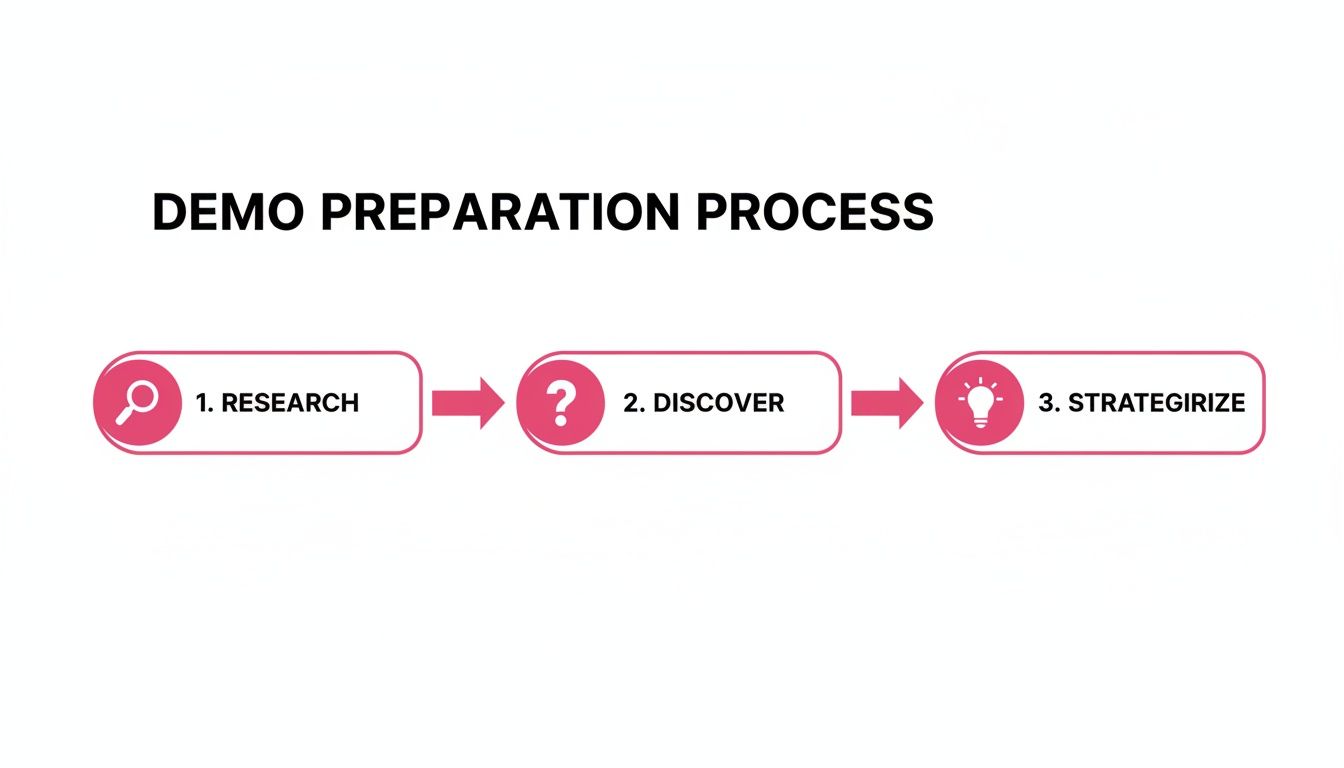
This preparation ensures the final delivery is relevant and feels natural.
Step 1: Start with the Prospect's Problem
Begin the demo by summarizing what you learned during discovery. Use the prospect's own words to describe their main challenges and their impact on the business.
This accomplishes two things. First, it confirms you were listening. Second, it gets them to agree on the problem before you present the solution.
Example Script: "To confirm, your team is losing about 10 hours each week manually creating sales reports, which delays your pipeline reviews. Is that the main challenge we need to address today?"
This question frames the entire conversation around their problem, making every feature you show relevant.
Step 2: Connect Problems to Value
After they confirm the problem, present a clear value proposition. This statement bridges their pain to your solution and promises a specific outcome.
For example: "Okay. The purpose of our call is to show you how to get those 10 hours back by automating your reporting. This will allow your managers to spend more time coaching." This sets a clear, results-oriented agenda. To learn how sales reps can optimize their time, read our guide on the modern role of inside sales representatives.
Step 3: Show Only What Is Necessary
When you share your screen, be precise. Resist the urge to show every feature. Your goal is to demonstrate only the one or two key capabilities that directly solve the problem you just confirmed.
This focused approach keeps the prospect engaged because they can see a direct path from their problem to your solution. A concise demo respects their time and shows you understand their immediate needs.
A Simple Feature Demonstration Flow:
Set the Context: Briefly explain what you are about to show, using their work environment as the example.
Show, Don't Just Tell: Walk them through the workflow. Every click should have a clear purpose.
Pause and Check In: After showing a key function, stop. Ask a question like, "Can you see how this would fit into your team's current process?" or "How does this compare to your current method?"
This creates a feedback loop. It ensures they understand and helps them visualize using your tool to improve their work.
Handling Objections and Defining Next Steps
Objections are a sign of engagement. When a prospect raises a concern, it means they are listening and thinking critically. Treat objections as opportunities for a deeper conversation, not as attacks.
When a concern is raised, pause and understand it before responding. Clarifying the real question shows respect and helps you address the core issue.
A Three-Step Framework for Handling Objections
A planned approach helps you stay in control when faced with a difficult question. This turns a potentially challenging moment into a productive discussion.
Step 1: Clarify. Always ask a follow-up question. If a prospect says, "This seems expensive," do not immediately justify the price. Instead, ask, "That's a fair point. Can you help me understand how you are evaluating the cost relative to your current process?" This uncovers the root of their concern.
Step 2: Validate. Acknowledge their perspective. Simple phrases like, "I understand why you'd see it that way," or, "That's a valid concern," build trust and lower their defenses. It shows you are listening.
Step 3: Respond. Provide a concise, evidence-based answer that connects back to the value you have already established. Frame your response around the specific problem they need to solve.
For context, consider how quickly businesses must adapt to new technologies. In Brazil, the Pix payment system was adopted by 76% of the population very quickly. Companies had to adapt or fall behind. You can frame your solution as an efficiency gain that will become a new standard. You can explore Brazil's rise as a global tech innovator on equinix.com.
How to Close the Demo with a Clear Next Step
The final five minutes of your win-win-won demo are critical. This is when you shift from demonstrating the solution to defining the next action. A weak closing like, "So, any questions?" creates ambiguity and loses momentum. End with a clear, mutually agreed-upon plan.
First, summarize the value you confirmed together. A brief recap of their main challenge and how your solution addresses it reinforces the "win" for them.
Example Recap: "To recap, we saw how the automated dashboard can eliminate the 10 hours your team spends on manual reports each week. This frees up your managers to focus on coaching. Does that accurately summarize it?"
Once they agree, propose a logical next step. This is the natural conclusion of the problem-solving conversation. Make your proposal specific and include a timeline.
Example of a Clear Next Step:
"Good. The next logical step is to schedule a 30-minute meeting with your Head of Operations to map out an implementation timeline. I will send over a few available times for next Tuesday."
This clear, confident closing defines the path forward. Everyone ends the call knowing the next action, which keeps the deal progressing.
Using AI to Analyze and Improve Your Demos
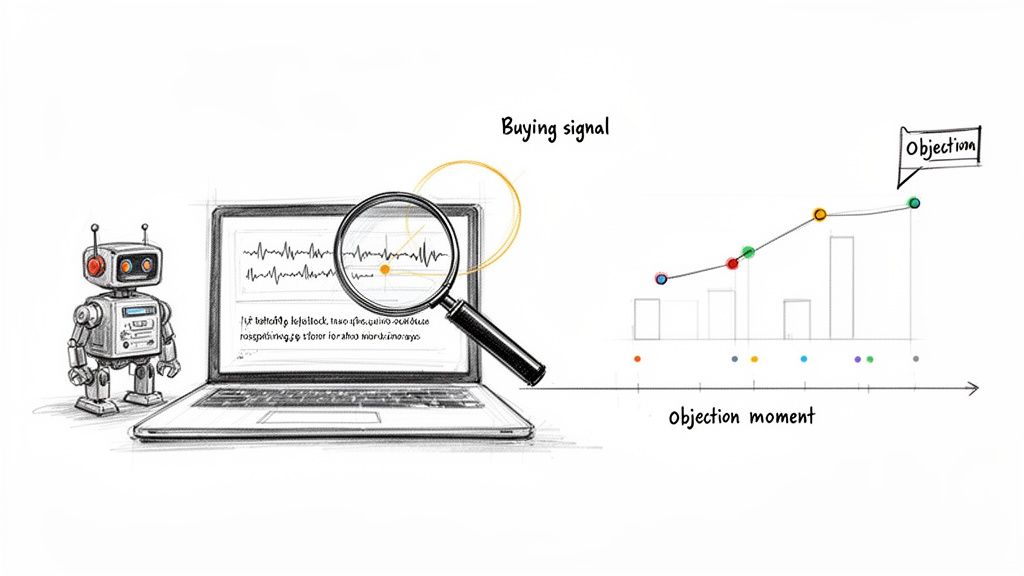
A good demo is a starting point. Consistent improvement comes from analyzing call data, not just relying on intuition. AI tools can turn every demo into a learning opportunity.
AI assistants, like Samskit, can join your calls to record and transcribe the entire conversation. This provides a searchable record of every interaction, allowing you to focus on the prospect instead of taking notes.
After the call, the AI analyzes the transcript to provide actionable insights.
Pinpointing Important Moments in the Call
An AI tool designed for sales conversations can automatically flag the critical moments of your demo. It provides a data-driven summary of the call's key turning points.
This analysis typically highlights:
Buying Signals: It identifies phrases like, "This would save us so much time" or "How soon could we implement this?" This shows you exactly when and why their interest increased.
Objections and Concerns: It pinpoints every instance of pushback, from pricing questions to feature doubts. You can then review how you handled each one.
Competitor Mentions: It flags any time a competitor is named, which provides valuable information about the competitive landscape for that deal.
This workflow provides concrete evidence of what worked and what did not.
Turning Analysis into Action
This data is meant to drive action and save time. One immediate benefit is the automation of administrative tasks. Based on the transcript and discussed next steps, the AI can draft a CRM update.
This eliminates the need to spend hours manually entering notes after calls. The system populates the deal record with accurate context, freeing up significant time. Automating such repetitive tasks has been shown to reduce the number of unqualified demos by up to 32%.
For Managers: This data is a valuable coaching tool. Instead of relying on anecdotal feedback, you can review call transcripts and analytics to identify specific, coachable moments for your team. You can spot effective patterns, share best practices, and provide feedback based on actual performance.
This data-driven approach allows you to refine every aspect of your win win won demo strategy. You can determine which objection-handling techniques are most effective or which value propositions resonate best with certain buyers. To learn more about using data for strategy, read about creating a sales forecast with Power BI.
Using AI to analyze your demos creates a continuous improvement cycle. Every conversation becomes a dataset that helps you and your team become more effective.
Common Questions About the Win-Win-Won Demo
Even with a solid framework, practical challenges can arise. Here are answers to common questions about implementing the win-win-won demo model.
"How does this apply to shorter sales cycles?"
For high-velocity sales or smaller deals with limited time for discovery, you need to adapt the principles, not abandon them.
Combine discovery and the demo into a single session. Dedicate the first five to ten minutes to targeted discovery questions to identify their primary pain point. Once you have it, immediately pivot and show them only the part of your solution that solves that specific problem.
The key is efficiency. Forget the full product tour; perform a focused demonstration that connects their problem to your solution in real time.
"What should I do if my technology fails during a demo?"
Technical issues happen. How you handle them demonstrates your professionalism.
First, remain calm. Do not panic or make excuses. A simple, confident statement like, "It looks like we've hit a technical issue. Give me one moment to reset this," can be very effective.
If you cannot resolve the issue in 30 seconds, move on. Do not make the prospect wait while you troubleshoot. Pivot the conversation back to their needs. You could say, "Rather than have you watch me fix this, let's discuss how this workflow would solve [prospect's problem]." Your value is in your expertise, not just your software.
Practical Tip: The goal is to maintain control of the conversation's value, even if you lose control of the technology. A smooth recovery can build more trust than a flawless presentation.
Always have a backup plan. Keep a pre-recorded video of the main workflow or a few key screenshots ready. It shows you are prepared and respect their time.
"How can I measure the effectiveness of this method?"
To get buy-in from your team and leadership, you need to prove the approach works. This means tracking metrics beyond just closed-won deals.
Key performance indicators (KPIs) to track:
Demo-to-Next-Step Rate: What percentage of your demos result in a concrete, agreed-upon next action? This is the clearest indicator of an effective demo.
Sales Cycle Length: A well-executed win-win-won demo should accelerate the sales process by addressing core issues faster. Monitor if your average cycle time decreases.
Stakeholder Engagement: Are you successfully identifying and involving key decision-makers earlier in the process? Getting the right people involved sooner typically leads to a smoother deal.
Tracking these metrics builds a data-backed case that focusing on the customer's "win" is the most direct path to a win for you and the company.
Ready to turn every demo into a source of powerful data? Samskit can join your calls to capture crucial insights like buying signals and objections, and even automate your tedious CRM updates. See how you can boost your demo performance and reclaim hours of your time at https://samskit.com.