If you're looking for a "spin selling pdf," you likely need a better way to sell. You want to move beyond pushy tactics and have more meaningful conversations with buyers. SPIN Selling provides a framework for that.
The core idea is simple: success in complex sales comes from understanding the customer's problems, not from pushing a product. This framework shifts your role from a salesperson to a trusted advisor who solves real issues. This guide breaks down the process into actionable steps.
What Is SPIN Selling and Why Does It Work?
SPIN Selling is a sales methodology based on research into successful sales calls. It found that top performers don't focus on closing. Instead, they guide customers to discover the need for a solution on their own.
This approach is essential today. B2B buyers are well-informed. They do not want a generic sales pitch. They need a partner who understands their specific challenges.
For example, the Latin American SaaS market is projected to double by 2027. Businesses in this market need more than software; they need expert guidance to manage growth. A report from EBANX details this trend. The SPIN framework helps you have these value-focused conversations.
The Four Stages of SPIN Selling at a Glance
SPIN is not a rigid script. It is a logical flow for a conversation that uncovers customer needs. Each question type serves a specific purpose, creating a natural progression. The customer moves from understanding their situation to explaining why they need your help.
This table summarizes how the four stages work together.
Stage | Goal | Example Question Template |
|---|---|---|
Situation | Understand the customer's current process. | "Can you walk me through your current process for...?" |
Problem | Identify pain points and challenges. | "What's the biggest challenge you face with that process?" |
Implication | Explore the consequences of those problems. | "How does that challenge impact your team's productivity?" |
Need-Payoff | Get the customer to state the value of a solution. | "What would it mean for your team if you could solve that?" |
By moving through these stages, you collaborate with the customer. You help them connect their problems to a solution. This makes your offering feel like their idea, not a purchase you pushed on them.
To learn more about integrating frameworks like this, read our guide on building a cohesive marketing and sales strategy.
A Practical Summary of SPIN Selling
If you need a quick spin selling pdf for reference, this section provides a usable summary. The methodology shows that aggressive closing tactics effective in small sales often fail in large, complex deals.
Top salespeople guide prospects to discover a solution's value for themselves. This requires a shift in thinking. You move from a product monologue to a structured, four-part questioning sequence. Each question type leads to the next. The process builds trust and makes the final decision feel logical.
This diagram outlines the four question types and their goals.
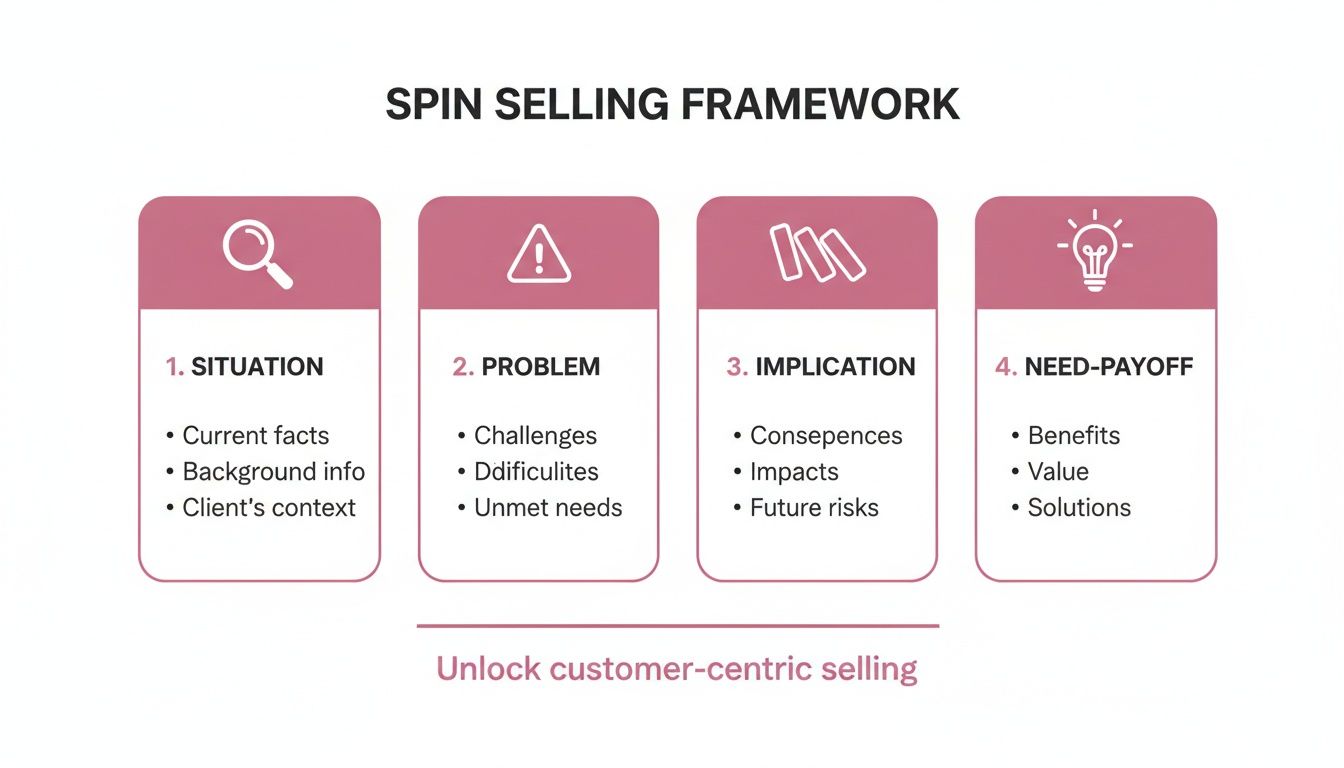
The framework moves the conversation from general context to the urgent need for a solution.
S is for Situation: Establish the Context
Situation questions gather basic facts. You learn about the customer’s operations, processes, and tools. Think of it as mapping the territory. You are listening and learning, not selling.
Purpose: To establish a factual baseline for the conversation.
When to ask: At the beginning of a discovery call.
Common mistake: Asking questions you could have answered with pre-call research. This wastes the buyer's time.
P is for Problem: Identify the Pain
Next are Problem questions. These uncover challenges, frustrations, or dissatisfactions. You probe for the specific pain points your solution solves. These questions shift the conversation from facts to difficulties.
“The objective is not to close a sale, but to open a relationship.” – Neil Rackham
This quote captures the correct mindset. You are looking for a chance to help, not an opening to pitch.
Purpose: To get the buyer to state that a problem exists.
When to ask: Once you have a basic understanding of their situation.
Common mistake: Pitching your solution as soon as you hear a problem. The buyer isn't ready until they understand the problem's full impact.
I is for Implication: Quantify the Pain's Impact
Implication questions are the most critical part of the SPIN framework. They help the buyer think about the consequences of the problems you have uncovered.
This is how you build urgency. You connect a small issue to larger business consequences, like lost revenue, lower productivity, or staff turnover. It is the difference between "Our reporting is slow" and "How many senior staff hours are wasted each month waiting for those reports?"
Purpose: To make the buyer feel the true cost and weight of the problem.
When to ask: After the buyer has acknowledged a clear problem.
Common mistake: Asking generic questions. Explore specific effects on their business, not just obvious consequences like "That must be frustrating."
N is for Need-Payoff: Guide Them to the Solution
Finally, Need-Payoff questions guide the buyer to state the solution's value in their own words. Instead of you telling them how great your product is, you ask questions that lead them to describe the benefits. This is powerful because it makes the solution feel like their idea.
For example, instead of saying, "Our software will save you 10 hours a week," you ask, "If you could automate that process, what would your team do with that extra time?"
Purpose: To have the buyer explain the value of solving the problem.
When to ask: After the problem's implications are clear and the buyer feels the pain.
Common mistake: Answering the question for them. Your job is to ask the question, then listen as they describe their ideal outcome.
SPIN Question Examples and Templates You Can Use
Let's apply the theory to a real conversation. This section provides a playbook with question templates for each stage of the SPIN framework. Use these as starting points, not rigid scripts. Adapt the language to fit your industry and prospect.
Mastering SPIN questioning requires listening more than talking. You guide the prospect to their own conclusions.
Situation Question Templates
Situation questions set the scene. Your goal is to understand their current processes, tools, and objectives. Do your research first to avoid asking basic questions.
"Could you walk me through your current process for [specific task]?"
"What tools does your team currently use to manage [area of responsibility]?"
"Who on your team is responsible for [business function]?"
"How do you measure success for [key performance indicator] right now?"
These questions gather facts and provide the context you need to dig deeper.
Problem Question Templates
Once you understand the current state, you can probe for challenges. Problem questions uncover friction and dissatisfaction.
"Are you satisfied with your current system for [task]?"
"What are the biggest challenges you face when trying to [achieve a specific goal]?"
"How much time does your team spend on manual data entry each week?"
"Does the current process ever feel inefficient or too expensive?"
Identifying a clear problem gives you the signal to move to the next stage.
Implication Question Templates
Implication questions separate effective salespeople from the rest. These questions connect a stated problem to its wider business consequences. This builds urgency.
The goal is to help your prospect connect a minor annoyance to a significant business issue with serious consequences.
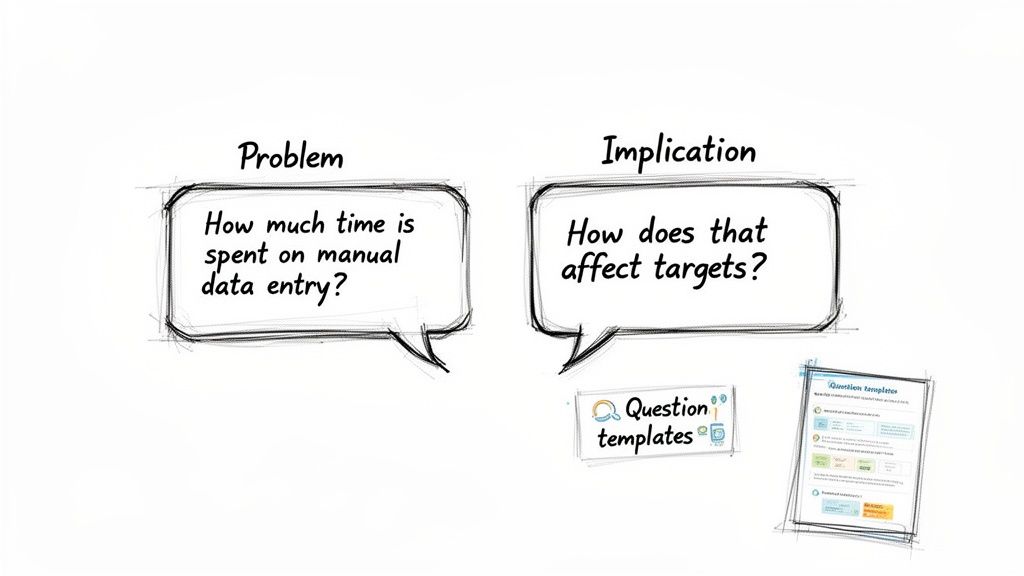
Here’s an example of the transition:
From Problem: "How much time is spent on manual data entry?"
To Implication: "What is the impact of that lost time on your team's ability to hit its targets?"
Other Implication question templates include:
"When that process is delayed, how does it affect production timelines or client deliverables?"
"How does dealing with [problem] repeatedly affect team morale?"
"What is the financial cost of that inefficiency over a full quarter?"
For those in business development, mastering these questions is critical. You can find more strategies for SDR and inside sales roles in our guide.
Need-Payoff Question Templates
After building up the pain, Need-Payoff questions shift the conversation to the solution. Your job is to guide the prospect to state the solution's value in their own words.
"What would it mean for your team if you could automate [the problematic process]?"
"If your team got back 10 hours each week, what could they accomplish?"
"How would having a clearer view of [key data] change your decision-making process?"
"Would a system that could [solve the core problem] be valuable to you?"
When the buyer articulates the benefits, they build the business case for you. Your proposal becomes the logical next step.
Weaving SPIN into Your Daily Sales Workflow
A good methodology must be applied consistently. To get results, you need to move SPIN from theory to daily practice. This means embedding its principles into your team's operations. The goal is to make your sales conversations more effective.
The SPIN sequence should become second nature for your team. The framework helps reps prepare for, conduct, and review their calls. It shifts your process from product-centric to problem-centric.
Build SPIN into Your Call Prep Checklist
Good SPIN conversations result from thoughtful preparation. Create a simple pre-call planning checklist based on SPIN. Before a discovery call, your reps should answer these questions.
Situation: What do I already know about this company? What key details must I confirm?
Problem: Based on their industry and role, what are their most likely pain points that we solve?
Implication: If these problems exist, how do they likely affect the business in terms of cost, time, or risk?
Need-Payoff: What does a successful outcome look like from their perspective?
This exercise forces reps to think like a consultant before the call begins. It changes the mindset from "What can I pitch?" to "What problem can I solve?"
Structure Your Agendas and CRM Around the Buyer's Journey
Your tools should support your methodology. Start by updating your discovery call agenda to follow the SPIN flow. Instead of a section called "Our Solution," use headings like "Exploring Your Current Challenges" and "Defining a Successful Outcome."
A well-designed workflow makes the right behavior easy. Align your CRM stages with the buyer's journey to focus your team on what matters to the customer.
Consider updating your CRM stages:
Qualification: Initial contact made.
Needs Discovery (S & P): Customer's key problems identified and documented.
Impact Analysis (I): Buyer understands the business consequences of the problems.
Solution Value (N): Buyer has articulated the value of solving the problem.
Proposal/Close: We are presenting a solution to a problem they agree is worth solving.
Use Scorecards for Coaching and Reinforcement
To make new habits stick, you must measure progress and coach effectively. Create a simple call scorecard for deal reviews and one-on-ones.
Did the rep uncover a clear business problem?
Did the rep explore the implications of that problem?
Did the customer state the value of a solution in their own words?
A scorecard provides a consistent framework for coaching. It changes vague feedback like "That was a good call" into actionable advice: "You did a great job uncovering the initial problem. Next time, let's focus on exploring its implications to build more urgency." This makes coaching practical and tied to performance.
How Samskit Automates Your SPIN Selling Process
Knowing the SPIN framework is one thing. Using it effectively during a sales call is another. Modern tools can help by making the methodology a consistent part of your workflow. Samskit is designed to act as an intelligent co-pilot on every call.
Samskit runs in the background of your meetings on platforms like Zoom or Google Meet. It automatically records, transcribes, and analyzes the conversation. This provides a perfect, searchable record of every call, replacing unreliable manual notes.
From Conversation to Actionable Data
Samskit's AI-driven analysis is its key feature. It does not just provide a transcript. It identifies and tags crucial moments in the conversation.
It flags each of the four question types as they occur:
Situation questions used to establish context.
Problem questions that uncovered a pain point.
Implication questions that built urgency.
Need-Payoff questions that guided the buyer to state a solution's value.
This turns a conversation into structured data. Sales managers can see how reps apply the SPIN methodology without shadowing every call. This makes coaching sessions more specific and effective.
The image below shows how Samskit summarizes the most important insights from a meeting.
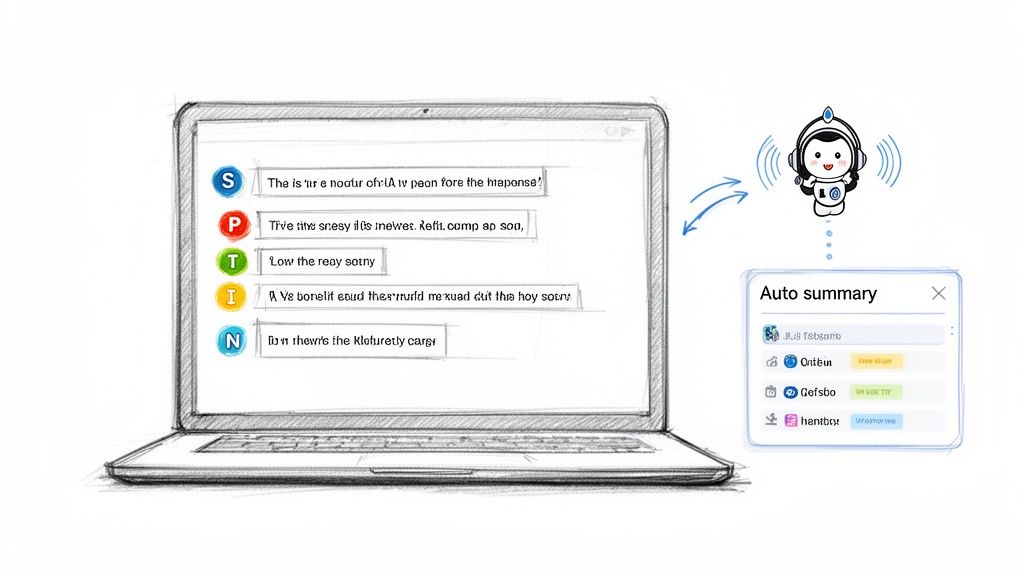
This automated summary ensures that buying signals, objections, and commitments are captured accurately every time. The risk of human error or a forgotten detail is eliminated.
Eliminating Manual Work and Syncing to Your CRM
This system greatly reduces manual data entry. Research shows that sales reps spend less than 28% of their week selling, with administrative tasks being the main reason. Samskit creates accurate call summaries and syncs them directly to your CRM.
By automating the capture of SPIN cues and meeting outcomes, you ensure that vital context is never lost. The CRM becomes a reliable source of truth, reflecting what actually happened in the conversation.
This level of detail is a significant advantage. For example, in complex markets where understanding subtle customer pain points is key, rich call data helps you succeed.
Automating your SPIN process frees your team to focus on building relationships and solving customer problems. It gives them more time for the human side of selling by letting technology handle administrative tasks.
SPIN Selling Frequently Asked Questions
Here are answers to common questions that arise when sales teams start using the SPIN framework.
Is SPIN Selling Still Relevant Today?
Yes. The framework was developed in the 1980s, but its core principles are more relevant than ever.
Today's B2B buyers research products before speaking to a salesperson. They do not want a generic pitch. They want a partner who understands their business challenges. SPIN's consultative approach is designed for this environment. It forces you to understand their world first, which is the only way to build trust and win large deals.
Can I Use SPIN for Smaller Transactional Sales?
The full SPIN process is designed for complex, high-value sales with long cycles. Using every stage for a simple transaction may be unnecessary if the buyer already knows what they want.
However, the core principles of SPIN are still useful. In a small sale, asking a quick Problem question followed by a Need-Payoff question can be very effective. You are still connecting your solution to a specific need, which is always better than just listing features.
The key takeaway from SPIN is a mindset shift: move from pitching features to solving documented problems. This approach is valuable in nearly any sales context.
How Long Does It Take to Master SPIN Selling?
You can start using the basics immediately. Simply learning to ask a good Problem question instead of starting with a pitch is a significant first step.
Becoming an expert takes time. Mastery means weaving these questions into a conversation so naturally that the customer feels like they are leading the discussion. It requires developing an instinct for asking the right question at the right moment.
Most reps become comfortable and see results within a few months, especially with good coaching and call reviews. Using tools that analyze your questioning patterns can speed up the learning process.
Ready to stop chasing context and start closing deals? Samskit turns your sales meetings into accurate CRM updates automatically, giving your team more time to focus on what matters—selling. See how it works at Samskit.