A Quarterly Business Review (QBR) is a scheduled meeting between a business and its customer, held every three months. Its purpose is to review performance, align on future goals, and strengthen the partnership.
A QBR is not a sales pitch or a casual check-in call. It is a high-level, collaborative session focused on demonstrating the value your solution provides to the customer's business.
The Core Purpose of a QBR

The primary goal of a QBR is to shift the conversation from daily operations to strategic impact. It answers the customer's key question: "Are we getting the value we paid for?" This meeting proves your product is a strategic investment, not just an expense.
These discussions elevate the relationship. You move from being a vendor to a partner invested in their success.
Turning Data into a Story of Success
An effective QBR uses data to tell a clear story. You connect how the customer uses your product to their business results. This is less about showing a dashboard and more about explaining what the numbers mean for their goals.
Celebrate wins and address challenges directly. Transparency about what works and what does not builds trust and shows commitment to the long-term partnership.
Aligning on Future Goals
The most critical part of a QBR is looking forward. This is where you and your customer define clear, achievable goals for the next 90 days. This forward-looking plan ensures you stay aligned with their evolving business needs.
A QBR is a tool for proving return on investment (ROI). It formalizes the value you deliver, making renewal and expansion talks a natural next step instead of a difficult negotiation.
Here is a quick breakdown of what a QBR involves.
QBR at a Glance
Component | Description |
|---|---|
Cadence | Held every three months (quarterly). |
Attendees | Key stakeholders and decision-makers from both sides. |
Focus | Strategic review, not a tactical check-in or sales pitch. |
Objective | Demonstrate value, align on future goals, and strengthen the partnership. |
Outcome | Clear action plan for the next 90 days and a stronger relationship. |
This structure keeps the meeting focused and helps deliver tangible results.
Customer-facing teams must track these important conversations. High performing teams managing customer relationships use solutions like Samskit to capture every commitment, action item, and goal from a QBR. This ensures nothing is missed, turning a single meeting into a continuous, documented strategy.
Why QBRs Are Critical for Customer Retention
A well-executed Quarterly Business Review is a powerful tool for customer retention and account growth. These meetings provide a dedicated time to methodically prove the return on investment (ROI) your solution delivers. This reframes your service in the customer's mind from a simple expense to a strategic investment.
When you consistently demonstrate value, you re-affirm their decision to work with you. A successful QBR gives your champions the evidence they need to justify the spend to their leadership, simplifying renewal conversations.
From Vendor to Indispensable Partner
A QBR changes the dynamic of your relationship. By moving beyond daily support tickets and operational issues, you create space for a strategic conversation. This is your chance to show you understand their long-term vision and align your product’s future with their goals.
This proactive approach helps identify churn risks before they become serious problems. It is better to hear about a frustration during a QBR than to be surprised by a cancellation notice. High-performing customer success teams use tools like Samskit to capture these critical insights, using all feedback to strengthen the partnership.
A QBR isn't about defending your contract. It's about proving your partnership is so valuable they can't imagine hitting their goals without you.
Uncovering Organic Growth Opportunities
Strategic conversations often lead to growth opportunities. When you understand a customer's upcoming challenges and goals, you can spot chances to expand the account. Another department might benefit from your solution, or a new feature may solve a problem they just mentioned.
These moments increase customer lifetime value. For example, local market data can add valuable context. A report from the Greater Birmingham Chamber of Commerce showed that 28% of firms reported a rise in domestic sales. Including such specific data shows you are a partner who understands their business environment.
This type of partnership directly boosts key SaaS metrics. By anticipating risks and seizing opportunities, you improve your company’s financial health. It is a core driver for metrics like Net Dollar Retention, which measures your ability to grow revenue from existing customers. A solid QBR process is one of the best ways to maintain a healthy NDR.
Assembling Your QBR Agenda and Attendees
A Quarterly Business Review is only as effective as its participants and its agenda. The right people and topics create a two-way dialogue. The wrong ones result in a one-sided presentation. A successful QBR starts with a solid framework for your guest list and agenda.
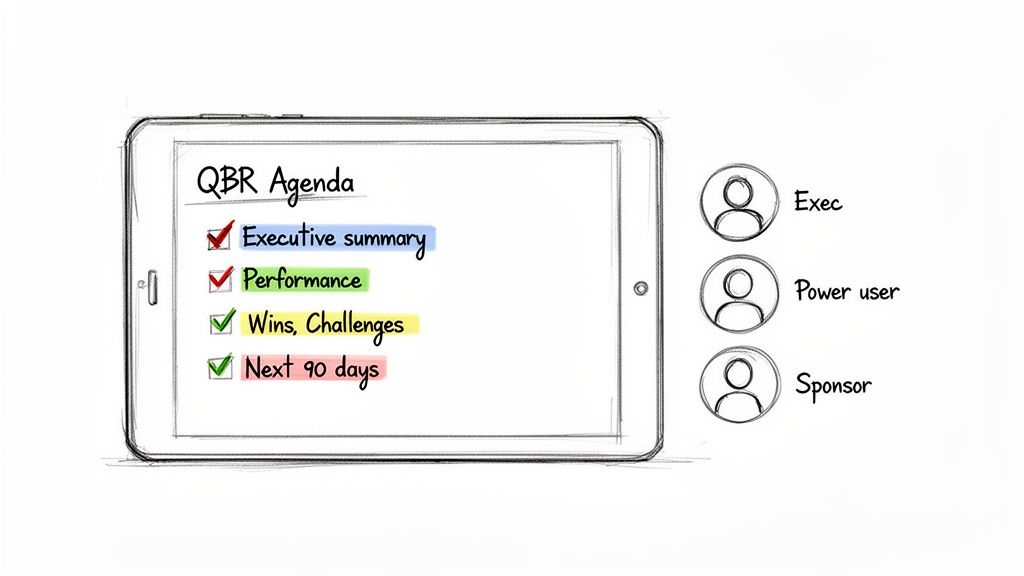
Think of your attendees as a team assembled for a specific mission. You need a mix of high-level strategic oversight and practical, on-the-ground experience to foster a productive conversation. Inviting everyone available leads to a disjointed meeting where the content feels irrelevant to many.
Who Should Be in the Room
Getting the right people to attend is half the battle. Your goal is to gather a group that can discuss strategy, daily usage, and the overall business impact of your partnership. A balanced group ensures the conversation covers both high-level goals and practical realities.
Here is a look at the essential roles to invite from both your team and the customer's.
Essential QBR Attendee Roles
Role | Responsibility | Why They Should Attend |
|---|---|---|
Executive Sponsor (Customer) | The ultimate decision-maker and budget holder. | They care about return on investment (ROI) and need to see the strategic value to justify renewing or expanding the relationship. |
Day-to-Day Power User (Customer) | The person who uses your product daily. | Their feedback on workflows and pain points is invaluable. They provide a real-world perspective on product usage. |
Account Manager/CSM (Your Team) | The relationship owner and QBR leader. | They guide the conversation, maintain a strategic focus, and ensure all customer objectives are addressed. |
Executive Sponsor (Your Team) | A senior leader from your company. | Their presence demonstrates your commitment to the partnership. They can also discuss your company's future direction and reinforce long-term value. |
This core group keeps the discussion focused and relevant. For high-performing teams, capturing every commitment and piece of feedback from these key stakeholders is vital. A tool like Samskit can automatically record and transcribe the entire meeting, ensuring no information is lost.
Crafting a Winning QBR Agenda
Once you have the right people, the next step is to build an agenda that guides a meaningful discussion. A strong agenda prevents the meeting from becoming a simple product demo. It should help you tell a compelling story of partnership and shared progress.
The best QBR agenda is a flexible framework that encourages discussion, not a rigid script. The goal is to spend less time presenting and more time talking with your customer.
Follow this five-part structure to create a repeatable and effective workflow:
Executive Summary & State of the Partnership: Start with the big picture. Remind everyone of the customer's original goals and briefly summarize the quarter's key highlights.
Review of Past Performance vs. Goals: Present data that shows progress against the objectives set in the last review. Connect their product usage directly to their business results.
Celebrate Wins & Discuss Challenges: Highlight specific achievements. Also, create a space for open discussion about any roadblocks or areas for improvement to build trust.
Future Roadmap & Strategic Alignment: Look ahead. Share relevant updates from your product roadmap that align with their future goals. Listen to their business initiatives for the next 6-12 months. You can learn more about aligning internal teams in our guide to effective sales meetings.
Define Next 90-Day Objectives: End the meeting with clear next steps. Collaboratively set 3-5 clear, actionable, and measurable goals for the upcoming quarter. Assign owners to each action item to ensure accountability.
Choosing the Right Metrics to Prove Value
Data is the foundation of a QBR, but presenting a raw spreadsheet is ineffective. A successful QBR uses data to tell a story about how you help your customer achieve their goals. To do this, you must select your metrics carefully and frame them around the customer's business objectives.
Choosing the wrong data can derail the meeting, shifting the focus from strategic value to minor operational details. Group your metrics into categories that answer the specific questions of different attendees. Focus on what your product helps them achieve, not just what it does.
Outcome Metrics The C-Suite Cares About
Your executive sponsor needs to see the return on their investment. Outcome metrics directly connect your partnership to their core business goals. These numbers justify your role in their technology stack.
Revenue Increased: Show a clear link between your work and their top-line growth. For example, "This quarter, sales teams using our platform closed 15% more deals."
Costs Saved: Provide a clear efficiency story. For example, "By automating manual reporting, your team saved 80 hours this quarter."
Risk Reduced: Quantify how you helped them avoid costly problems like compliance fines or system downtime.
Usage and Adoption Metrics
While executives focus on the big picture, department heads and daily users want to understand how their teams are using the tool. Usage and adoption metrics show that your solution is integrated into their daily workflow.
A spike in feature adoption is a leading indicator of customer health. It shows the customer is finding new ways to extract value from your partnership.
Focus on metrics that illustrate engagement:
Feature Adoption Rate: Identify which key features they use most. This indicates where they find the most value.
User Engagement Frequency: Track daily or weekly logins. This signals a healthy, active user base.
Team-Wide Utilization: Measure the percentage of active licenses. High utilization shows value across the entire team.
For high-performing teams, a tool like Samskit is invaluable. With a clear history of every interaction, you can easily pull up goals from previous calls and connect them directly to usage data. This turns your QBR into an evidence-based conversation.
Health and Satisfaction Metrics
Health and satisfaction metrics gauge the overall state of the relationship. These numbers help you identify potential issues before they become serious problems.
Include these metrics:
Support Ticket Trends: Track the number and resolution time of tickets. A downward trend shows their team is mastering the product and your support is efficient.
Customer Satisfaction (CSAT) Scores: This provides direct feedback on specific interactions.
Net Promoter Score (NPS): This high-level indicator measures their loyalty and willingness to recommend you.
Streamlining Your QBR Workflow with Samskit
Preparing for a QBR often involves a last-minute search through emails, notes, and CRM entries to build a customer story. This time-consuming process shifts your team's focus from strategic thinking to administrative tasks.
Effective teams automate this work. They have transformed QBR preparation from a chaotic data hunt into an insight-driven process. As a result, each review is based on actual events, not just memory.
Automating QBR Preparation
A smarter workflow starts with capturing information effectively. Instead of relying on inconsistent notes, a tool like Samskit can automatically record, transcribe, and analyze every customer conversation. This creates a single, searchable source of truth for each account.
The AI can then extract the most important information for your QBR deck.
Stated Customer Goals: It flags business objectives mentioned by the customer over the last 90 days.
Recurring Pain Points: It highlights common issues that have been raised repeatedly.
Product Feedback: It captures direct quotes and specific suggestions about your product.
Key Commitments: It logs promises made by both your team and the customer, ensuring accountability.
This intelligent summary provides the building blocks for a relevant QBR presentation, saving your team hours of preparation time. You can learn more about how AI helps structure customer data in our guide on building your dream team bot.
Capturing Action Items and Ensuring Follow-Up
The value of a QBR depends on the action that follows it. If agreed-upon next steps are lost, the meeting was a waste of time. A streamlined workflow must cover what happens both during and after the meeting.
During the QBR, Samskit listens for and captures every commitment and next step. It can assign owners and deadlines directly from the conversation.
This is where you move from discussing relationship health to driving tangible outcomes.
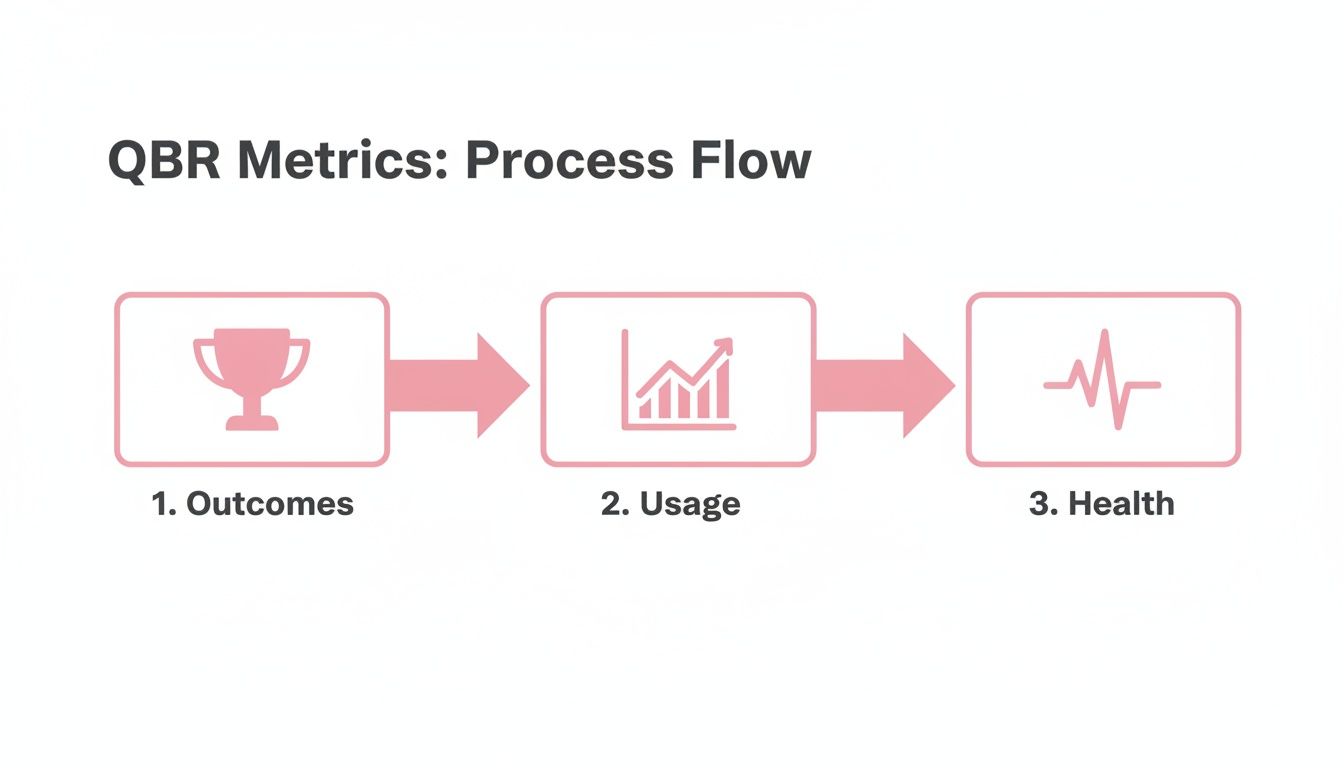
This flow illustrates a simple truth: demonstrating great outcomes requires a foundation of solid product usage and a healthy customer relationship.
By turning strategic discussions into an accountable plan, you ensure the momentum from the meeting leads to real progress. This automated follow-up closes the loop, transforming a one-off meeting into a continuous cycle of improvement.
Avoiding Common QBR Mistakes
A poorly executed QBR can damage a client relationship. When a strategic meeting becomes a one-sided presentation or gets lost in minor details, it wastes everyone's time and erodes trust.
The most common mistake is treating the QBR as a monologue. Teams spend the entire hour presenting slides with information the customer could have read beforehand. This approach prevents real conversation and leaves the client feeling unheard.
A QBR should be a dialogue, not a demo. If you are doing all the talking, you are missing the point of the meeting.
Another common error is focusing on product features instead of business outcomes. Your customer's leadership team cares about how your partnership helps them achieve their goals, such as growing revenue or cutting costs. You must connect your data to their objectives.
Simple Fixes for Common Problems
You can avoid these pitfalls with some planning and simple process adjustments. These steps will help you ensure your QBRs deliver value every time.
Dodge the Monologue: Send your slide deck and key data at least 24 hours in advance. This action frees up meeting time for discussion instead of presentation.
Build the Agenda Together: Do not create the agenda alone. Ask your main contact what is top of mind for them to ensure the conversation focuses on their priorities.
Define Clear Next Steps: A QBR without an action plan is just a conversation. End the meeting by agreeing on 3-5 specific, measurable goals for the next 90 days, with assigned owners and deadlines.
High-performing teams use tools like Samskit to manage this process. Capturing every commitment and action item as it is discussed creates accountability. This ensures the energy from the QBR translates into measurable progress, strengthening the client relationship quarter after quarter.
Your QBR Questions, Answered
Here are answers to common questions from teams looking to improve their QBR process.
How Long Should a QBR Meeting Be?
The ideal length for a QBR is between 60 and 90 minutes. This allows enough time to review performance, have a strategic discussion, and agree on next steps without causing fatigue.
To make every minute count, send the agenda and slide deck at least 24 hours in advance. This ensures participants arrive ready to discuss and make decisions.
Do You Need a QBR for Every Customer?
No. QBRs are most effective for your most strategic accounts—those with high growth potential or significant value. Focus your efforts where they will have the greatest impact.
For smaller customers, a less frequent review may be more appropriate, such as semi-annually or annually. Segment your customer base to determine the right meeting cadence and format for each tier.
What’s the Difference Between a QBR and a Check-In?
The difference is strategy versus tactics.
A check-in is tactical. It covers day-to-day items like support tickets, quick questions, and project updates. A QBR is strategic. It focuses on business value, ROI, and high-level alignment.
Check-ins keep daily operations running smoothly. QBRs ensure the partnership is heading in the right direction and driving business results for your customer.
Top-performing teams use Samskit to translate strategic QBR conversations into concrete CRM updates and trackable action items. This ensures no tasks are dropped and every promise is kept. You can see how to automate your QBR follow-up and maintain momentum.