A sales meeting is the conversation that moves a prospect from "just looking" to "let's do this." It's where you build trust, understand needs, and show how you can help. A good meeting ends with everyone agreeing on what happens next.
This guide provides practical steps, checklists, and templates to help you run better sales meetings.
What Are Sales Meetings?
Think of your sales process as a series of steps. Your goal is a closed deal, and your sales meetings are the key milestones. Each one has a specific purpose that guides a prospect forward.
Modern B2B sales meetings are two-way conversations, not one-way pitches. Your goal is to act as a partner, not a vendor. This shift builds lasting relationships and drives reliable revenue.
The Core Purpose of Sales Meetings
The purpose of any sales meeting is to create forward momentum. Every interaction must move the deal along. This means changing your mindset from, "What can I sell?" to "How can I solve their problem?"
Effective meetings focus on three actions:
Build Trust: Show you understand the prospect’s challenges.
Uncover Needs: Ask smart questions to find the root of their problems.
Demonstrate Value: Connect your solution to their specific goals.
This consultative style is effective in growing economies. For example, Brazil's economy shows steady growth, making businesses more open to investing in solutions for growth and efficiency. A problem-solving sales approach is more impactful than ever. You can read more about Brazil's economic outlook on efginternational.com.
The Fundamental Meeting Types
Sales professionals use a few core meeting types. Knowing which type of meeting you're in helps you prepare and guide the conversation. The most common sales meetings are:
Discovery: The first real conversation. You learn about their business, pain points, and goals.
Demo: A customized presentation showing how your product solves the problems you found in discovery.
Negotiation: The discussion about pricing, terms, and timelines to reach an agreement.
Renewal/QBR: A check-in with a current customer to review progress, prove value, and find new opportunities.
Each of these meetings plays a vital role. Mastering them is a necessary skill for any salesperson. You can learn more about what this role entails in our in-depth guide on inside sales representatives.
The Four Essential Types of Sales Meetings
Not all sales meetings are the same. Using one script for every call won't work. Each conversation has a specific role in guiding a prospect from initial interest to a final decision.
Understanding the four main meeting types helps you enter every call with a clear strategy to keep the deal moving forward.
This diagram shows how these meetings connect to create a path from introduction to a closed deal.
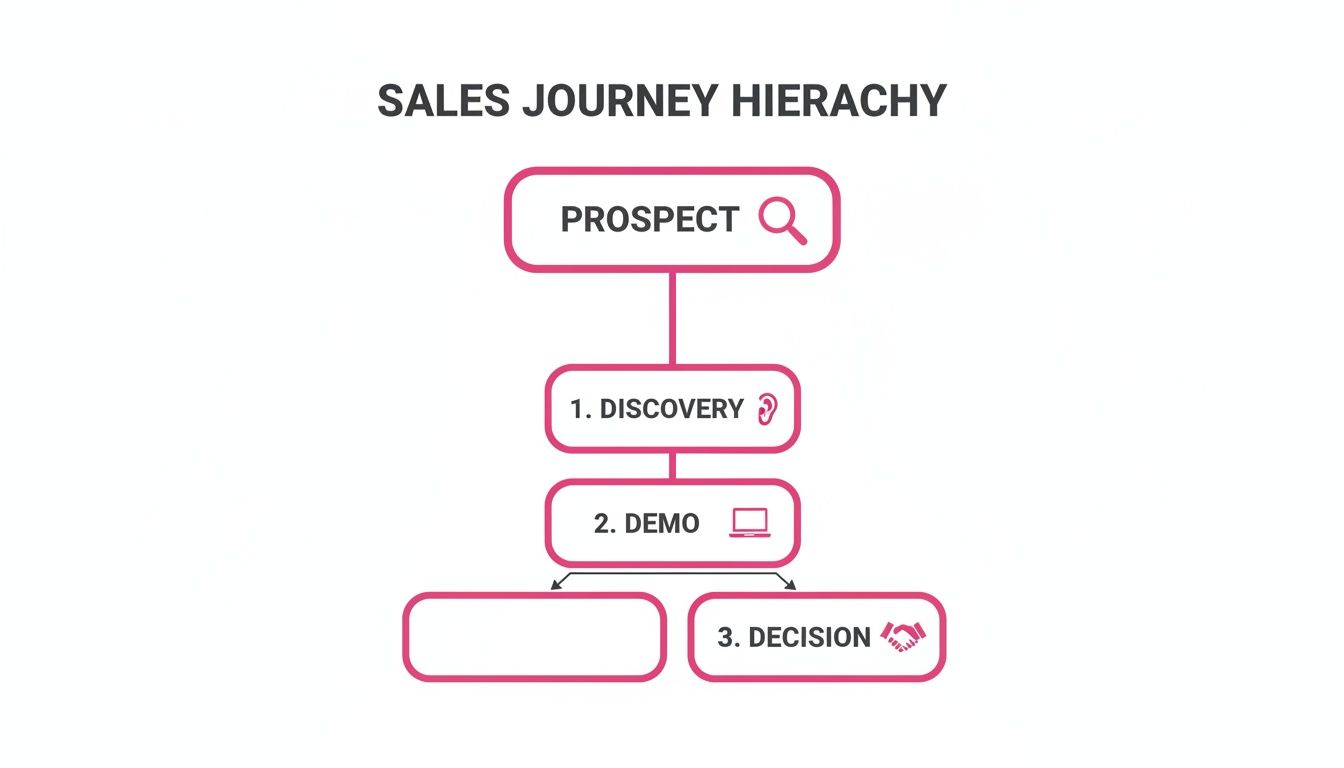
Each stage builds on the previous one, creating the momentum needed to close.
Here is a simple breakdown of how these meetings differ.
Sales Meeting Types At a Glance
Meeting Type | Primary Objective | Seller's Role | Desired Outcome |
|---|---|---|---|
Discovery | Understand the prospect's pain points, challenges, and goals. | Business consultant; diagnosing the problem. | Mutual understanding of the problem and agreement to explore a solution. |
Demo | Show how your product solves the problems from discovery. | Problem-solver; connecting features to the prospect's needs. | The prospect sees how your solution helps them achieve their goals. |
Negotiation | Agree on commercial terms (price, scope, timeline). | Partner; finding a win-win agreement. | A signed contract that delivers value to both parties. |
Renewal/QBR | Reinforce value, ensure customer success, and find growth opportunities. | Strategic advisor; focused on the customer's long-term success. | A renewed contract and a stronger relationship. |
This table is a useful quick reference. Now, let's look at the details of each conversation.
1. Discovery Meetings
The discovery meeting is your first real conversation with a qualified prospect. Your job is to diagnose, not sell.
Think of yourself as a business consultant. Ask questions to understand their problems and the impact on their business.
Aim to get answers to questions like these:
"What change in your business led you to look for a solution now?"
"If we speak again in six months, what needs to happen for you to consider this a success?"
"What is the cost of doing nothing if this problem isn't solved?"
The only goal is to leave the meeting with a clear picture of the prospect's pain. If you do it right, you both will agree on whether it makes sense to continue the conversation.
2. Demo Meetings
After you diagnose the problem, the demo meeting is where you present the solution. This is not a generic tour of your product.
A good demo is a personalized presentation. It connects every feature you show directly to the pain points from the discovery call. You are telling a story where the prospect is the hero.
For example, instead of saying, "Here's our analytics dashboard," try: "You mentioned your team struggles to track progress. This dashboard gives you the real-time visibility you need to see what's working."
The goal is for the prospect to see themselves using your solution to solve their problems.
3. Negotiation Meetings
When the prospect agrees your solution is a good fit, the conversation moves to a negotiation meeting. Here, you discuss pricing, contract terms, and implementation details.
The objective is to find a win-win agreement. It's about structuring a deal that feels valuable to them while meeting your company's targets.
A successful negotiation is not about one side winning. It is about building a partnership where both parties feel confident in the terms.
This stage requires transparency and a focus on building a mutually beneficial relationship.
4. Renewal and QBR Meetings
The work continues after the contract is signed. For existing customers, the renewal meeting or Quarterly Business Review (QBR) is a critical touchpoint.
These meetings are your chance to prove your value again. You reinforce the results you have delivered, check that the customer is hitting their goals, and look for new ways to help them grow.
Your goal is to solidify the partnership and secure long-term loyalty. A successful QBR often leads to a renewal and an expansion.
How to Craft Agendas That Drive Results
A great sales meeting doesn't just happen. It requires careful planning, starting with a solid agenda. An agenda acts as a roadmap for the conversation. It keeps everyone on track and ensures a clear outcome.
Sending an agenda beforehand shows you are a professional who respects the buyer's time. It sets a collaborative tone and helps everyone come prepared.
A Universal Agenda Template
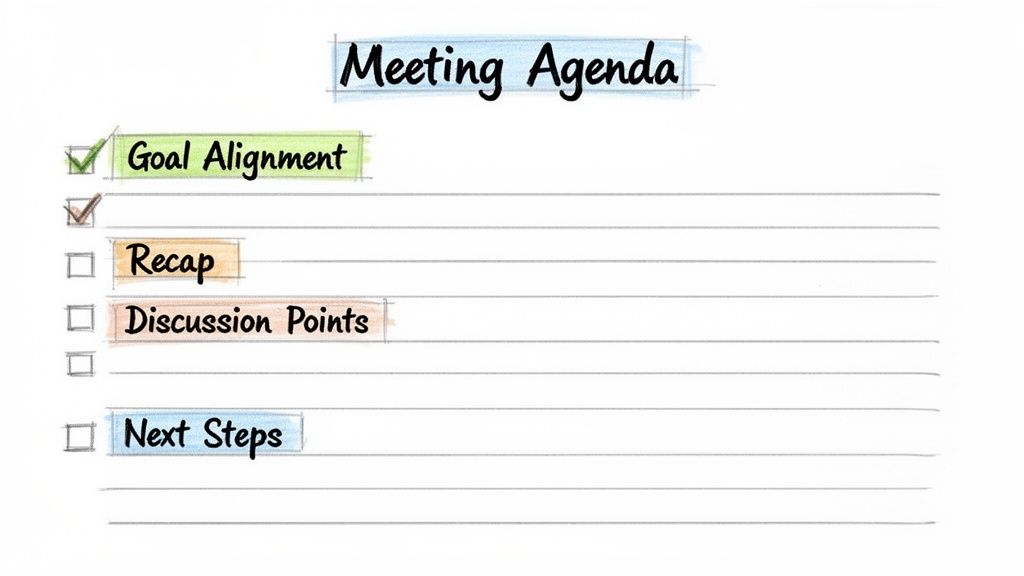
The best agendas are simple and clear. Most successful sales meetings follow a straightforward, four-part structure.
Here is a practical framework:
Goal Alignment: Start with one clear sentence stating the meeting's purpose. For example, "Today's goal is to understand your current challenges and see if our solution is a potential fit."
Recap & Context: A quick "last time we spoke..." or review of an email provides context and starts the conversation.
Discussion Points: List the 2-3 key topics for discussion. For a discovery call, this might be a few high-level questions.
Next Steps: Always end a meeting by defining what happens next. This creates momentum and accountability.
This structure keeps the conversation focused, purposeful, and moving forward.
Adapting the Template for Different Meetings
Use the universal template as your starting point. Then, adjust it for each stage of the sales cycle.
For example, Brazil's retail sector grew by 1.6% last year, showing that retailers are looking for solutions to improve efficiency. Knowing this helps you tailor your agenda to their specific pain points. You can read more about Brazil's retail sales performance on tradingeconomics.com.
Example Agenda: Discovery Call
Goal: Determine if there is a good fit between your challenges and our solution.
Recap: Review your initial inquiry.
Discussion:
Walk me through your current process for [specific task].
What are your biggest roadblocks?
What would an ideal solution look like?
Next Steps: Agree on whether a detailed demo is the right next step.
Example Agenda: Product Demo
Goal: Show you how our platform solves [Problem X] and [Problem Y].
Recap: Confirm the key challenges from our last call.
Discussion:
Live look at [Feature A] solving [Problem X].
Walkthrough of [Feature B] workflow for [Problem Y].
Open floor for questions.
Next Steps: Outline the process for a trial or proposal.
By tailoring your approach, each of your sales meetings becomes a deliberate step toward closing the deal. To learn more about structuring persuasive conversations, our guide on the SPIN Selling methodology is a great resource.
A Practical Checklist for Every Sales Call
Successful sales meetings follow a repeatable process: preparation, execution, and follow-up.
Think of it as a pilot's routine: pre-flight, in-flight, and post-flight checks. Each step ensures a smooth journey and a successful outcome. This process turns good intentions into consistent actions that move deals forward.
Before the Meeting: A 30-Minute Prep Checklist
You win the meeting before it begins. Just 30 minutes of focused preparation can change the entire conversation.
[ ] Research: Look at their LinkedIn profile, company news, and any previous interactions with your company. What are their likely priorities?
[ ] Set a Clear Objective: What is the one thing you must achieve? Is it qualifying them? Booking a demo? Write it down.
[ ] Prepare Key Questions: Have 3-5 open-ended questions ready. They should be designed to uncover specific pain points.
[ ] Test Your Tech: Check your video link, microphone, and camera. Technical glitches kill momentum.
During the Meeting: A Step-by-Step Workflow
Your main job is to listen more than you talk. Top salespeople have a talk-to-listen ratio of around 43:57. They let the customer do most of the talking.
You cannot solve a problem you do not fully understand. Diagnose before you prescribe.
Follow these steps to guide the conversation:
Step 1: Set the Agenda. Start by confirming the meeting's purpose and topics. This shows respect for their time.
Step 2: Practice Active Listening. Summarize what you hear. For example, "So, if I understand correctly, the main challenge is..." This confirms you are on the same page.
Step 3: Manage the Time. Keep an eye on the clock. Ensure there is enough time for questions and next steps.
Step 4: Confirm Next Steps. Before ending, summarize key takeaways and state the agreed-upon actions. For example: "I'll send the case study by tomorrow, and you will connect me with your finance director next week. Does that sound right?"
After the Meeting: A 3-Step Follow-Up Plan
What you do after the meeting often separates stalled deals from closed ones. A sharp follow-up maintains momentum.
Send a Summary Email. Within a few hours, send a short email that recaps the conversation and confirms the next steps.
Update Your CRM. Add all new information—pain points, contacts, next steps—to your CRM while it's fresh in your mind.
Do What You Promised. If you promised to send a resource, deliver on time. This builds trust and shows you are a reliable partner.
Automating Meeting Insights and CRM Updates
Manually logging notes after every sales call is a time-consuming task. It takes reps away from selling, and important details get lost. This leaves your CRM with incomplete data.
Conversation intelligence tools can help. They act as a sales assistant that automatically records, transcribes, and analyzes your calls. The tool identifies buyer objections, commitments, and next steps.
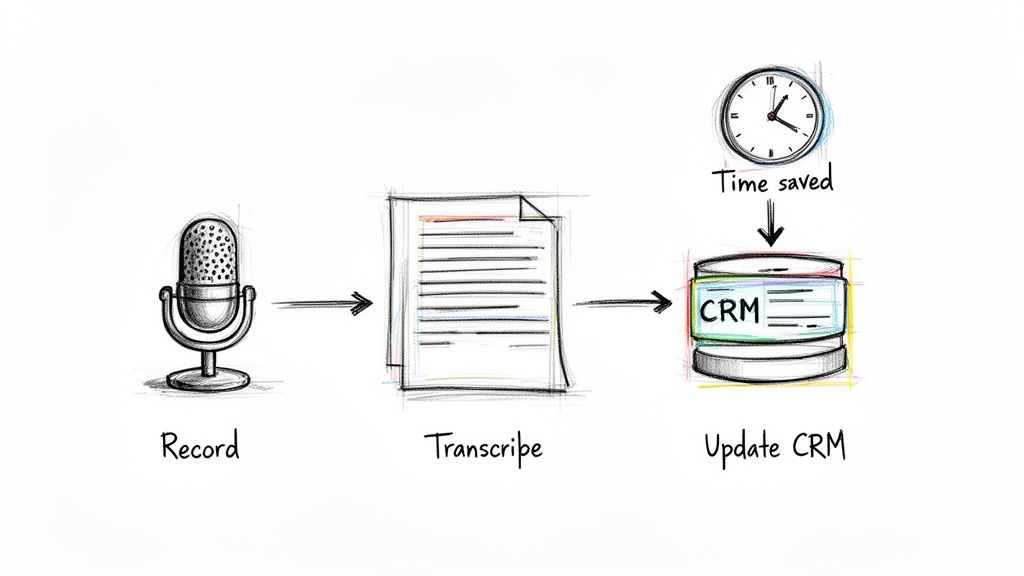
This workflow shows how automation turns conversations into structured data in your CRM without manual effort.
Before and After Automation
Let's compare the manual process to an automated one.
Scenario 1: The Manual 30-Minute Routine
A sales rep finishes a discovery call. The next 30 minutes are spent on admin tasks:
Rewatching Recordings: They search the recording for key details about budget or competitors.
Typing Notes: They write a summary from memory, hoping it's accurate.
Updating the CRM: They fill out multiple fields, update the deal stage, and create follow-up tasks.
This process is slow and prone to errors. Important context is often forgotten, leaving the CRM with a watered-down version of the conversation.
Scenario 2: The Automated 5-Minute Review
Now, imagine the same call with a tool like Samskit working in the background.
Receive a Summary: An automated summary with action items and key questions arrives in the rep's inbox.
Review and Approve: The rep reviews the pre-populated CRM update, makes any needed tweaks, and syncs it with a single click.
The real benefit is not just saving time. It's capturing higher-quality information with less effort. This ensures your CRM accurately reflects what happened on the call.
This streamlined workflow saves about 25 minutes after every meeting. That time adds up, freeing sellers to focus on activities that generate revenue. This efficiency is critical in competitive markets, like Brazil's shopping mall sector, which saw revenues hit a record R$200.9 billion. These clients expect a professional sales experience. You can find more insights on Brazil's retail landscape on brazilstockguide.com.
Automation transforms your CRM from a simple database into an intelligent system. For more on this, read our guide on improving your inside sales CRM strategy. This shift provides your team with more accurate data and more time to close deals.
Your Sales Meeting Questions, Answered
Even well-planned sales meetings can present challenges. Here are answers to common questions from sales reps and managers.
How Do I Handle Resistance to Meetings?
No one wants a meeting that could have been an email. Resistance happens when meetings feel like a waste of time. To get your team on board, every meeting must offer clear value.
Here are three steps to make your sales meetings more valuable:
Send a clear agenda. An agenda shows you respect everyone's time and that the meeting has a purpose.
Focus on "what's in it for them." Frame the meeting as a chance to solve a problem or share an insight that helps them close deals faster.
Keep it short. A focused 20-minute meeting is usually better than a rambling hour-long review.
How Can I Tell if a Meeting Was Productive?
A productive meeting creates action. You should see a direct impact on your team's work and your sales numbers. It's about outcomes, not just conversation.
Look for these signs of a successful meeting:
Everyone has clear next steps. People know what they need to do, who is responsible, and by when.
Decisions lead to action. The choices made in the meeting are put into practice.
The team is engaged. People asked questions and challenged ideas. If only one person talked, the meeting was likely not productive.
If your meetings lack these elements, it is a sign you need to change the format.
What Is the Best Way to Keep the Team Focused?
Keeping salespeople engaged requires making the meeting interactive.
Use these techniques to hold their attention:
Break it down. Divide longer meetings into smaller, topic-focused sections with short breaks.
Make it visual. Use a live dashboard, presentation, or a short video to illustrate your points.
Get them involved. Ask people for their input, run a quick poll, or use role-playing exercises.
Share the spotlight. Let different team members present parts of the agenda to increase ownership.
Is It a Good Idea to Record Sales Meetings?
Yes. Recording your sales meetings is a great practice for coaching and analysis. The recordings become a library of real-world examples to train new hires and help experienced reps improve.
Recording meetings turns abstract coaching advice into concrete examples. Sellers can see and hear what a successful call sounds like.
The benefits include:
Better onboarding. New reps learn from your top performers by reviewing their calls.
Powerful self-coaching. Reps can review their own calls to identify areas for improvement.
Seamless handoffs. Recordings ensure no details are lost when an account moves from sales to customer success.
Just be sure to inform everyone that the meeting is being recorded. Transparency is key.
Ready to stop wasting time on manual CRM updates and start closing more deals? Samskit turns your customer conversations into reliable data, automatically. By capturing every commitment, risk, and next step, Samskit gives your entire revenue team the context they need to win. Learn how you can automate your sales workflows.