A modern sales and marketing strategy is not two separate plans. It is a single roadmap for generating revenue. It aligns both teams on who the customer is, what they need, and how to guide them from a first click to a signed contract.
Why Your Current Strategy Is Leaking Revenue
Do your sales and marketing teams operate in separate silos? This disconnect costs you money. When these teams are out of sync, it creates internal friction that hurts your bottom line. This is not just a culture problem. It is a business problem that wastes money, burns out your team, and stops growth.
Imagine this workflow: Marketing generates a large volume of leads. The sales team then dismisses them as low-quality. Or sales complains about a lack of support while ignoring the content marketing has produced. This is how customer acquisition funnels leak. Potential buyers fall through the cracks, and promising deals are lost.
This friction is a real drag on your company’s momentum, as this diagram shows.
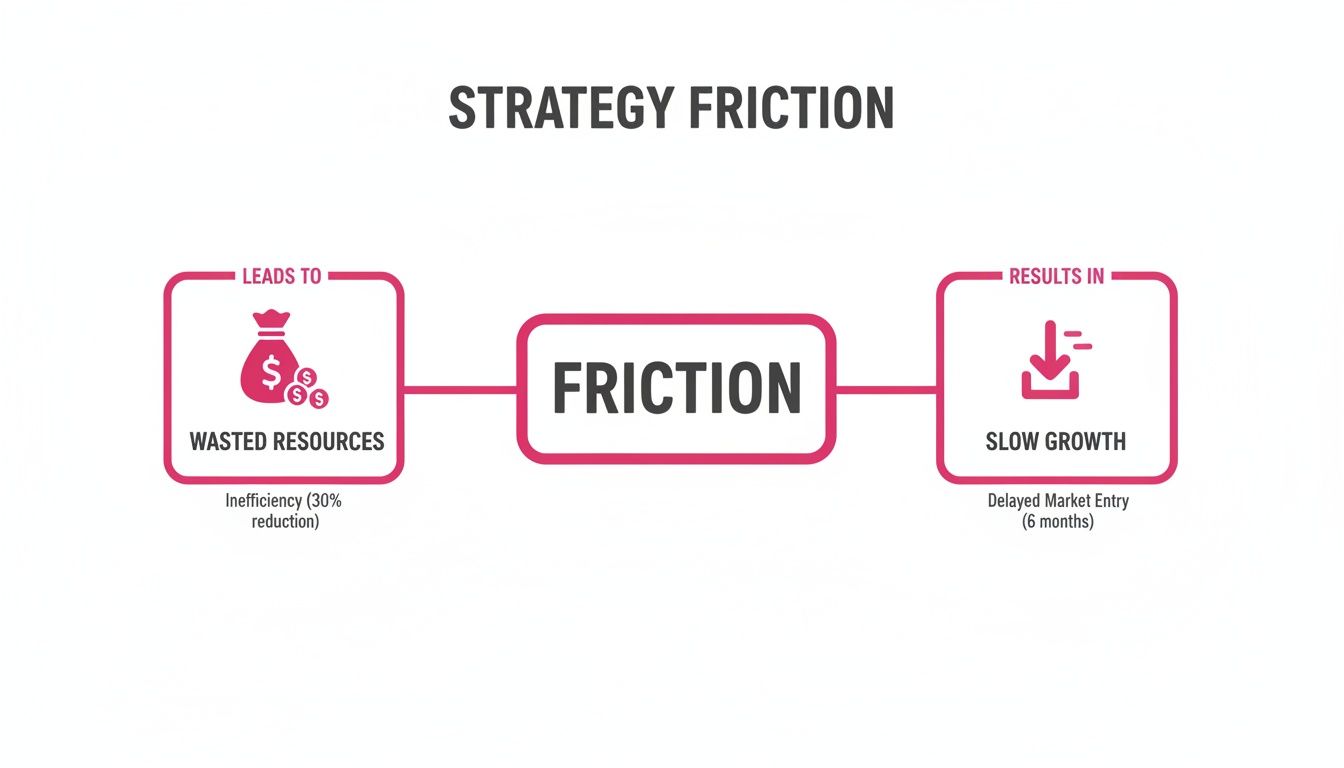
Strategic friction is not an abstract issue. It drains your budget and slows your growth.
The Real-World Cost of Misalignment
A fragmented strategy creates inefficiency in your daily operations. It also damages team morale. When teams are siloed, they develop their own goals and language. This leads to a cycle of finger-pointing and frustration.
Most organizations with this problem show the same symptoms. The table below outlines common pain points. Use it as a checklist to identify disconnects in your business.
Key Indicators of Sales and Marketing Misalignment
Symptom | Marketing Team Impact | Sales Team Impact | Business Consequence |
|---|---|---|---|
Finger-Pointing | "Sales ignores our high-quality leads." | "Marketing sends us junk leads." | Low morale, high team turnover, and a toxic "us vs. them" culture. |
Wasted Budget | Campaigns generate leads that are never followed up on, wasting ad spend and effort. | Reps spend valuable time on unqualified leads instead of closing deals. | High Customer Acquisition Cost (CAC) and poor marketing ROI. |
Jarring Customer Experience | A lead is nurtured with personalised content... | ...only to speak with a rep who has no context on their journey or interests. | Damaged brand trust, lost deals, and customers defecting to competitors. |
Stalled Sales Cycles | Leads aren't properly qualified or nurtured before handoff. | Reps are forced to re-qualify leads from scratch, lengthening the sales cycle. | Inaccurate forecasting, missed revenue targets, and lower sales productivity. |
These symptoms point to one root cause. Your teams are not working as a single, cohesive unit.
The core issue is that many companies treat sales and marketing as separate functions with separate goals. A truly modern sales and marketing strategy forces them to operate as a single revenue team, accountable to shared outcomes like pipeline growth and customer lifetime value.
This guide provides a practical blueprint to build that integrated strategy. We will show you how to align your goals, create a seamless customer journey, and turn your teams into a unified revenue engine.
Step 1: Build a Customer-Centric Foundation
An effective sales and marketing strategy starts with a clear understanding of your customer. If you do not have a shared, precise picture of your ideal customer, your teams will work in different directions.
This section provides a practical method to build a unified Ideal Customer Profile (ICP) and buyer personas that both teams can use daily. We move beyond generic templates to use real-world data. This creates a single source of truth that shapes every marketing campaign and sales conversation.
Define Your Ideal Customer Profile Collaboratively
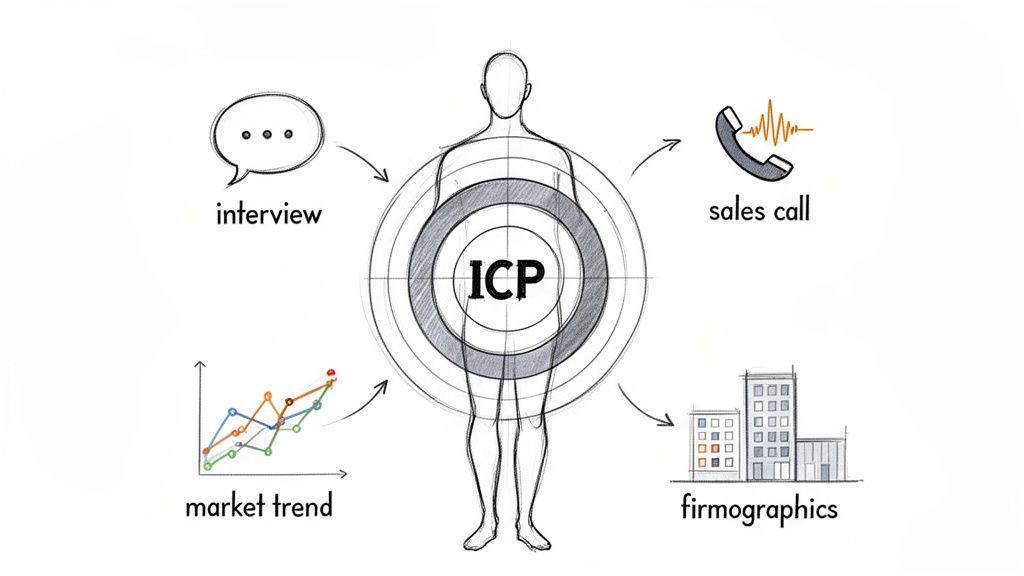
An Ideal Customer Profile (ICP) is a detailed description of the perfect company to sell to, not a person. To define this, you need both sales and marketing to share their knowledge.
Start with your existing customer base. Analyze your best, most successful accounts. A simple checklist can help you identify patterns.
Data-Driven ICP Checklist:
Industry or Vertical: Are your best customers in a specific sector, like SaaS or manufacturing?
Company Size: What is the ideal range for employee count or annual revenue?
Geography: Do you find more success in certain regions or countries?
Technology Stack: What other tools do they use? This can indicate a good fit.
Business Model: Are they B2B, B2C, or another model?
Pain Points: What common operational challenges does your product solve for them?
Buying Triggers: What events typically start their search for a solution? Examples include new leadership, funding rounds, or market expansion.
An ICP is not a static document. It is a living profile. Review and update it quarterly based on new sales data, market shifts, and customer feedback. This keeps your targeting sharp and relevant.
Once you define the ideal company, focus on the people who make decisions. This is where you use buyer personas.
Build Actionable Buyer Personas from Real Data
While an ICP describes the ideal company, buyer personas represent the individuals within those companies who influence the buying decision. Avoid creating vague, generic personas. The best ones are built on real data from interviews, sales call recordings, and customer feedback.
Understand their professional world.
Role & Responsibilities: What is their job title, and what are their duties?
Goals & KPIs: How is their performance measured? What are their professional goals?
Challenges: What are their daily frustrations and obstacles?
Information Sources: Where do they find information? Which blogs, social networks, or peer groups do they trust?
This detail helps marketing create content that connects. It also gives sales insights to tailor their outreach. You can find more practical steps in our complete guide to lead qualification for marketing.
Map the Buyer's Journey Together
With a solid ICP and rich personas, the final foundational step is to map the buyer's journey. This is the path a potential customer takes from becoming aware of a problem to signing a contract.
When sales and marketing align on these stages, the process works better. Marketing knows what content to deliver and when. Sales knows the right moment to step in.
For example, marketing sees a contact from an ICP-fit company download a case study. This signals a move from the "Awareness" stage to "Consideration." This is the perfect trigger for a sales rep to reach out with a relevant message related to the case study. The call becomes a timely, helpful conversation, not a cold call.
This customer-first approach is crucial, especially in growing markets. Brazil's advertising market, for instance, is projected to hit USD 21,461.76 million by 2034. With internet advertising leading, a successful sales and marketing strategy must use personalized B2B outreach to be effective.
Step 2: Craft a Unified Messaging and Content Plan
Knowing your customers is the first step. Next, you must speak their language consistently across all touchpoints. This is how you turn your data-rich Ideal Customer Profile (ICP) into a unified message that both sales and marketing can deliver.
Consider the customer's experience. If they read a blog post about one benefit and then get a sales pitch focused on something different, it feels inconsistent. This breaks the flow and erodes trust. A solid sales and marketing strategy ensures every ad, email, and conversation reinforces the same core story. This guides the customer smoothly through their journey.
Develop Your Core Value Propositions
Your value proposition is not a list of features. It is a simple, direct promise of the results a customer will get. It answers their biggest problem. To make your message effective, your value propositions must address the pain points you identified when building your ICP.
Frame your message in terms of customer challenges. For example, if your ICP struggles with inaccurate CRM data and wasted time, your messaging should focus on solving that specific problem.
Value Proposition Template
Customer Challenge | Our Solution | The Outcome |
|---|---|---|
"My sales team wastes hours updating the CRM after calls." | Samskit automatically captures call details and syncs them to your CRM. | Your team gets 5-10 hours back per week to focus on selling. |
"We have no visibility into what happens on sales calls." | Samskit provides analytics on call topics, objections, and talk time. | Managers can coach reps using real data, not guesswork. |
"Deals stall because of poor handoffs between teams." | Samskit creates structured notes and next steps from calls. | Everyone has clear context, reducing friction and speeding up deals. |
This exercise anchors every communication in a tangible customer benefit. The result is a clear story that both marketing and sales can tell confidently.
Map Content to the Buyer’s Journey
Once your core messaging is set, create the right content for each stage of the buying process. The goal is to provide value and answer questions as they arise, building trust. A content map is your playbook. It ensures marketing creates assets that sales can use to close deals.
A typical B2B buyer’s journey has three main stages. Here is a practical look at what content works best at each stage:
Awareness Stage: The buyer realizes they have a problem. Your content should be educational and helpful, not pushy.
Content Types: Blog posts, checklists, research reports, and social media content that helps define their problem.
Consideration Stage: The buyer is actively researching solutions. Your content must show how your product solves their problem better than alternatives.
Content Types: Case studies, webinars, product comparison guides, and detailed solution briefs.
Decision Stage: The buyer is ready to make a decision. Your content should build confidence and make it easy to choose your product.
Content Types: Free trials, implementation guides, pricing pages, and customer testimonials.
Your content map is a living document. It should evolve based on performance data and feedback from the sales team, ensuring it always aligns with what customers need.
Create a Sales-to-Marketing Feedback Loop
The most effective strategies have a built-in system for continuous improvement. Your sales team is on the front lines. They hear real-world objections, questions, and pain points every day. That information is valuable for your marketing team.
Establish a simple, repeatable process for sales to share this intelligence. It could be a dedicated Slack channel, a custom field in your CRM, or a brief weekly meeting. When a sales rep reports that 70% of prospects ask about a specific integration, that is a direct signal for marketing. Marketing should then create a blog post or one-pager on that topic.
This simple workflow turns customer conversations into actionable insights. It allows you to fine-tune your messaging and create content that proactively addresses sales objections. To discover more ways to boost performance, check out our guide on other powerful marketing strategies to increase sales. By closing this loop, your teams can respond to what customers actually need instead of guessing.
Step 3: Integrate Your Processes and Technology
A good strategy requires execution. You must integrate your customer targeting and messaging plans into the daily work of your teams. This step connects the dots, turning your strategy into a predictable revenue engine.
The goal is to eliminate friction and ensure no valuable lead is lost during a handoff. It starts with clear definitions and agreements that both teams accept and follow. Without this operational backbone, even the best plans will fail.
Define the Handoff from Marketing to Sales
The handoff of a lead from marketing to sales is a critical point. To get this right, you need a shared, objective definition of a "sales-ready" lead. This is called a Sales Qualified Lead (SQL).
An SQL is not just someone who downloaded an e-book. An SQL is a contact who meets specific criteria that signal genuine buying intent and a good fit for your product. Creating this definition must be a collaborative effort.
SQL Definition Checklist:
Firmographic Fit: Does their company match your Ideal Customer Profile (ICP)? Consider industry, company size, and location.
Demographic Fit: Is the contact a decision-maker or key influencer matching a buyer persona?
Behavioral Triggers: Have they shown high-intent engagement? Examples include requesting a demo, viewing your pricing page multiple times, or downloading a case study.
BANT (Budget, Authority, Need, Timeline): Has initial qualification confirmed they have a potential budget, authority, a clear need, and a timeline?
Once everyone agrees on this checklist, it becomes the official trigger. Only when a lead meets these criteria does it move from marketing to sales.
Establish a Service Level Agreement
With a clear SQL definition, the next step is to formalize the process with a Service Level Agreement (SLA). An SLA is a simple internal contract that outlines each team's commitments to the other. It eliminates ambiguity and replaces guesswork with clear expectations.
An SLA is about building trust and accountability, not micromanaging. It ensures marketing delivers quality leads and sales gives those leads immediate attention. This maximizes your conversion chances.
A solid SLA answers two key questions:
Marketing's Commitment: How many SQLs will marketing deliver to sales each month or quarter? This holds marketing accountable for generating genuine pipeline.
Sales' Commitment: How quickly will the sales team follow up on an SQL? This is usually measured in hours. It also specifies how many contact attempts a rep must make before marking a lead as unresponsive.
This two-way commitment ensures that marketing's momentum is not lost. For example, a common SLA might state that sales must follow up on every new SQL within 4 hours and make at least 5 contact attempts over two weeks.
Connect Your Process to Your Tech Stack
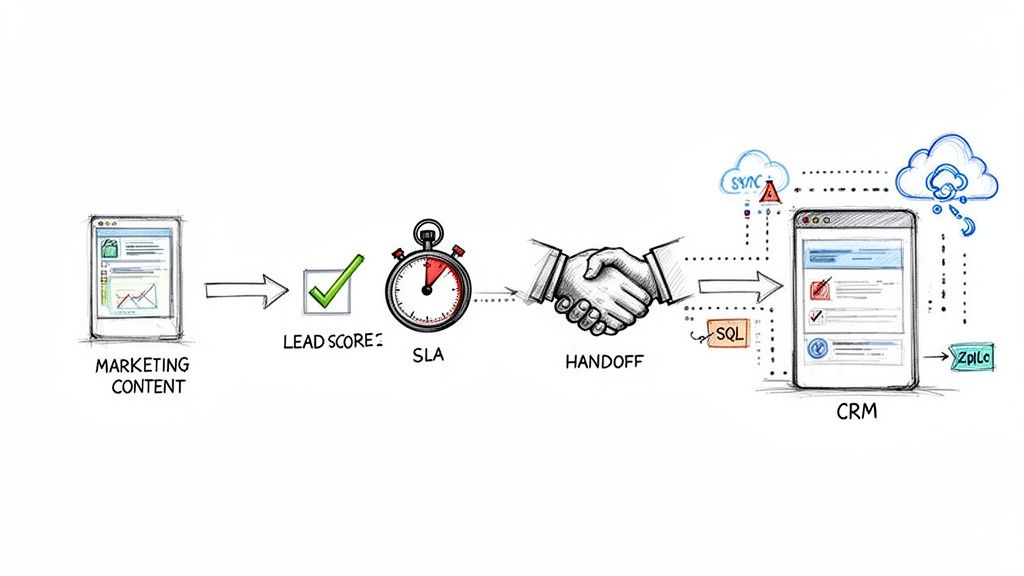
Your processes and technology must work together. Your tech stack—mainly your CRM and marketing automation platform—automates and enforces your SLA. This makes your strategy a practical, daily workflow.
The diagram below shows how you can structure a unified messaging blueprint, aligning your content directly with the buyer's journey.
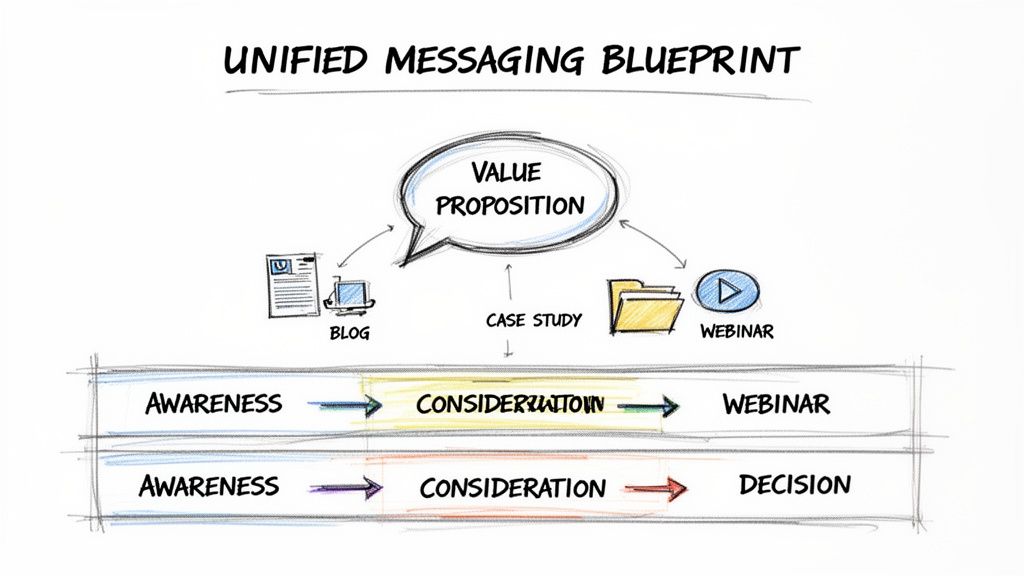
This structure ensures the content marketing creates directly supports sales conversations at every stage. Your technology can automate the delivery and tracking of this content, sending valuable signals back to the sales team. For example, when a prospect downloads a case study, a tool like Samskit can surface that activity right before a sales call. This gives the rep crucial context for the conversation. You can learn more about how to transform your CRM into an inside sales powerhouse.
Automating these workflows keeps your data clean and makes handoffs smooth. It also frees up your reps to focus on selling. In a market like Brazil's digital advertising space, which is projected to grow from US$17.28 billion in 2025 to US$19.28 billion in 2026, this efficiency is essential. As shown in Brazil's digital ad spend trends on GlobeNewswire, the competition for attention is intense. B2B sales teams can use tools to track ad investments. CRM syncs can automatically log next steps, freeing up account executives for high-value outreach. By properly connecting your process and technology, you build a scalable system for growth.
Step 4: Measure Success with Shared KPIs
You cannot have a unified strategy if sales and marketing use different metrics for success. A common problem is when marketing celebrates a spike in website traffic while sales complains about low-quality leads. To align both teams, you must measure success with the same metrics.
This means moving away from siloed "vanity metrics" and using shared Key Performance Indicators (KPIs). These numbers show the health of your entire customer journey. They hold both teams accountable for the only goal that matters: driving revenue.
What Makes a Good Shared KPI?
A good shared KPI makes each team care about the other's results. It directly links marketing efforts to sales outcomes. It also gives sales a stake in the quality of marketing’s work.
Here are some of the most impactful KPIs for a shared dashboard:
Customer Acquisition Cost (CAC): The total cost of sales and marketing to acquire one new customer. This shifts the focus from spending money to spending it wisely.
Pipeline Velocity: How fast a new lead becomes a closed deal. A slowdown might indicate poor-quality leads from marketing or an inefficient sales process. It is a shared problem.
Stage-by-Stage Conversion Rates: This metric helps find leaks in the funnel. By tracking how many leads progress from one stage to the next (e.g., MQL to SQL), you can identify where the process is breaking down.
Lead-to-Customer Rate: The ultimate bottom-line number. This is the percentage of leads that become customers. It gives a clear view of combined lead quality and sales effectiveness.
The key is not to track dozens of metrics. Choose three to five KPIs that truly reflect the health of your revenue engine. Review them together on a consistent basis.
The Shared Sales and Marketing KPI Dashboard
To make this practical, you need a single source of truth. A shared KPI dashboard is the centerpiece of your collaborative meetings, where data drives conversation and action.
Here is a simple template to get you started.
Shared Sales and Marketing KPI Dashboard
Metric | What It Measures | Why It's a Shared KPI | Example Goal |
|---|---|---|---|
Pipeline Velocity | The speed at which a lead moves through the sales funnel. | Marketing's lead quality impacts speed, while sales' process efficiency determines it. | Reduce average sales cycle from 90 to 75 days. |
Customer Acquisition Cost (CAC) | Total sales and marketing spend divided by new customers acquired. | Connects marketing's budget directly to the efficiency of sales outcomes. | Maintain a CAC below R$5,000 per new account. |
MQL to SQL Conversion Rate | The percentage of marketing-qualified leads that sales accepts as sales-qualified. | This is the direct measure of how well marketing and sales definitions are aligned. | Achieve a 25% MQL-to-SQL conversion rate. |
Lead-to-Customer Rate | The percentage of initial leads that become paying customers. | Provides a holistic view of the entire funnel's performance, from first touch to final close. | Increase lead-to-customer rate from 1% to 1.5%. |
Building the dashboard is the first step. The real work happens when you use it.
Your Monthly "Smarketing" Huddle
Data in a dashboard is useless without action. You need a regular 'Smarketing' (sales + marketing) meeting to bring it to life. This is your monthly meeting to review the shared dashboard, identify what works, and address what does not.
This meeting is not for blaming others. It is a collaborative workshop to understand the "why" behind the numbers.
For example, if pipeline velocity has slowed, you can use call analytics from a tool like Samskit to find out what is happening on sales calls.
This is especially important in changing markets. While Brazil's retail trends and economic indicators on Trading Economics show fluctuations, direct selling is projected to grow from USD 11,589.1 million in 2025 to USD 19,041.1 million by 2033. Using Samskit, teams can analyze calls for customer intent around this shift. They can automatically log objections or questions in the CRM. This transforms raw data into real-world intelligence for more accurate forecasting and coaching.
Common Pitfalls and How to Avoid Them
Even a well-designed sales and marketing strategy can fail during execution. Knowing the common pitfalls is your best defense. Most problems come from good intentions that get lost in daily work, not from a bad plan.
One common mistake is the "set-it-and-forget-it" strategy. A team spends weeks creating a plan, holds a kickoff meeting, and then returns to old habits. Your market and customers change, so your strategy must also change.
Inconsistent Messaging
Another major pitfall is when sales and marketing tell different stories. Marketing might launch a campaign with one core message, but the sales rep pitches different features on a call. This creates a confusing experience for the customer, erodes trust, and lengthens the sales cycle.
The solution is to create a single source of truth for your messaging.
Create a Central Playbook: Keep your value propositions, answers to common objections, and key brand phrases in one accessible place.
Establish a Sales Feedback Loop: When sales reps hear a new objection or question, that information should go directly into the playbook. This is valuable intelligence from the front lines.
Review and Refine Weekly: Marketing should review this feedback every week. Use these real-world insights to sharpen messaging and create content that solves actual problems.
This simple workflow ensures everyone uses the same message, reinforcing your brand in every interaction.
Technology Overload
It is easy to think new software will solve all your problems, but it rarely does. Often, teams have too many tools that do not integrate. This creates data silos, broken workflows, and reps who waste time switching between apps.
The goal is not to have the most software. The goal is to build a smart, integrated tech stack with the right tools that solve real problems. Focus on a core set of platforms that connect your marketing automation, CRM, and sales intelligence.
Before you buy another tool, ask if you are fully using what you already have. For instance, instead of adding another platform, a sales assistant like Samskit can integrate with your existing CRM to automate call notes and data syncs. This solves a major data entry problem without adding more complexity. Often, the answer is better integration, not more software.
By watching for these common issues, you can troubleshoot your strategy and ensure your efforts lead to results.
Frequently Asked Questions
It is one thing to discuss a unified strategy, but implementing it is where real questions arise. Here is direct advice for common challenges leaders face when moving from plan to practice.
How often should we review our strategy?
A "set it and forget it" approach is a mistake. Your sales and marketing strategy is a living guide that must adapt to your business and market.
A quarterly review is a good frequency for most companies. It allows you to stay agile and respond to new trends, customer feedback, or performance issues without constant changes. In these meetings, sales and marketing leaders should review shared KPIs and discuss what is working and what is not.
A quarterly check-in is your early warning system. If a new competitor appears or your MQL-to-SQL conversion rate drops, a regular review lets you adjust your messaging or targeting before a small problem becomes a big one.
How do I get both teams to buy into this?
Getting team buy-in is not about forcing a new process. It is about showing each team what is in it for them. If they do not see a personal benefit, they will resist.
For Sales: The key benefits are "better leads that close faster." Frame it as an end to wasting time on poor prospects and a direct path to more conversations that help them meet their quota.
For Marketing: This is their chance to show a clear impact on revenue. You are giving them a direct line to sales feedback, which helps them create effective content and demonstrate a clear ROI.
Start with a joint workshop. Have both teams build the Ideal Customer Profile (ICP) and define the Service Level Agreement (SLA) together. When people help create the rules, they are more likely to feel ownership and follow them.
We’re a small business. What is the very first step we should take?
If you are a small business, your first step is simple and free: get sales and marketing to agree on one Ideal Customer Profile (ICP). This single action is the foundation for everything else.
Sit down with your top five happiest customers, with both sales and marketing present. Ask them specific questions: Why did you choose us? What specific problem do we solve for you? What results have you seen? Find the common themes and write them down. This exercise provides immediate focus. It ensures every effort and dollar is aimed at the right target from the start.
Ready to turn your team’s customer conversations into reliable CRM updates and actionable insights? Samskit is the sales assistant that automates note-taking and data entry, giving your team more time to focus on building a winning sales and marketing strategy. Learn how Samskit can boost your team's productivity.