Mastering SPIN selling questions provides a roadmap for every sales conversation. Instead of pitching your product and hoping for the best, you guide the prospect on a journey of self-discovery. They articulate the need for your solution themselves. The SPIN method transforms a sales pitch into a strategic consultation. It shifts the focus from "what our product does" to "what customer problems we solve."
This guide is a workflow, not just a list. We will detail eight essential types of questions to identify problems, create urgency, and position your offer as the inevitable solution. You will find practical examples and guidance on when to use each question to maximize impact. The goal is clear: replace generic speeches with conversations that close deals.
For each question category, we provide:
Main Objective: What you are trying to achieve with this type of question.
Key Examples: Specific phrases you can adapt and use immediately.
When to Use: Ideal contexts within the sales cycle to apply these questions.
Common Mistake to Avoid: Pitfalls that can sabotage your conversation.
This article provides a structured collection of SPIN selling questions to equip sales teams, SDRs, and CSMs with the tools for more effective, results-focused dialogues.
1. Situation Questions: Establishing Current State Context
Situation questions are the starting point in the SPIN methodology. Their purpose is to gather factual information about a prospect's current business environment. Think of them as the foundation for the entire sales conversation. These initial SPIN selling perguntas are not meant to uncover problems directly but to establish the context needed to understand the prospect’s world.

By asking about their current processes, tools, and team structures, you create a clear baseline. For example, a rep might ask about a prospect's existing CRM update habits to understand their data entry workflow. This information is crucial for later stages, as it allows you to connect their situation to potential problems and, eventually, your solution. For a deeper dive into the framework, explore this complete SPIN Selling guide.
Example Situation Questions
To an AE: "Could you walk me through your team’s process for updating your CRM after a client call?"
To a Sales Manager: "What tools are you currently using to track and analyze your team’s conversational data?"
To a RevOps Leader: "How many people are typically involved in your weekly deal reviews, and what data do they focus on?"
Actionable Tips for Implementation
Do Your Homework: Research the company before the call. Use their website or LinkedIn to gather basic facts. This allows you to ask more specific, insightful questions.
Keep It Brief: Avoid turning the discovery call into an interrogation. Ask one or two crucial situation questions to establish context, then move on.
Transition Smoothly: Once you have the context, create a natural bridge to the next stage. A good transition might be, "Thanks for sharing that. It helps me understand your workflow. How is that process working out for the team?" This shifts the conversation toward potential problems.
2. Problem Questions: Uncovering Operational Inefficiencies
After establishing the prospect's current state with Situation Questions, the next step is to uncover pain points. Problem Questions explore difficulties, dissatisfactions, and operational friction. These strategic SPIN selling perguntas shift the conversation from facts to feelings, encouraging the prospect to acknowledge and articulate specific challenges they face.
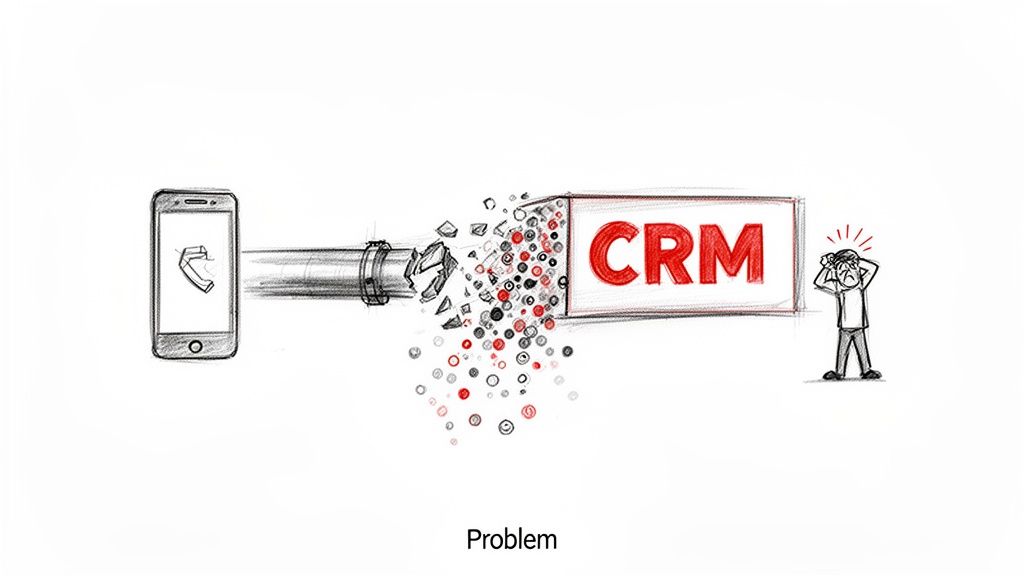
The goal here is to guide the prospect toward identifying issues you can solve. These questions could focus on inefficiencies from manual CRM updates, the risks of inaccurate pipeline data, or the frustration of lost deal context. By getting the prospect to voice these problems themselves, you build credibility and lay the groundwork for presenting your solution as the logical answer.
Example Problem Questions
To an AE: "What challenges do your reps face when trying to update Salesforce after back-to-back customer calls?"
To a Sales Manager: "How often do you find that crucial deal context gets lost between sales and customer success handoffs?"
To a RevOps Leader: "What impact does incomplete call documentation have on the accuracy of your deal reviews and forecasting?"
Actionable Tips for Implementation
Let the Prospect Talk: The most powerful problem statements come from the prospect. Ask open-ended questions and resist the urge to fill the silence. Their words carry more weight than your explanations.
Follow Up to Deepen Understanding: When a prospect mentions a problem, ask a follow-up question to understand its scale. A simple "How does that affect your team's weekly planning?" can reveal significant consequences.
Connect Problems to Business Outcomes: Link the operational friction to tangible business results. Guide the conversation toward how these issues impact time, revenue, or customer retention.
3. Implication Questions: Connecting Problems to Consequences
Once a prospect acknowledges a problem, Implication questions explore its consequences and build urgency. Their purpose is to help the buyer understand the full impact of the issue. These powerful SPIN selling perguntas connect a seemingly small problem to significant business pains like lost revenue, decreased productivity, or customer churn. This makes the need for a solution feel more immediate.

By asking about the downstream effects of a problem, you guide the prospect to articulate the pain in their own words. This is more persuasive than telling them what their problems are. For instance, you could connect a prospect's complaint about messy CRM data to the larger implication of inaccurate sales forecasting. This transforms a minor annoyance into a critical business challenge, justifying the investment in a solution.
Example Implication Questions
To an AE: "If deal context continues to be lost in handoffs, what might that mean for your customer onboarding timeline?"
To a Sales Manager: "How does your team's inability to quickly access call summaries impact your deal velocity and your ability to forecast accurately?"
To a RevOps Leader: "What's the ripple effect on data integrity when your reps spend 15 minutes after each call updating CRM records?"
Actionable Tips for Implementation
One Problem at a Time: Focus your implication questions on one specific problem you have already uncovered. Asking about multiple issues at once can dilute the impact.
Use Trigger Phrases: Frame your questions with phrases like, "What is the effect of...?", "What happens if...?", or "How would that impact...?" to guide the prospect toward thinking about consequences.
Document and Leverage: Listen carefully for both business and personal impacts. Capture these implications in your CRM to build a strong business case. Use them in follow-up conversations and proposals to remind the prospect of the cost of inaction.
4. Need-Payoff Questions: Establishing Solution Value
Need-payoff questions are the final, value-building stage in the SPIN methodology. They shift the focus from the problem to the solution. These questions encourage the prospect to articulate the benefits of change in their own words. These specific SPIN selling perguntas are constructive and forward-looking, guiding the buyer to envision a better future with their challenges resolved.
By asking about the value or payoff of a solution, you transform the conversation from a problem-focused discussion into a collaborative exploration of potential gains. This technique builds desire and internal buy-in before you mention your product. Instead of you telling them why your solution is great, they tell you. This co-creation of value makes the final proposal compelling.
Example Need-Payoff Questions
To a Sales Manager: "How would it help your team's performance if reps could spend less time on manual CRM data entry and more time selling?"
To a RevOps Leader: "What would be valuable about having automatically generated deal context available for your weekly pipeline reviews?"
To a Customer Success Manager: "How important would it be to eliminate the back-and-forth on call summaries between sales and customer success during handoffs?"
Actionable Tips for Implementation
Build from Implications: Only ask need-payoff questions after the buyer clearly understands the negative implications of their problems. The value of the solution is directly proportional to the pain of the problem.
Use Positive Framing: Employ constructive and positive language. Phrases like "How would it help if..." or "What would be the value of..." encourage the prospect to think about gains and benefits.
Let the Prospect Elaborate: Once they state a benefit, encourage them to expand on it. Ask, "Could you tell me more about why that would be so useful?" This gets them to sell themselves on the solution's value.
5. Discovery Questions for Multi-Threaded Selling: Identifying Key Stakeholders
In complex B2B sales, a single decision-maker is rare. Discovery must extend beyond one contact to uncover the distinct problems and priorities of multiple stakeholders. These multi-threaded SPIN selling perguntas target the unique concerns of different departments, from revenue leaders to customer success. This ensures your solution addresses the organization's collective challenges.
This approach acknowledges that a problem for a sales leader (e.g., inaccurate forecasting) often stems from an issue impacting another team, like a RevOps leader struggling with CRM data quality. By mapping these interconnected pains, you build a more robust business case that resonates across the entire buying committee. You can find more strategies for engaging multiple contacts in this guide to effective sales prospecting.
Example Multi-Threaded Questions
To a Sales Leader: "How is incomplete deal context from your reps currently affecting your ability to forecast accurately?"
To a RevOps Leader: "What data quality issues in your CRM are creating the most friction when building pipeline reports for leadership?"
To a Customer Success Manager: "Which promises or critical client risks are being missed during the handoff process from the sales team?"
Actionable Tips for Implementation
Map Stakeholder Questions: Before calls, prepare specific problem and implication questions for each buyer persona you expect to meet.
Create a Stakeholder Map: Document each person’s role, their stated problems, and their measures for success. This helps you visualize the political landscape and identify internal champions.
Synthesize the Narrative: Use the insights gathered from each stakeholder to build a unified solution story. Frame your offering as the bridge that connects their individual needs and solves shared organizational goals.
6. Competitive Discovery Questions: Understanding Incumbent Solutions
Effective discovery includes the competitive landscape. Competitive discovery questions are designed to understand what solutions, tools, or systems the prospect currently uses, is considering, or has previously rejected. These specialized SPIN selling perguntas help you identify switching costs, satisfaction gaps, and opportunities for differentiation without directly attacking a competitor. They are a subtle way to gauge loyalty to an incumbent and uncover frustrations your solution can address.
This line of questioning is crucial for positioning. For instance, when speaking with a team using a manual note-taking process or a basic transcription service, understanding what they like and dislike provides a clear opening. You can then tailor your follow-up to highlight how your automated CRM sync and intent analysis solve the exact gaps they mention. This makes your solution feel like a necessary evolution.
Example Competitive Discovery Questions
To a Sales Manager: "Are you currently using any tools to automatically capture meeting insights or update your CRM?"
To a RevOps Leader: "What's working well with your current solution, and where do you see gaps in its capabilities?"
To an AE: "If you could change one thing about how you currently handle post-call documentation, what would it be?"
Actionable Tips for Implementation
Ask Neutrally and Late: Introduce competitive questions later in the discovery phase, once trust is established. Avoid opening with "Who are you using now?" as it can put prospects on the defensive.
Focus on Capability Gaps: Frame questions around the prospect's process and outcomes, not the competitor's brand name. Ask "What part of your current workflow for analyzing sales calls feels the most time-consuming?"
Document and Differentiate: Capture competitive feedback in your CRM. Use it to inform how you position unique features as direct solutions to their stated challenges. This also helps build valuable competitive intelligence for your team.
7. ROI and Business Impact Questions: Building Financial Justification
ROI and Business Impact questions bridge the gap between solving a problem and proving its financial value. These SPIN selling perguntas help prospects quantify the cost of their challenges and the potential return on investment from your solution. By focusing on metrics, you help them build a compelling internal business case. This makes it easier to secure budget and executive buy-in.

These questions move the conversation from operational pain to financial consequences. For instance, after uncovering that reps spend significant time on manual CRM updates (a Problem), you can ask about the cost of that lost selling time. This transforms a workflow issue into a tangible revenue problem. This focus on quantifiable metrics is a key component of robust sales frameworks like the MEDDIC sales methodology.
Example ROI and Business Impact Questions
To a Sales Manager: "If your reps spend 15 minutes per call on CRM updates, what is that costing you annually in lost productivity?"
To a Customer Success Leader: "How many deals are at risk due to incomplete or delayed handoffs from the sales team?"
To a RevOps Leader: "What is the annual revenue impact if you could accelerate your customer onboarding process by one week?"
Actionable Tips for Implementation
Establish Baselines Early: Ask about current metrics like time spent on tasks or deal velocity during your initial discovery. This gives you a foundation for later ROI calculations.
Help Them Calculate: Guide prospects through the math. For example, "Let's break that down. With 10 reps each spending 5 hours a week on admin, that's 50 hours. What's the average value of one of those selling hours?"
Document Everything: Capture every metric discussed in your notes. Use a tool to automatically log these details in your CRM, ensuring they are available for building an ROI calculator or business case later.
8. Buying Process and Evaluation Criteria Questions: Understanding Decision Dynamics
Understanding how a prospect makes decisions is as crucial as understanding why they need to make one. Buying process and evaluation criteria questions address the mechanics of the purchase. These SPIN selling perguntas uncover the decision-making unit, the specific criteria they will use to judge solutions, and their timeline. This ensures you can navigate the internal process effectively and avoid late-stage surprises.
By asking about their evaluation process, you position yourself as a partner who respects their internal procedures. This clarity helps you align your sales process with their buying journey, identify key stakeholders, and understand what "success" looks like from their perspective. A rep could ask how a new software solution is typically evaluated to ensure they provide the right documentation from the start.
Example Buying Process and Evaluation Criteria Questions
To a Department Head: "Could you walk me through how you typically evaluate new software solutions in your organization?"
To a Potential Champion: "Besides yourself, who else needs to be involved in evaluating a solution like this?"
To a Technical Buyer: "What would a successful implementation look like, and how would you measure it?"
To a Project Lead: "What is your timeline for making a decision, and what key milestones might cause that to shift?"
Actionable Tips for Implementation
Establish Key Criteria Early: Ask about their evaluation criteria to understand what matters most to the entire buying committee, not just your initial contact. This allows you to tailor your demonstrations accordingly.
Map the Decision Unit: Identify potential champions and detractors early. Align with your champions on the evaluation process and work with them to navigate internal politics.
Document and Confirm: After the call, send a follow-up email summarizing the agreed-upon buying process, key stakeholders, criteria, and timeline. This creates documented alignment and provides a clear roadmap.
8-Point SPIN Question Comparison
Question Type | 🔄 Implementation Complexity | 💡 Resource Requirements | 📊 Expected Outcomes | ⚡ Ideal Use Cases | ⭐ Key Advantages |
|---|---|---|---|---|---|
Situation Questions: Establishing Current State Context | Low — simple factual probes, low risk | Low — basic research + brief prep | Baseline context and rapport; clearer discovery scope | First-touch discovery; pre-call context setting | Builds trust and factual foundation for later questions |
Problem Questions: Uncovering Operational Inefficiencies | Medium — requires tact and follow-ups | Medium — listening, examples, call analytics | Uncovers explicit pain points and impact areas | Diagnose operational friction and rep workflows | Encourages prospect self-recognition of problems |
Implication Questions: Connecting Problems to Consequences | High — needs business acumen and timing | Medium–High — analytics + domain knowledge | Creates urgency and frames business consequences | Mid-funnel to escalate priority and impact | Drives internal buy-in and a stronger business case |
Need‑Payoff Questions: Establishing Solution Value | Medium — must be sequenced after problems | Low–Medium — note-taking and timing discipline | Prospect-stated benefits and success criteria | Pre-proposal alignment; validating value drivers | Generates prospect-owned value statements for proposals |
Discovery for Multi‑Threaded Selling: Identifying Key Stakeholders | High — coordinates multiple stakeholders | High — time, mapping, multi-party analytics | Broader stakeholder alignment and larger deals | Complex B2B/enterprise accounts with buying committees | Creates multiple champions and robust approval paths |
Competitive Discovery Questions: Understanding Incumbent Solutions | Medium — diplomatic questioning required | Low–Medium — competitor research + neutral phrasing | Reveals incumbent gaps, switching costs, objections | Late discovery or evaluation-stage differentiation | Uncovers objections early and informs positioning |
ROI and Business Impact Questions: Building Financial Justification | Medium–High — quantitative and consultative | High — metrics, finance input, ROI templates | Financial case, payback estimates, budget alignment | Executive-level deals and budget approvals | Strengthens economic justification and reduces price sensitivity |
Buying Process & Evaluation Criteria Questions: Understanding Decision Dynamics | Medium — process mapping and follow-up | Medium — stakeholder ID, timelines, documentation | Clear decision path, known criteria, agreed next steps | Any deal stage to prevent surprises; pre-close alignment | Prevents hidden blockers and aligns evaluation expectations |
Turn Questions into Pipeline: Practical Next Steps
Your journey to mastering SPIN selling questions begins with deliberate application. We covered the four fundamental SPIN phases and explored how to extend that logic to complex scenarios like multi-threaded selling, competitive analysis, and building a business case. The common thread is clear: the right questions, asked in the right order, transform sales conversations from interrogations to collaborative consulting sessions.
The real power is not in memorizing scripts, but in internalizing the framework. Each question category has a strategic purpose. Your goal is to guide the prospect on a journey where they articulate the pain and the value of the solution. This is the difference between telling them they have a problem and helping them reach that conclusion themselves.
From Theory to Execution
The transition from theory to practice is where most teams fail. Knowledge of the SPIN methodology is valuable, but consistent execution is what generates pipeline and closes deals. The biggest obstacle is capturing and organizing the information gathered during these complex conversations. The answers to your best questions lose their value if they are trapped in disorganized notes or forgotten after the call.
To put these principles into practice effectively, follow these steps:
Choose One Category to Focus On: Do not try to implement everything at once. For the next week, concentrate only on refining your Problem questions. The following week, add Implication questions. Incremental mastery is more sustainable.
Prepare Before Each Call: Based on your prospect’s profile, prepare three to four key SPIN selling questions from each category. Having a plan means being prepared to listen and adapt, not being robotic.
Review Your Calls: Listen to your own call recordings and those of your colleagues. Identify where questions succeeded and where a different approach could have been more effective. Where was a problem revealed but not explored with an Implication question?
Centralize Your Insights: Crucial information about the buying process, decision criteria, and financial impact needs to be accessible. Ensure these data points are structured in your CRM to inform your deal strategy.
Mastering the art and science behind SPIN selling questions is a direct investment in your success. It transforms you from a product vendor into a business problem-solver. By focusing less on pitching and more on asking, you build trust, uncover urgent needs, and help your clients succeed.
To ensure every valuable insight from your discovery calls is captured, analyzed, and synced to your CRM, consider a conversation intelligence platform. Samskit transcribes and analyzes your meetings, identifying the answers to your most important SPIN selling perguntas and making them actionable for your entire team. Visit Samskit to transform your conversations into strategic data.