
Sales prospecting is the process of finding potential customers. The goal is to start conversations that lead to new business. It involves researching, qualifying, and contacting people or companies that fit your ideal customer profile.
Laying the Groundwork for High-Value Prospecting
Before you write an email or make a call, you must build a solid foundation. Many sales teams make the mistake of chasing every possible lead. This approach leads to burnout and poor results. Successful teams focus their efforts on a clear Ideal Customer Profile (ICP).
An ICP is a detailed blueprint of your perfect customer. It guides every prospecting action you take. This is especially important when navigating a complex market like Brazil.
Define Your Ideal Customer Profile
Your ICP acts as a compass for all your prospecting efforts. It helps you avoid wasting time on accounts that are not a good fit. It points you toward prospects who will get the most value from your solution. A strong ICP is built on three types of data.
Firmographics: These are the basic company details. Go beyond industry and employee count. Look at annual revenue, specific geographic locations in Brazil, and their growth rate. A fast-growing tech company in São Paulo has different problems than a mature manufacturing firm in the South.
Technographics: This is the technology your ideal customer uses. Find out their CRM (Salesforce, HubSpot), marketing automation, or other key software. Knowing their tech stack helps you tailor your pitch. You can highlight an integration or a competitive advantage.
Buying Signals: These are events that indicate an opportunity. Did a target company just receive new funding? Are they hiring a "Head of Sales"? Did a key decision-maker you know start a new role there? These events signal change, and change often creates need.
An ICP is not a static document. Review and update it regularly. Analyze your best customers. What common traits do they share? Use this feedback to make your prospecting smarter and more accurate over time.
For instance, a dashboard like this one from Samskit can help your team see patterns in your sales pipeline.
Tools like this provide the data needed to identify common traits among your best customers. You can then use these insights to refine your ICP. Once you have a clear ICP, you can build a targeted list of high-potential accounts. This makes every subsequent step more effective.
You have now defined your Ideal Customer Profile (ICP). The next step is to create a list of companies and people to contact. Building a quality prospect list is the foundation of your sales pipeline. A well-researched list ensures your outreach is relevant and effective.
You will stop wasting time on poor-fit leads and start having more productive conversations. The quality of your list directly impacts the quality of your results.
This infographic breaks down the core data points—firmographics, technographics, and buying signals—that inform your ICP. Use it as a starting point for building your target list.
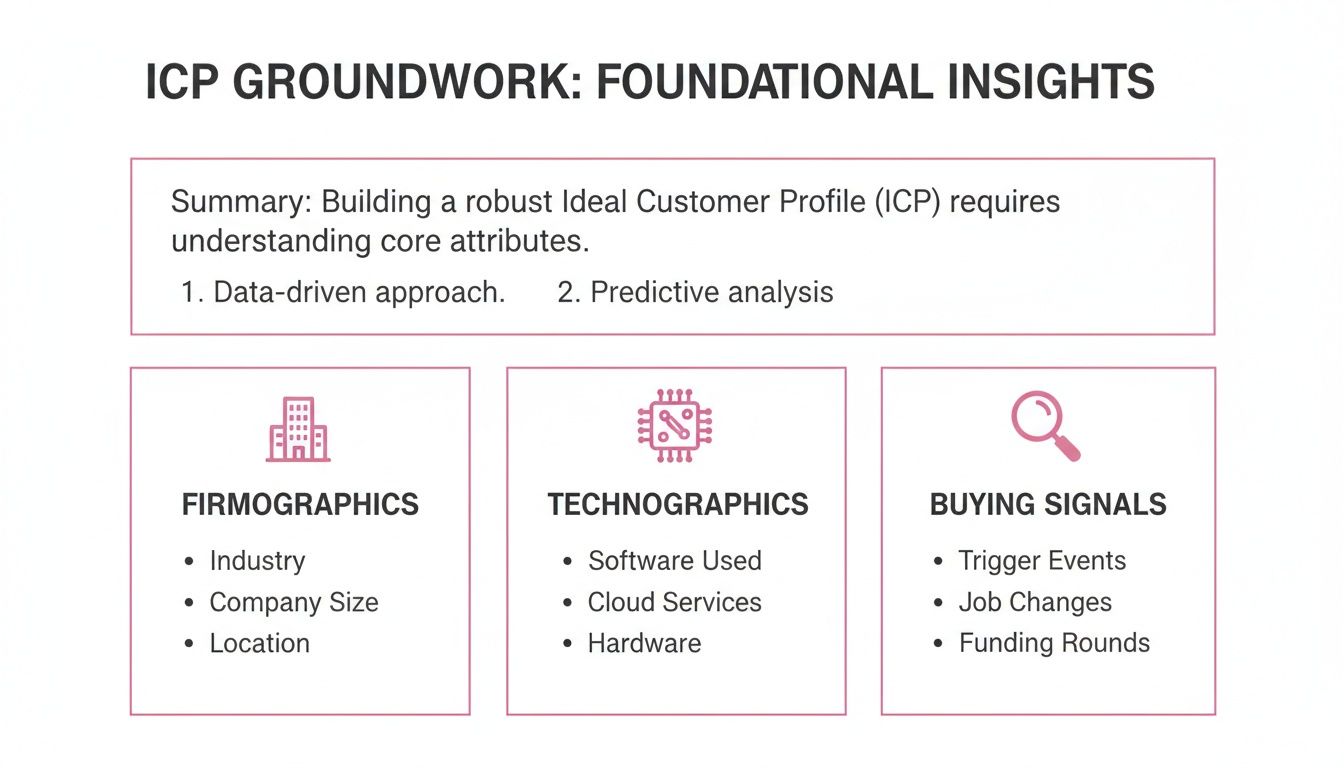
A good list starts with a clear picture of who you are looking for. Use these three data pillars to filter your search and identify high-potential accounts.
Choosing Your List-Building Strategy
You have two main options for creating a prospect list: build it yourself or buy one. Each method has its pros and cons. The best choice depends on your team's time, budget, and the specificity of your ICP.
Building Your Own List
This is the manual approach. You use tools like LinkedIn Sales Navigator, company websites, and industry directories to find contacts. It takes more time, but it results in a highly accurate list. You control the data quality and ensure every contact matches your ICP.
Buying a Prospect List
Buying a list from a B2B data provider offers speed and scale. You can acquire thousands of contacts quickly. The main drawback is that the data can be outdated. This leads to high email bounce rates and wasted effort. If you choose this route, vet the vendor carefully. Be prepared to clean and verify the data.
Do not treat a purchased list as ready for outreach. It is raw material. Your team must first scrub the list, verify contacts, and remove anyone who does not match your ICP. Only then should you begin your outreach.
Prospect List Building Methods Comparison
Choosing the right method to build your prospect list is crucial. This table compares common methods to help you decide which is best for your team's resources and goals in the Brazilian market.
Method | Pros | Cons | Best For |
|---|---|---|---|
Manual Research | - Highly accurate and customised | - Extremely time-consuming | Teams with a very niche ICP, targeting high-value accounts where deep personalisation is key. |
Buying Lists | - Fast and immediate access | - Often contains outdated/inaccurate data | Teams needing to quickly build a large pipeline for a high-volume sales process, with resources for data cleaning. |
Data Enrichment Tools | - Enhances existing CRM data | - Ongoing subscription costs | Companies with an existing database of leads that need to be updated, completed, or validated at scale. |
Social Prospecting | - Access to real-time buying signals | - Requires consistent daily effort | SDRs and AEs building a personal brand and targeting specific personas in industries active on platforms like LinkedIn. |
Often, a hybrid approach works best. You might start with a purchased list and then use manual research and enrichment tools to refine it into a high-quality, actionable asset.
Segmenting Your List for Personalised Outreach
A single, unsegmented list leads to generic messaging. To get responses, you must segment your list. Grouping prospects by shared characteristics allows you to tailor your outreach and increase your impact.
Here are a few ways to segment your list:
By Industry: A FinTech firm in São Paulo has different needs than an Agribusiness company in Mato Grosso. Your messaging must reflect these differences.
By Role: A Head of Sales cares about pipeline and revenue. A Head of IT worries about security and integration. Use language that speaks to their specific concerns.
By Priority Tier: Not all ICP-fit accounts are equal. Create tiers (e.g., Tier 1, Tier 2, Tier 3) based on how closely they match your ideal profile. Spend 80% of your effort on your Tier 1 accounts.
This targeting allows for personalisation at scale. You can create highly relevant messages for specific groups without writing a unique email for every person. A well-organized CRM is essential for this process, as detailed in our guide to managing your inside sales CRM.
For example, Brazil's e-commerce market accounts for 55% of all sales in Latin America. The Southeast region is responsible for 56% of that volume. This data provides a powerful segmentation filter. It tells you to prioritize e-commerce prospects in states like São Paulo and Rio de Janeiro. This is how you turn a simple list into a strategic tool.
Crafting Your Multichannel Outreach Cadence
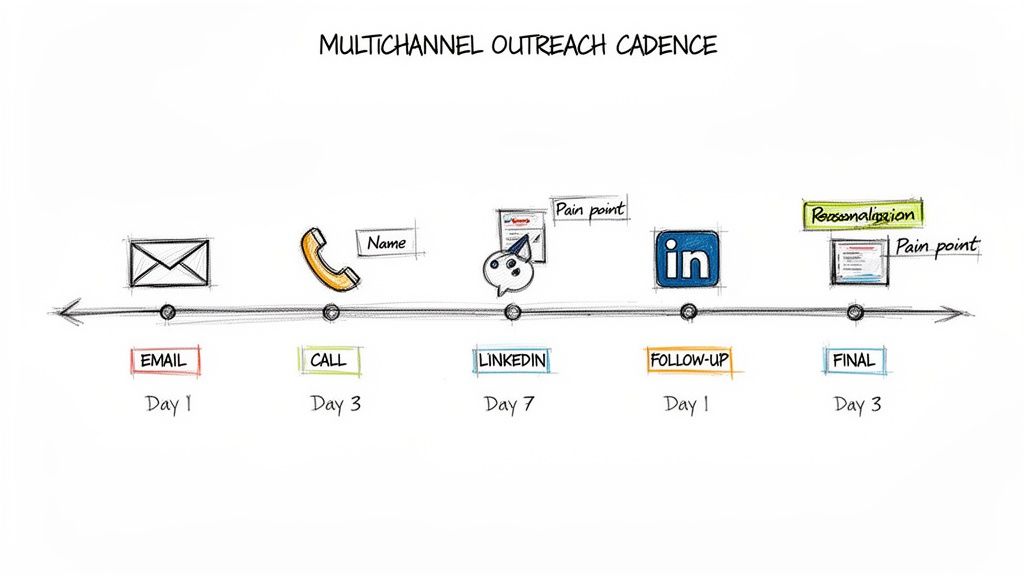
You have your list of ideal prospects. Now it's time to contact them. A single email or cold call is not enough. You need a structured sequence of touchpoints across different channels, known as an outreach cadence.
A good cadence creates a persistent and professional presence. The goal is to build familiarity and start a conversation, not just to pitch. It combines email, phone calls, and social platforms like LinkedIn to keep you on your prospect's radar without being intrusive.
Blending Channels for Real Impact
Relying on a single channel, like email, is risky. Campaigns using multiple channels consistently outperform single-channel efforts. The key is to make each touchpoint feel like a natural continuation of the last.
Here is how the three main channels can work together:
LinkedIn: Use this for your opening move. Before emailing or calling, a profile view or a connection request with a short note can put you on their radar. Engage with their content by leaving a thoughtful comment on a post.
Email: This is the core of your cadence. Email allows you to deliver value, share resources, and present a clear call to action. It also creates a record of your contact attempts.
Phone: A phone call adds a human element. It is the most direct way to have a real-time conversation, ask discovery questions, and handle objections.
Do not treat each channel as a separate activity. Your LinkedIn activity warms up the prospect, your email provides valuable information, and your phone call aims to start a dialogue. Each channel plays a part in the overall process.
A Sample 10-Day Outreach Cadence in Action
A good cadence has a clear rhythm and purpose for each step. It should be persistent but not annoying. Here is an adaptable template for your top-tier accounts.
Day 1: The Opener
LinkedIn: Start with a profile view. Do not send a connection request yet. This subtle action often makes them curious enough to view your profile.
Email: A few hours later, send a personalized email. Focus on a specific pain point relevant to their role or company. Keep it short, mention your research, and end with a simple question like, "Am I speaking to the right person about this?"
Day 3: The First Conversation Attempt
Phone: Make your first call. The goal is to introduce yourself and reference your email. If you reach voicemail, leave a short message that piques their curiosity.
Email: Immediately after the call, send a follow-up. Say something like, "Hi [Name], I just left you a voicemail. I was following up on my last email about [pain point]..."
Day 5: Adding Value
LinkedIn: Send a connection request now. Add a note for context: "Hi [Name], I've been trying to connect via email. Noticed we both follow [Industry Influencer], so I thought it made sense to connect here."
Email: Share something useful, such as a relevant case study, a blog post (like our guide on inbound vs outbound sales), or an industry report. Give value without asking for anything in return.
Day 7: The Second Call
Phone: Make your second call. If they answer, your opener can be, "I was just calling about the report I sent over..." If you get voicemail, change your message. This time, mention a specific result you achieved for a similar company.
Day 10: The Graceful Exit
Email: Send a "break-up" email. This is a final, polite message to close the loop. It often creates a sense of urgency. Try: "Hi [Name], I've reached out a few times without success, so I'll assume this isn't a priority right now. I won't follow up again, but please feel free to get in touch if that changes."
Tips for Nailing Your Cadence Execution
Executing your cadence effectively requires discipline. Make each prospect feel like your top priority.
Don't Over-Automate: Use automation for scheduling tasks, but keep your core messages human. Create strong templates for each customer segment, then add one or two unique, well-researched sentences for each prospect.
Time it Right: Be mindful of time zones. Avoid Monday mornings and Friday afternoons. Mid-week, from mid-morning to early afternoon, typically has the best response rates.
Track Everything: Use your CRM to log every touchpoint. This prevents mistakes and provides data to see what is working. Over time, you can use this data to refine your cadences.
Mastering the Call and Handling Objections
Getting a prospect on the phone is a significant step. How you handle the conversation determines the outcome.
Your goal on the first call is to understand, not to sell. Act like a doctor: diagnose the problem before you prescribe a solution. The right questions will uncover their pain points and show if you can help.
How to Structure Your Discovery Call
A good discovery call feels like a natural conversation but follows a clear structure. In Brazilian business culture, building trust before discussing business is essential.
Here is a simple four-step structure:
The Opening: Start with a friendly, low-pressure introduction. Mention how you connected to provide context. Create a comfortable and professional atmosphere.
Setting the Agenda: Respect their time. State the call's purpose and suggest a brief plan. For example, "I'd like to take 15 minutes to discuss how you handle [area of pain], then I can share how we've helped similar companies."
The Discovery Phase: This is the most important part. Listen more than you talk. Ask open-ended questions to get them talking about their situation, challenges, and goals.
The Wrap-Up: Summarize the key problems you discussed. Propose a clear next step, such as a follow-up meeting with their team or a full product demo.
A successful first call is not about getting a 'yes.' It's about understanding their challenges. Did you identify a problem they need to fix? Do you know how it impacts their business? If so, you have found a real opportunity.
Handling the Objections You'll Inevitably Hear
Objections are not rejections. They are requests for more information. A prospect's pushback is an opportunity to clarify your value and address their concerns.
Here is a workflow for handling three common objections:
"I'm not interested."
What they mean: "I don't know who you are or why you're calling."
Your action: Stay calm. Acknowledge their statement and pivot. "I understand. Many leaders in [their industry] say that at first. Before I go, could I ask one quick question about how you’re handling [specific challenge]?"
"Just send me an email."
What they mean: "I'm busy, and this call isn't a priority."
Your action: Agree, but use it to qualify them. "Of course. To make sure I send the most relevant information, could you tell me which is a bigger priority for you right now: [Option A] or [Option B]?"
"We don't have the budget."
What they mean: "I don't see enough value to justify the cost."
Your action: Shift the conversation from cost to value. "That's fair, and we’re not at the budget stage yet. My goal today is to see if we could create significant value for you. Many of our clients find our solution saves them money on [specific cost center]."
Understand the buying habits of your target market. For instance, 75% of online shoppers in Brazil use installment plans, typically over six payments. This is a crucial detail for sales conversations. When you log call notes in your CRM with a tool like Samskit, capturing these payment preferences is vital for accurate forecasting. You can learn more about local purchasing habits from the latest Brazil e-commerce trends on accio.com.
Anticipating and responding thoughtfully to objections keeps you in control of the conversation and turns potential dead ends into opportunities.
Turning Prospecting into a Scalable System
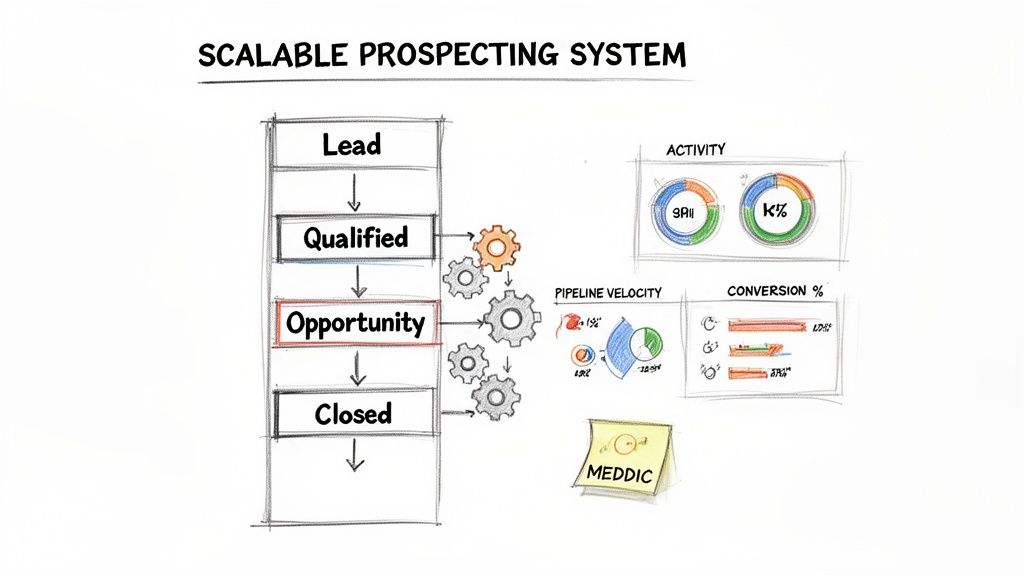
Successful prospecting is not about random outreach; it is about building a repeatable system. Top-performing sales teams operationalize their process to achieve consistent results.
A systematic approach gives you a clear view of your pipeline, shows what is working, and provides data to make informed adjustments. It turns prospecting from an art into a science.
Defining Your Pipeline and Qualification Rules
Your CRM is your system's command center. Start by creating a clean pipeline with clear stage definitions. Each stage, from "New Lead" to "Meeting Booked," must represent a tangible step in the buyer's journey.
To move prospects through the pipeline effectively, use a qualification framework. The MEDDIC framework is a powerful tool for B2B sales:
Metrics: What are the prospect's key performance indicators? What results do they need to achieve?
Economic Buyer: Who has the authority to approve the purchase?
Decision Criteria: What criteria will they use to make their decision?
Decision Process: What steps do they follow to sign a contract?
Identify Pain: What is the underlying business problem that requires a solution?
Champion: Who inside the company will advocate for your solution?
Using a framework like MEDDIC ensures that every opportunity is genuinely qualified. This helps you focus on deals that are likely to close. This process is a key part of revenue growth management.
Must-Track KPIs for Prospecting Success
You cannot improve what you do not measure. Tracking the right Key Performance Indicators (KPIs) provides a clear view of your prospecting performance. Focus on outcomes, not just activity.
Many teams focus only on activity metrics like calls dialed or emails sent. These are inputs. The key is to connect these activities to outcomes like meetings booked and pipeline generated.
External data can also guide your efforts. For example, recent data showed Brazil's retail sector grew 0.5% in one month, driven by IT equipment (3.2%) and furniture (1.0%). For a sales team, this is a clear signal of where to focus prospecting.
Here are the most critical KPIs for any prospecting team.
Key Sales Prospecting KPIs to Track
KPI | What It Measures | Why It Matters |
|---|---|---|
Activity Volume | The number of calls, emails, and social touches per rep. | Measures effort and consistency, providing a baseline for outreach activity. |
Contact-to-Meeting Rate | The percentage of prospects contacted who agree to a meeting. | Shows the effectiveness of your messaging and initial outreach. |
Meeting-to-Opportunity Rate | The percentage of meetings that convert into qualified pipeline opportunities. | A crucial indicator of lead quality and the rep's qualification skills. |
Pipeline Value Generated | The total value of qualified opportunities created from prospecting. | Directly connects prospecting efforts to revenue and sales team goals. |
Sales Cycle Length | The average time it takes for a prospected lead to become a closed deal. | Helps forecast revenue and identify bottlenecks in the sales process. |
Average Deal Size | The average value of deals sourced through prospecting. | Indicates whether you are successfully targeting high-value ICPs. |
By monitoring these numbers, you can spot trends, coach your team, and make data-driven decisions to optimize your prospecting system.
Automating the System to Free Up Sellers
Smart automation is the final component of a scalable system. Your top sales reps should spend their time on high-value conversations, not on administrative tasks.
Logging call notes, updating CRM fields, and setting reminders are necessary but time-consuming. These tasks reduce productivity.
Tools like Samskit can help. It can automatically join sales calls, transcribe them, and push critical information—like objections, buyer intent, and next steps—directly into your CRM. This saves your reps hours each week and ensures your data is accurate. It frees up your sellers to sell and makes your entire system smarter.
Navigating Prospecting in Brazil: Your Questions Answered
Prospecting in Brazil requires an understanding of its unique business culture. What works in other markets may not be effective here. Answering common questions about local customs is the first step to building strong business relationships.
Here are answers to some frequently asked questions from sales teams starting to prospect in Brazil.
How Formal Should My Initial Outreach Be?
In Brazil, business relationships are built on personal connections. Be professional but avoid being overly formal, which can seem cold. Your first email or LinkedIn message should be friendly yet respectful.
Start a genuine conversation. A polite opening that acknowledges them as a person, not just a job title, works well. This approach is different from cultures where a direct, to-the-point style is preferred.
What works well: "Olá [Prospect Name], espero que esteja tudo bem. Notei seu trabalho em [Project/Company] e fiquei impressionado..." (Hello [Prospect Name], I hope all is well. I noticed your work on... and was impressed...)
What often falls flat: "Prezado [Prospect Title], escrevo para solicitar uma reunião para discutir sinergias." (Dear [Prospect Title], I am writing to request a meeting to discuss synergies.)
The goal is to be approachable. This warmth helps build the rapport needed to do business in Brazil.
What's the Best Channel for a First Contact?
A multichannel approach is effective, but the preferred channels in Brazil may differ. WhatsApp is a common business tool, but it should never be used for a cold first contact.
LinkedIn is a good starting point for research and a soft introduction. A well-written email is the best channel for the first formal outreach. Phone calls are more effective after you have already made an initial connection.
A common mistake is to send a WhatsApp message as the first contact. This is often seen as too informal and invasive. Warm up the prospect with an email or a LinkedIn connection first. Suggest moving to WhatsApp only after a conversation has started.
How Do I Handle the "Send Me an Email" Objection?
This is a common way to dismiss a sales call. In Brazil, it can be a test of your persistence and your ability to provide value quickly. Do not send a generic brochure.
Use this as an opportunity to demonstrate that you listened. Your follow-up email should be a concise summary of your value proposition, tailored to their company.
Here is a three-step process:
Agree, then pivot: "Claro, com certeza. Para garantir que eu envie a informação mais relevante, qual é a sua maior prioridade no momento: [Opção A] ou [Opção B]?" (Of course, absolutely. To make sure I send the most relevant information, what is your biggest priority right now: [Option A] or [Option B]?)
Send a value-packed email: Keep it short. Reference your brief conversation and attach a single, relevant piece of content, such as a case study from another Brazilian company in their industry.
Book the next call: In the email, propose a specific time for a follow-up call to discuss the material. This shows you are organized and serious.
By turning this objection into a concrete next step, you maintain control of the process. You also show respect for their time, which can significantly improve your chances of securing the next meeting.
Ready to make your prospecting system smarter and more efficient? See how Samskit automatically captures critical deal information from your sales calls and updates your CRM, giving your team more time to focus on what matters closing deals. Learn more about Samskit.