
Stop using generic advice. To increase B2B SaaS sales, you need structured, data-driven marketing strategies. These strategies should align with how your customers buy. Many revenue teams have a gap between sales activities and real customer conversations. This gap leads to bad forecasts, stalled deals, and mixed messages. This guide offers a clear, actionable framework for growth.
We will explore 10 specific marketing strategies to increase sales. Each strategy is a complete workflow. You will learn what it is, why it works, and how to implement it step-by-step. You will also learn which key performance indicators (KPIs) to track for each one.
This guide focuses on using tools for call intelligence and CRM automation. Tools like Samskit turn customer conversations into a strategic asset. The goal is simple: optimize every interaction to move a deal forward. This article provides the practical steps your sales, marketing, and customer success teams need to build a predictable revenue engine.
1. Implement Sales Conversation Intelligence
Sales conversation intelligence uses AI to analyze recorded sales calls. It extracts insights about buyer intent, objections, and deal progress. This approach replaces manual notes and subjective recall. It provides a data-driven view of what happens in successful customer conversations.
How It Works & Why It’s Effective
Platforms like Samskit, Gong, or Chorus.ai connect with your communication tools and CRM. They record, transcribe, and analyze every customer interaction. The system identifies keywords, topics, and sentiment.
This is a direct marketing strategy to increase sales. It turns raw conversation data into a predictable revenue source. Teams can see which talking points work with buyers. They can identify top performer behaviors to copy. They can also spot deals at risk before they stall.
Key Insight: Conversation intelligence changes sales coaching from guesswork to data-backed performance improvement. This directly impacts win rates.
Actionable Implementation Steps
Set Up Pipeline Triggers: Configure the platform to update CRM stages based on conversation events. For example, if a buyer says "budget approval," the tool can move the opportunity to the next stage. This keeps the pipeline accurate.
Create Data-Driven Playbooks: Analyze your top performers' calls to find patterns. What specific questions or phrases do they use? Add these insights into your sales playbooks and training. To learn more about structuring questions, review the SPIN selling methodology.
Run Targeted Coaching: Use call snippets to coach reps on specific skills, like handling objections. Reviewing actual call moments provides concrete feedback that improves skills faster than role-playing.
Ensure Compliance: Always tell participants that the call is being recorded. This complies with consent laws. It also builds trust and ensures your data collection is legal.
2. Use Account-Based Selling (ABS)
Account-Based Selling (ABS) is a focused strategy. Sales and marketing teams treat a single high-value account as its own market. Instead of broad campaigns, ABS concentrates resources on a few target companies. It uses personalized engagement to build relationships with key decision-makers.
How It Works & Why It’s Effective
ABS aligns sales and marketing to deliver coordinated, relevant messages. This method is an efficient marketing strategy to increase sales for large contracts. It stops wasted effort on prospects who are a poor fit. By personalizing outreach based on research, you increase relevance and engagement.
Tools like LinkedIn Sales Navigator help identify stakeholders. Platforms like 6sense can show which accounts are actively looking for a solution. The goal is to provide the buying committee with content that addresses their specific challenges. This leads to larger deals and higher win rates.
Key Insight: ABS shifts the focus from lead quantity to account quality. It directs your sales efforts to prospects with the highest revenue potential.
Actionable Implementation Steps
Define Your Ideal Customer Profile (ICP): Identify the characteristics of your best customers. Use this data to create a tiered list of target accounts.
Map the Buying Committee: For each target account, use LinkedIn Sales Navigator to identify all key stakeholders. Map their roles and influence on the deal.
Use Conversation Intelligence: Analyze insights from tools like Samskit. Understand the pain points discussed by similar accounts. Tailor your message for each stakeholder based on what you know works.
Coordinate Multi-Channel Outreach: Create a plan for outreach. Marketing runs personalized ads and email campaigns. Sales reps conduct direct outreach via email, calls, and social media.
Create Account-Specific Playbooks: Use CRM data and call insights to build a success plan for each target account. Document key players, business goals, and tailored value propositions.
3. Maintain CRM Data Integrity
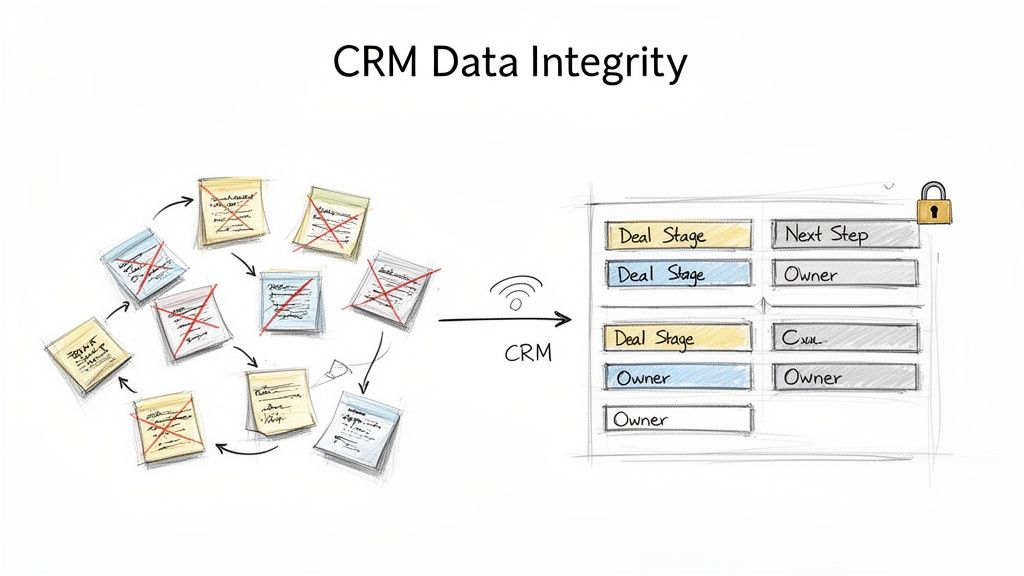
CRM data integrity is a strategy for keeping your CRM data clean, current, and useful. It goes beyond manual data entry. It automatically syncs insights from customer conversations directly into your CRM. This creates a single, reliable source of truth for deal progress.
How It Works & Why It’s Effective
Tools with automated CRM sync, like Samskit, Salesforce Einstein, or HubSpot’s Operations Hub, close the gap between conversations and system data. They automatically capture key data points, such as budget confirmations or next steps. Then they update the relevant fields and opportunity stages in real-time.
This is a critical marketing strategy to increase sales because it removes administrative work and human error. Accurate pipeline data leads to reliable sales forecasts. It helps leaders make better strategic decisions. It also ensures marketing and sales teams work from the same facts.
Key Insight: Real-time data sync turns a CRM from a historical record into an active, strategic tool that reflects your current revenue pipeline.
Actionable Implementation Steps
Define Mapping Rules: Create clear rules that connect conversation events to CRM updates. For example, when a phrase like "send the proposal" is detected, the deal stage automatically changes to "Proposal Sent."
Set Up Data Validation: Implement automated checks to ensure information is high quality before it's logged. This could involve verifying that a budget figure is a number or that a next step includes a date.
Train Teams on the Automation: Teach your sales team what data is auto-populated and which fields still need manual input. This manages expectations and encourages them to trust the system.
Review and Refine Sync Rules: Schedule regular reviews of your automation rules. Analyze accuracy metrics to find and fix any sync errors. This keeps the system aligned with your sales process.
4. Coach Sales Skills with Call Analytics
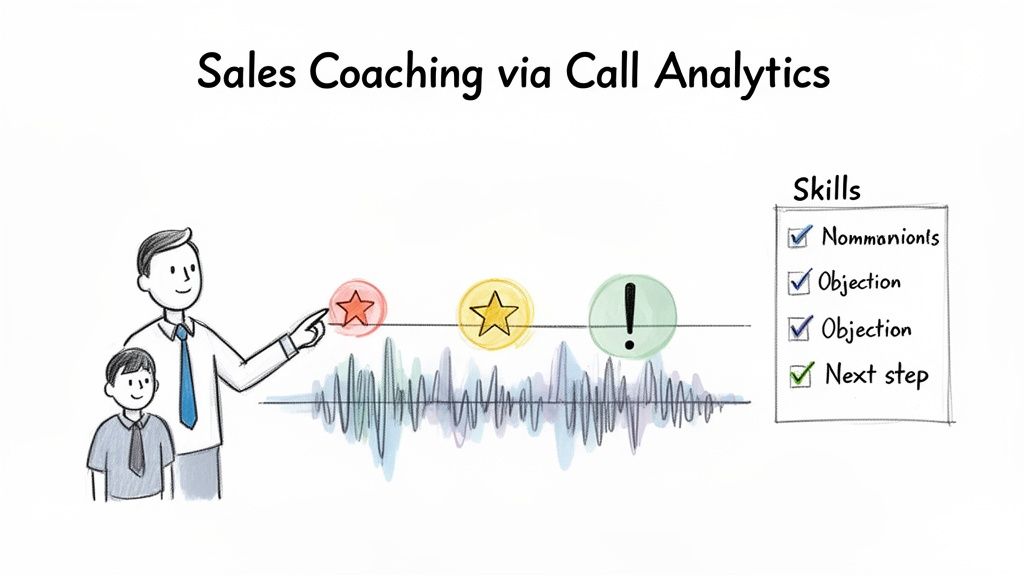
Sales coaching with call analytics is a strategy that uses objective call data to find skill gaps. Managers create targeted development plans based on this data. Instead of relying on opinions, they analyze patterns in recorded calls to find specific areas for improvement and track progress.
How It Works & Why It’s Effective
Platforms like Samskit or Gong provide deep analytics on sales conversations. They create scorecards for reps and identify coaching moments. Managers can compare call structures and objection handling techniques between top performers and the rest of the team. This helps establish best-practice benchmarks.
This is an effective marketing strategy to increase sales because it makes skill development systematic. Coaching becomes more efficient and impactful by focusing on specific, proven behaviors. It turns manager 1-on-1s from pipeline reviews into strategic sessions focused on skills that generate revenue.
Key Insight: Call analytics removes subjective opinions from coaching. It lets managers focus on the specific skills that differentiate top performers.
Actionable Implementation Steps
Create Data-Informed Development Plans: Analyze a rep's call transcripts to find recurring challenges, like struggling with pricing objections. Build their quarterly plan around mastering one or two of these specific skills.
Build a Best-Practice Call Library: Find and tag excellent calls where reps handle difficult questions perfectly. Share these anonymized recordings with the team to provide a clear model of success.
Run Skill-Focused Coaching Sessions: Dedicate weekly 1-on-1s to a single skill. Use specific call snippets as examples to discuss what went well and what could be improved.
Track Skill Improvement Metrics: Monitor metrics over time, such as a rep's talk-to-listen ratio or how often they successfully handle pricing discussions. This data shows the tangible return on your coaching efforts.
5. Manage Buyer Intent and Objections
This strategy uses AI analysis of customer conversations to identify buying signals and uncover objections. It helps prioritize accounts that show strong purchase intent. Instead of treating all leads the same, this approach lets revenue teams focus on opportunities most likely to close.
How It Works & Why It’s Effective
Platforms like Samskit or intent data providers like 6sense analyze interactions to score an account's likelihood to buy. Conversation intelligence tools find keywords and sentiment in calls that signal high intent (e.g., "we need a solution by next quarter"). They also identify customer objections.
This is a powerful marketing strategy to increase sales because it replaces guesswork with data. Teams can allocate resources more precisely. By understanding and addressing a buyer's core hesitations, you shorten sales cycles and improve forecast accuracy.
Key Insight: Managing objections based on conversational data turns potential deal-breakers into opportunities to build trust.
Actionable Implementation Steps
Create an Objection Handling Checklist: Use a tool like Samskit to automatically find common objections from calls. Group them by category (e.g., pricing, features). Map pre-approved, effective responses to each one to create a playbook for your team.
Prioritize Follow-up with Intent Scores: Connect your intent platform with your CRM to create automated workflows. Trigger immediate follow-up tasks for reps when an account shows high intent.
Share Insights with Other Departments: Hold a weekly review of the top objections identified by your AI platform. Share these patterns with product teams to highlight feature gaps and with marketing to refine messaging.
Set Up Risk Alerts for Early Intervention: Configure alerts for when specific objection keywords are detected in a high-value deal. This allows sales managers to step in early with coaching or resources.
6. Improve the Customer Success Handoff
This strategy systematizes the transition from sales to customer success. It uses technology to automatically capture all relevant conversation context from the sales cycle. This ensures a seamless transfer of knowledge and a faster, more effective onboarding for new clients.
How It Works & Why It’s Effective
A poor handoff can quickly damage customer trust and increase churn risk. This strategy prevents that. Platforms like Samskit automatically analyze sales calls. They document commitments, business goals, and potential risks. This structured summary is then passed to the Customer Success (CS) team.
This is a crucial marketing strategy to increase sales because it directly impacts customer lifetime value (LTV). When a CS team is fully informed from day one, they can speed up time-to-value. They can also prevent early dissatisfaction and find upsell opportunities based on goals set during the sales process.
Key Insight: A smooth sales-to-CS handoff turns a sale into a long-term partnership. It lays the groundwork for retention and expansion.
Actionable Implementation Steps
Create a Standard Handoff Template: Develop a required checklist for every handoff. It should include key stakeholders, business objectives, promises made by sales, and known risks. Use tools to auto-populate this from call transcripts.
Document All Commitments: Use call intelligence platforms to automatically capture and summarize every promise made during the sales cycle. Share these with the CS team to ensure nothing is missed.
Build Onboarding Plans from Customer Priorities: Analyze sales conversations to find the customer’s top priorities. Structure the onboarding checklist around delivering value against these specific goals first.
Establish Clear Ownership: Define who is responsible for tracking the outcomes of promises made during sales. This shared accountability ensures a cohesive customer experience.
7. Improve Sales Forecast Accuracy with Deal Intelligence
This is a predictive strategy that improves forecast reliability. It analyzes actual customer conversations. Instead of relying on subjective sales rep estimates, this approach uses objective signals from buyer interactions to assess deal health and the probability of closing.
How It Works & Why It’s Effective
Platforms like Samskit, Gong, or Salesforce Einstein connect with your CRM and communication tools. They analyze interactions for key signals like risk factors, buyer engagement levels, and competitor mentions. This provides a data-driven validation of traditional forecasting methods.
This is a valuable marketing strategy to increase sales because it prevents revenue surprises. It allows leaders to allocate resources more effectively. By understanding which deals are truly progressing, teams can focus on opportunities with the highest chance of success.
Key Insight: Deal intelligence changes forecasting from an art based on feelings to a science based on verified customer behavior.
Actionable Implementation Steps
Validate the Pipeline with Conversation Data: Use a tool to automatically extract risk factors, like mentions of budget cuts, from calls. Compare these objective signals against the deal stage in your CRM to confirm its health.
Compare AI Scores with Rep Forecasts: Hold monthly meetings to review the difference between AI-generated deal scores and the sales team's forecast. Use this as a coaching opportunity.
Focus Deal Reviews on Evidence: Structure your pipeline review meetings around conversation evidence. Instead of asking, "How do you feel about this deal?", ask, "What did the customer say in our last call about next steps?"
Adjust Forecast Weighting: Analyze historical data to see which signals, like low stakeholder engagement, often precede a lost deal. Use these insights to create a more accurate forecast model. To learn more about building these models, see how to improve your forecasting with Power BI.
8. Standardize the Sales Process
Sales process standardization means creating a consistent, repeatable framework. It guides every salesperson through each stage of the sales cycle. By developing data-driven playbooks, organizations give their teams proven methods, talking points, and objection-handling techniques.
How It Works & Why It’s Effective
This strategy stops each sales rep from creating their own process. It uses insights from conversation intelligence tools to analyze successful and unsuccessful calls. It identifies the behaviors that consistently lead to closed deals. This information is then used to create formal playbooks.
This is an effective marketing strategy to increase sales because it makes top performance accessible to everyone. New hires can learn faster. Average performers can adopt the habits of your best closers. Standardization reduces inconsistency and improves forecast accuracy.
Key Insight: A standardized sales process provides a proven framework. It lets reps focus their energy on building rapport and solving customer problems.
Actionable Implementation Steps
Analyze Top Performer Conversations: Use call recordings from your top deals to find patterns. Document the specific questions and objection responses that work best. Build them into stage-specific playbooks.
Create Stage-Specific Guides: Develop playbooks for each pipeline stage (e.g., Discovery, Demo, Proposal). Include key qualifying questions and competitive positioning statements. For a structured approach, consider a framework like the MEDDIC sales methodology.
Validate and Roll Out: Ask your top performers to review the playbooks before a company-wide rollout. This ensures the content is practical and gets team buy-in.
Measure Adoption and Iterate: Use call analytics to track playbook adoption and its impact on metrics like conversion rates. Update your playbooks quarterly based on new win-loss analysis.
9. Align Revenue Teams with Cross-Functional Visibility
Revenue team alignment is a collaborative strategy. It breaks down information silos between sales, marketing, and customer success. It centers on creating a single source of customer truth, using conversation intelligence data. This ensures all customer-facing teams work from the same context.
How It Works & Why It’s Effective
Platforms like Samskit act as a central hub for customer interactions. They make call insights and deal context visible across the entire revenue organization. When marketing can hear real sales conversations, they can refine their messaging. When customer success understands the promises made during the sale, they can provide a better onboarding experience.
This is a powerful marketing strategy to increase sales because it prevents problems caused by a disconnected customer experience. Coordinated efforts lead to better lead quality, higher conversion rates, and improved retention.
Key Insight: Aligning revenue teams around shared customer intelligence turns separate functions into a single, efficient revenue engine.
Actionable Implementation Steps
Create Centralized Insight Channels: Set up shared Slack channels where a platform automatically posts key call highlights, like competitor mentions. This gives other teams real-time customer feedback.
Run Cross-Functional Pipeline Reviews: Host a weekly revenue team meeting. Use shared dashboards and call playlists as the foundation. Analyze why deals are progressing or stalling by listening to key call moments together.
Inform Marketing Campaigns with Call Data: Let your marketing team access sales call transcripts. They can find common pain points and compelling language to create relevant ad copy and content.
Flag Churn Risk Proactively: Set up alerts to notify the customer success team when a sales call reveals potential issues. This lets them prepare an onboarding plan that addresses the customer's specific concerns.
10. Optimize Deal Velocity and Time-to-Close
Deal velocity optimization is a strategy that systematically shortens the sales cycle. It involves analyzing the sales process to find and remove bottlenecks. This ensures opportunities move from one stage to the next as efficiently as possible.
How It Works & Why It’s Effective
This strategy uses data from your CRM and conversation intelligence platforms. It measures the time a deal spends in each pipeline stage. By seeing where deals slow down, revenue teams can make targeted process changes. Platforms like Samskit automatically extract 'next steps' from calls, giving a real-time view of deal progression.
Optimizing deal velocity is a strong marketing strategy to increase sales because it directly impacts revenue and forecast accuracy. A faster sales cycle means quicker cash flow and lets sales reps manage more opportunities.
Key Insight: Focusing on deal velocity shifts the team's mindset from just closing deals to closing them efficiently.
Actionable Implementation Steps
Establish Stage Duration Benchmarks: Analyze historical data to find the average time a successful deal spends in each pipeline stage. Use these numbers to create target velocity benchmarks.
Identify Bottlenecks with Call Intelligence: When deals stall in a specific stage, use call analysis tools to find out why. Listen to recordings from stuck deals to identify common objections or points of confusion.
Track "Next Step" Commitments: Configure your tools to automatically capture when a "next step" is agreed upon in a call. Compare these planned actions against actual progress in the CRM to spot deals that are going off track.
Compare Fast vs. Slow Deals: Analyze deals that closed quickly versus those that dragged on. Look for patterns in the call data. Did fast-closing deals involve a specific stakeholder earlier? Use these insights to refine your sales process.
10-Point Sales Strategy Comparison
Item | 🔄 Implementation Complexity | 💡 Resource Requirements | 📊 Expected Outcomes | Ideal Use Cases | ⭐ Key Advantages / ⚡ Efficiency |
|---|---|---|---|---|---|
Sales Conversation Intelligence & Call Recording | Medium — multi-platform integrations, compliance setup | Moderate — recordings/transcription, AI licensing, training | Real-time call insights, objection detection, improved forecasting | Teams needing automated evidence from every customer interaction | ⭐⭐⭐⭐⭐ — Objective insights, stronger forecasting; ⚡⚡⚡ (reduces manual notes) |
Account-Based Selling (ABS) with Personalization | High — deep account research, coordinated processes | High — research resources, multi-channel tools, cross-team effort | Higher win rates, larger deal sizes, stronger stakeholder relationships | Targeting high-value enterprise accounts with tailored outreach | ⭐⭐⭐⭐ — Highly effective for strategic accounts; ⚡ (focused resource use) |
CRM Data Integrity & Real-Time Pipeline Accuracy | Medium–High — mapping rules, legacy CRM integrations | Moderate — integration work, validation workflows, monitoring | Clean CRM, accurate pipeline, data-driven forecasting and audits | Organizations needing a single source of truth for deal progress | ⭐⭐⭐⭐⭐ — Reliable pipeline visibility; ⚡⚡ (reduces admin time) |
Sales Coaching & Skill Development Through Call Analytics | Medium — tooling + manager process change | Moderate — analytics subscriptions, manager training, review time | Evidence-based coaching, measurable rep improvement, lower turnover | Ops wanting scalable, data-driven rep development programs | ⭐⭐⭐⭐ — Actionable coaching examples; ⚡⚡ (speeds coaching prep) |
Buyer Intent & Objection Management | Medium — intent model tuning and definitions | Moderate — intent data, continuous model refinement, playbooks | Faster identification of hot opportunities, proactive objection handling | Prioritizing follow-up and rescue of at-risk deals | ⭐⭐⭐⭐ — Focuses effort on high-probability deals; ⚡⚡⚡ (prioritizes saves time) |
Customer Success Handoff & Onboarding Acceleration | Low–Medium — handoff templates and access controls | Low–Moderate — transcript sharing, template automation, CS training | Shorter ramp times, fewer missed commitments, better CS preparedness | Companies scaling handoffs between sales and CS teams | ⭐⭐⭐⭐ — Reduces churn risk, improves satisfaction; ⚡⚡ (accelerates onboarding) |
Sales Forecast Accuracy Through Deal Intelligence | Medium — model training, historical data requirement | Moderate — analytics platform, data engineering, review cadence | Improved forecast accuracy, early miss detection, better resource planning | CFOs/RevOps needing reliable revenue projections | ⭐⭐⭐⭐ — More predictable forecasts; ⚡⚡ (earlier corrective actions) |
Sales Process Standardization & Playbook Development | Medium — analysis of call patterns, playbook creation | Moderate — analytics, documentation effort, change management | Consistent execution, faster ramp, repeatable best practices | Organizations scaling teams or hiring rapidly | ⭐⭐⭐⭐ — Replicable winning approaches; ⚡ (accelerates ramp) |
Revenue Team Alignment & Cross-Functional Visibility | Medium — governance, sharing controls, culture change | Moderate — shared repositories, access policies, meeting cadence | Fewer silos, coordinated go-to-market, faster decisions | Companies wanting unified sales/marketing/CS insights | ⭐⭐⭐⭐ — Cross-team efficiency gains; ⚡⚡ (speeds collaboration) |
Deal Velocity & Time-to-Close Optimization | Medium — velocity tracking, sample benchmarking | Moderate — telemetry, analytics, process change to act on insights | Shorter sales cycles, predictable timing, bottleneck elimination | Teams focused on shortening sales cycles and CAC | ⭐⭐⭐⭐ — Faster revenue realization; ⚡⚡⚡ (improves time-to-close) |
Start Implementing Your High-Impact Sales Strategy Today
These ten strategies show a major shift in how modern revenue teams work. Guesswork, intuition, and manual data entry are no longer enough. The most effective marketing strategies to increase sales today are part of a single, customer-focused system. They are built on data, powered by technology, and executed with precision.
The common element in every strategy is conversation intelligence. Your customer conversations are your most valuable asset. They contain the truth about market needs, buyer objections, and competitor tactics. By capturing and analyzing this data, you turn opinions into objective, actionable insights.
How the Strategies Work Together
The main idea is to move from manual processes to data-driven workflows. This is the key to scalable growth.
A Foundation of Truth: Strategies like CRM Data Integrity and Sales Conversation Intelligence create a single source of truth. When your CRM reflects reality, forecasting becomes accurate and coaching becomes relevant.
Precise Execution: With good data, you can run targeted strategies. Account-Based Selling (ABS) becomes more effective because it's based on real insights. Buyer Intent & Objection Management becomes a systematic process.
Systematic Improvement: Lasting success requires continuous improvement. Sales Coaching through Call Analytics and Sales Process Standardization create feedback loops that improve the whole team's performance.
Organizational Alignment: Finally, strategies like Revenue Team Alignment and seamless Customer Success Handoffs break down internal silos. When marketing, sales, and success teams all use the same conversational data, the customer has a consistent experience.
Your Actionable Path Forward
Do not try to implement all ten strategies at once. Find your biggest bottleneck and start there.
Identify Your Biggest Bottleneck: Is your pipeline inaccurate? Start with CRM Data Integrity. Are reps struggling with a specific competitor? Focus on Objection Management. Is your sales cycle too long? Prioritize Deal Velocity Optimization.
Choose One or Two Initiatives: Select the strategies that will have the most immediate impact on that bottleneck. For example, if your problem is inconsistent rep performance, focus on Sales Coaching and Sales Process Standardization.
Define Success Metrics: Before you start, define what success looks like. For a CRM integrity project, the KPI might be a 95% reduction in overdue tasks. For a coaching initiative, it might be a 15% increase in the talk-to-listen ratio.
Implement, Measure, and Iterate: Roll out your chosen strategy with a small pilot group. Use tools like Samskit to automate data capture and analysis. Measure the results against your KPIs and get feedback. Refine your approach, then expand it to the whole team.
By using this focused, step-by-step approach, you can show value quickly. You are not just trying new marketing strategies to increase sales; you are building a resilient and predictable system for revenue growth. The future of sales belongs to teams that can listen, learn, and adapt. The voice of your customer is the blueprint for your success.
Ready to turn your customer conversations into your most powerful asset? Samskit automates the capture and analysis of sales calls, directly updating your CRM to provide the real-time intelligence needed to implement these strategies effectively. Discover how you can build a more predictable revenue engine by visiting Samskit today.