
AI for sales prospecting helps you find and qualify potential customers more effectively. It uses smart tools to automate repetitive work. This frees up your sales team to build relationships and close deals. AI systems analyze data to find high-intent buyers, turning a manual process into a data-driven workflow.
Moving Past Manual Prospecting
The old way of prospecting is inefficient. Sales development reps (SDRs) spend hours building lists, making cold calls, and sending generic emails. This high-effort, low-reward cycle is frustrating and unsustainable. Buyers now expect a personal touch that manual methods cannot provide at scale.
Traditional prospecting relies on basic filters and guesswork. You might target companies by size or industry, but you miss a key question: Why reach out to them now? This guesswork leads to wasted time on accounts that are a bad fit or are not ready to buy.
From Guesswork to Data-Driven Targeting
AI changes this entire process. It shifts your team from a manual grind to a proactive strategy. Instead of filtering by static data, AI platforms analyze thousands of real-time signals. This creates a dynamic picture of your ideal customer.
AI spots critical buying signals that a person would likely miss.
Practical Examples of Buying Signals:
A new executive hire: A new VP of Sales often invests in new tools.
A recent funding round: Fresh capital signals a larger budget for new solutions.
A new technology adoption: If a company adds a complementary tool, they might be a fit for you.
Negative competitor mentions: A prospect complaining about a rival online is a clear opportunity.
By flagging these events, AI helps your team engage prospects when their interest is highest.
Traditional vs. AI-Powered Prospecting: A Workflow Comparison
Here is a step-by-step look at how the daily activities change.
Activity | Traditional Workflow (Manual) | AI-Powered Workflow (Automated) |
|---|---|---|
List Building | Scrape LinkedIn, databases, and event lists. The data is often outdated and requires manual verification. | Generate dynamic lists based on real-time buying signals and your ICP. The data is always current. |
Lead Qualification | Reps use simple BANT criteria and intuition. This process is subjective and prone to error. | Score leads using thousands of data points. The AI predicts their likelihood to convert with high accuracy. |
Outreach | Send generic, one-size-fits-all email templates in bulk. This results in low open and reply rates. | Personalize messaging at scale. The AI uses prospect data, job changes, and company news to tailor content. |
Timing | Rely on luck and a fixed cadence. You contact prospects on your schedule, not theirs. | Engage prospects at the optimal moment. Outreach is triggered by specific buying signals you define. |
Research | Reps spend hours digging through websites and social profiles before each call. This is not scalable. | Summarize key insights, talking points, and relevant news in seconds. The rep gets a pre-call brief. |
The difference is clear. AI makes the entire process smarter and more targeted.
A New Daily Workflow
This shift has a major impact on an SDR's day. Instead of spending 60% of their week on manual research, they can focus on engaging high-potential prospects. These prospects are already flagged by the AI system.
AI changes the SDR's role from a data miner to a strategic communicator. They get the context needed to start a real conversation. The goal is no longer to hit a call quota. It is to connect with the right person at the right time.
This trend is growing quickly. In Brazil, for example, the B2B AI market is expanding rapidly. The market is projected to grow from USD 340.7 million in 2025 to USD 9,139.3 million by 2033. Much of this growth comes from tools that help teams identify high-intent buyers faster.
AI does not replace salespeople. It empowers them. It gives them tools to focus on building relationships and solving problems for customers who need their help.
How to Build an AI Prospecting Workflow
Let's get practical. Building an AI-powered prospecting system saves time and improves data quality. It gets your sales team back to selling. The goal is to weave AI into each step of your process to create a scalable system for finding good leads.
This starts with a change in how you find and prioritize prospects. Forget wide, generic outreach. AI tools analyze thousands of real-time data points to find actual buying intent.
Step 1: Shift from Static Lists to Dynamic Prioritization
First, use AI for smarter lead identification. Instead of pulling a static list, AI platforms actively scan for buying signals. These signals include a company hiring for a key role, a recent funding announcement, or online discussion about a competitor.
This turns your lead list from an outdated document into a live queue of prioritized prospects.
A Simple 3-Step Workflow:
Define Your Ideal Customer Profile (ICP): Give the AI a clear definition of your best customers. Include firmographics, technographics, and pain points.
Set Up Signal Monitoring: Tell the AI which buying signals matter to you. Is it a new technology adoption? A surge in hiring for a specific role? You decide.
Receive Prioritized Feeds: The AI delivers a constantly updated list of accounts. These accounts fit your ICP and show active buying signals.
This workflow ensures your team focuses on accounts that are in-market today.
The core shift is from asking, "Who could we sell to?" to answering, "Who is ready to buy now?" AI provides the data to answer that second question.
Step 2: Write Personalized Outreach That Scales
You have your prioritized list. Now, you need outreach that gets a response. Generic messages no longer work. Generative AI helps you personalize communication for hundreds of leads without spending hundreds of hours.
These tools draft tailored messages by pulling in context from various sources:
A prospect’s recent LinkedIn post.
The company’s latest press release.
Specific challenges mentioned on their website.
By feeding this context to the AI, it can generate relevant first drafts for emails or social media messages. The sales rep then refines these drafts, adding a personal touch. This balances automation with authenticity.
This flowchart shows how an AI-driven process compares to a manual one.
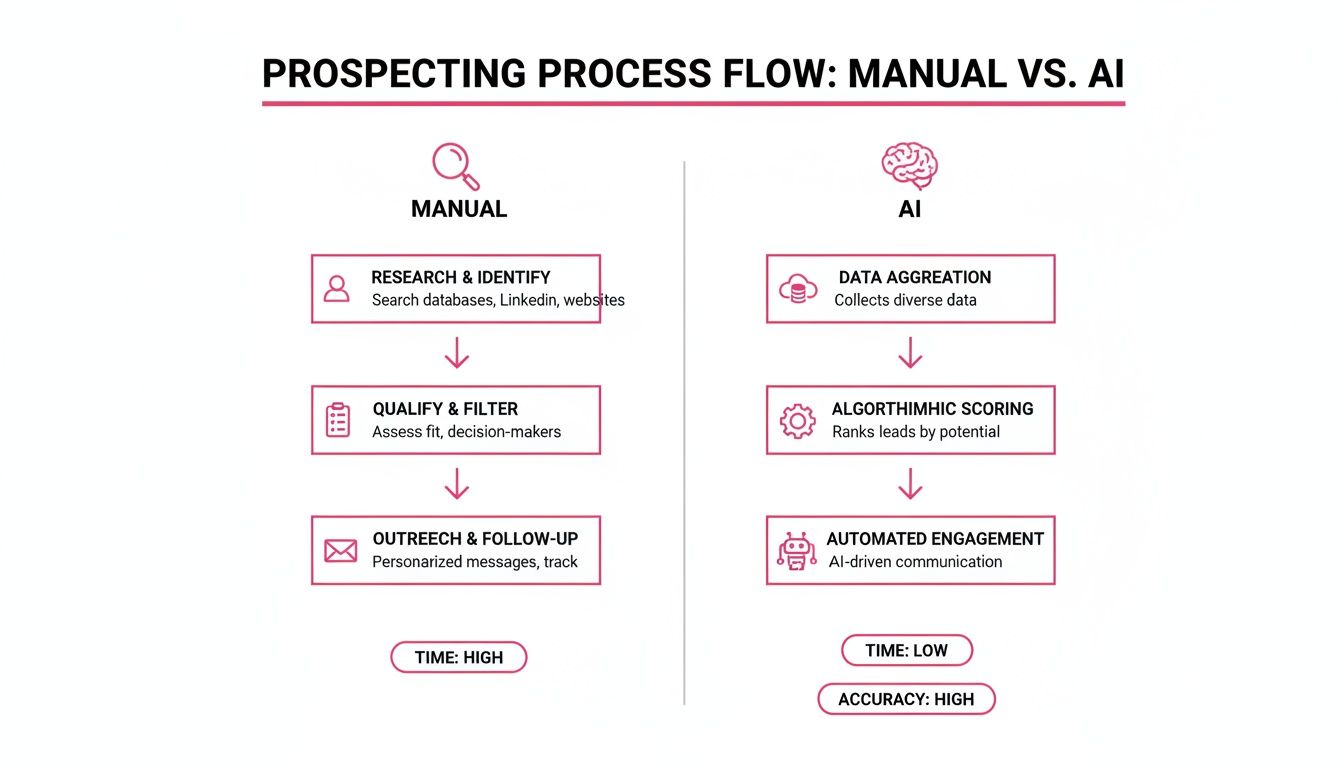
The AI-powered workflow automates the research and initial drafting. This frees up your reps to have more high-value conversations.
Step 3: Integrate Your Tools for a Seamless Data Flow
Your AI tools must connect to your Customer Relationship Management (CRM) system. A disconnected tech stack creates data silos and more manual work. Integration with systems like Salesforce or HubSpot is essential.
A well-integrated system ensures data from your AI prospecting tools flows directly into your CRM. This creates a single source of truth for every prospect. To learn more, read about optimizing your CRM for inside sales.
When your systems are connected, the entire revenue team benefits:
Sales Reps: Get instant access to prospect insights in one place.
RevOps: Maintain clean, accurate data without manual cleanup.
Sales Leaders: Get a clearer view of the pipeline for more accurate forecasts.
Building an AI prospecting workflow is a strategic move. It automates repetitive work, provides your team with better data, and creates a scalable process for predictable growth.
Crafting Hyper-Personalised Outreach That Scales
Personalization cuts through the noise in a prospect’s inbox. But doing it manually for hundreds of leads is impossible. Generative AI allows your team to send tailored messages without reducing volume. The focus is on quality communication that speaks to a prospect's specific situation.
Think of generative AI as a co-pilot for your sales reps. Instead of starting with a blank page, reps can use AI to generate first drafts of emails, LinkedIn messages, and call scripts. The key is to provide the AI with the right context.
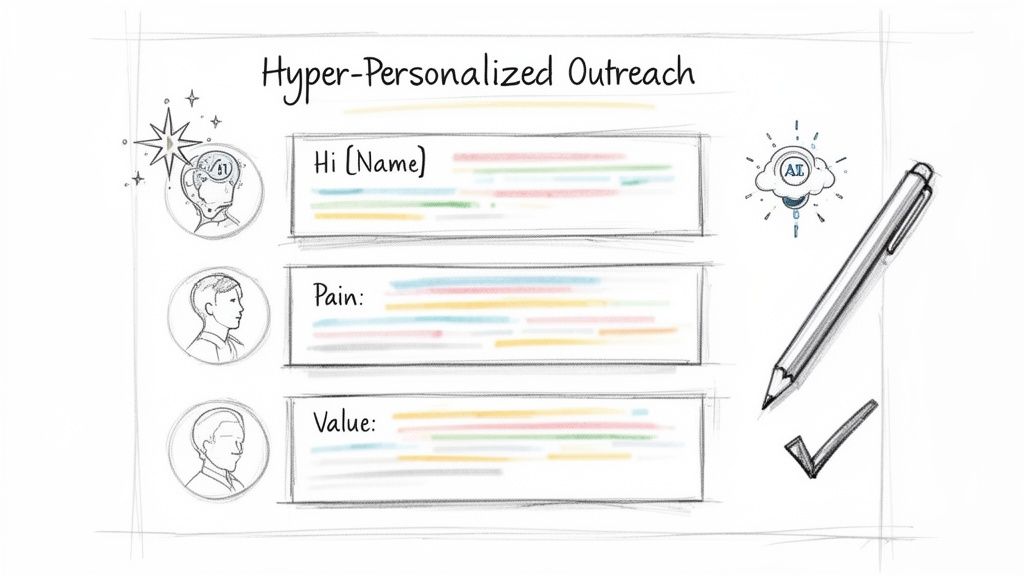
The secret is to pull real-time data from your CRM and other sources to make every touchpoint relevant.
Use Data Points to Create Conversation Starters
To get high-quality output, you must provide high-quality input. This means connecting your AI tools to your CRM and other data sources. This gives the AI the context it needs.
Effective AI-powered outreach uses specific triggers like these:
LinkedIn activity: Did they recently post about a team challenge?
Company news: Was their company in the news for a product launch?
Job description language: What are their stated responsibilities?
CRM insights: Did they download a whitepaper or attend a webinar?
When you feed these details into an AI tool, you move beyond basic [First Name] personalization. You can generate an opening line that shows you have done your research.
The goal of using AI for sales prospecting is not to trick someone. It is to give a human the insights to start a meaningful conversation faster. The AI handles the research and drafting, so the rep can provide the final human touch.
A Practical Template for AI Prompts
How you ask the AI to write is as important as the data you give it. Vague prompts lead to generic messages. A well-crafted prompt produces authentic content in your brand's voice.
Here is a practical prompt template for a personalized cold email:
Prompt Template: Personalized Email
Act as a B2B sales development representative for Samskit. Your goal is to book a 15-minute discovery call.
Draft a short, concise, and conversational email to [Prospect Name], the [Prospect Title] at [Company Name].
Context to use for personalization:
Prospect recently posted on LinkedIn about the challenge of maintaining accurate CRM data with a growing remote sales team.
[Company Name] just announced a new enterprise sales division.
Email Structure:
Opener: Reference their LinkedIn post about CRM data challenges.
Problem: Briefly connect their challenge to the difficulty of scaling a new enterprise division.
Solution: Introduce Samskit as a way to automate CRM updates from sales calls, ensuring data is always accurate.
Call to Action: Ask for a 15-minute call next week to show them how it works.
Tone: Keep the tone helpful, not pushy. Avoid marketing jargon.
This structured prompt gives the AI clear guardrails. It produces a relevant and compelling message. The SDR then reviews it, makes minor tweaks, and hits send. This process takes a fraction of the time of writing from scratch.
This workflow has a significant impact. In some markets, generative AI is boosting email response rates by as much as 35%. Some SDRs have cut their prospecting time from 60% of their week to under 30%, freeing them up to sell. You can find more findings on Brazil's generative AI market for more detail.
Connecting Prospecting to the Full Sales Cycle
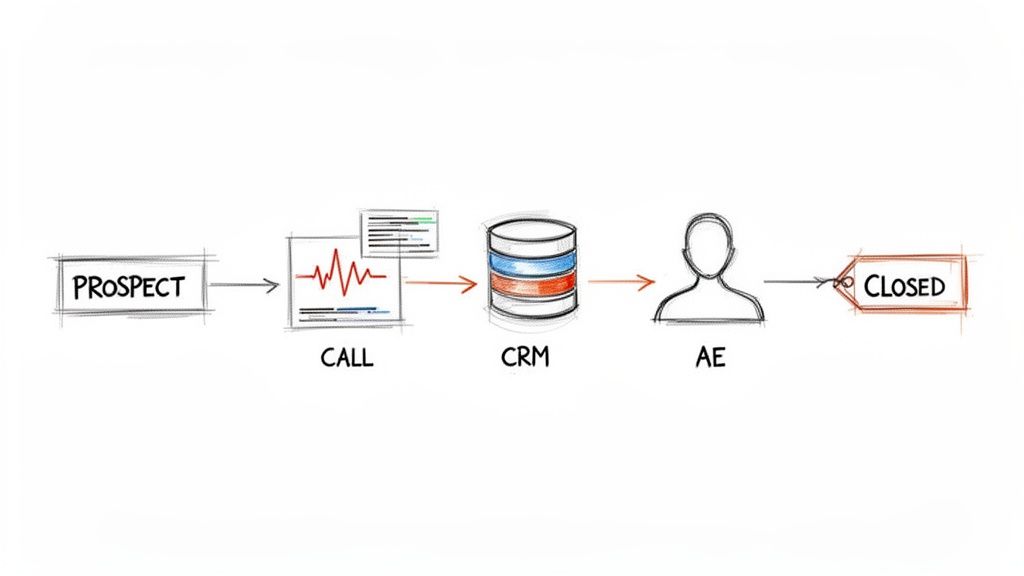
Finding a good prospect is just the start. The intelligence your AI tools uncover must not disappear during the handoff from an SDR to an Account Executive (AE). A clunky handover kills momentum.
From the prospect's view, an AE asking the same questions the SDR just asked erodes trust. It shows your internal processes are disorganized and wastes their time. This can undo all the hard work from the initial outreach.
Capture Intelligence from Every Conversation
Many sales teams now use AI-powered conversation intelligence tools. Platforms like Samskit automatically join, record, transcribe, and analyze sales calls. They create a searchable record of every interaction.
This frees reps from taking notes so they can focus on listening and building rapport. It also ensures no critical details are lost. The AI understands the context of the conversation.
It can pinpoint key moments, such as:
Buyer Intent Signals: When a prospect mentions their budget, timeline, or decision-makers.
Objections and Concerns: Highlighting roadblocks the AE needs to address.
Commitments and Next Steps: Flagging action items so everyone is aligned.
By extracting these insights automatically, the team gets a clear view of a deal's health without listening to the full recording.
The goal is to build a single source of truth for every deal inside your CRM. When conversation intelligence syncs to the account record, you create a living history that benefits the entire revenue team.
This process turns unstructured conversation data into actionable intelligence. For sales leaders, it enables more accurate forecasting based on evidence from calls, not just a rep’s intuition.
From Handoffs to Holistic Account Management
A smooth SDR-to-AE handoff is just the beginning. This centralized intelligence empowers the entire team. After a deal closes, the customer success team can access the full history of the sales journey.
They can see the customer's original pain points and the promises made during the sales cycle. This context is critical for successful onboarding and reduces early churn. Teams using this method are also quicker to spot expansion opportunities because they deeply understand the customer's goals. This detailed approach works well with structured frameworks like the MEDDIC sales methodology in our guide.
The Modern Sales Tech Stack
Integration is key to making this work. A modern AI for sales prospecting workflow extends through the entire customer lifecycle. Here is a breakdown of the essential AI tools for a high-performance sales stack.
Essential AI Tools for the Modern Sales Stack
Tool Category | Primary Function | Example Platforms |
|---|---|---|
Lead Identification & Scoring | Finds and prioritizes prospects based on real-time buying signals and ICP fit. | |
Generative AI for Outreach | Crafts personalized emails and social messages at scale to boost engagement. | |
Conversation Intelligence | Records, transcribes, and analyzes sales calls to extract key deal insights. | |
CRM Data Automation | Automatically updates CRM fields with context from calls, saving admin time. | Samskit, Dooly, Scratchpad |
When you connect these systems, you create a feedback loop. Insights from sales calls can refine your ideal customer profile. This makes your prospecting efforts smarter over time. This cycle of continuous improvement helps top sales organizations succeed.
Measuring Success and Driving Team Adoption
Implementing AI tools is only the first step. You must prove their value with data and ensure your team uses them. Investing in AI for sales prospecting requires measuring what matters and getting your reps on board.
Sales reps are often skeptical of new technology. Many have seen "game-changing" tools that only added more administrative work. You must show them these AI tools are different and that they save time for selling.
Identify the KPIs That Actually Matter
Avoid vanity metrics. More calls or emails are meaningless if they do not lead to qualified pipeline. The goal of AI is to generate better opportunities, faster. Focus on KPIs that connect prospecting activity to revenue.
A Checklist of Key Metrics:
Lead-to-Meeting Conversion Rate: This is the best measure of lead quality. If your AI finds better-fit prospects, this number should increase.
Pipeline Velocity: How fast do deals move from the first conversation to a signed contract? AI should help shorten the sales cycle by delivering the right message at the right time.
Customer Acquisition Cost (CAC): By automating research and data entry, your reps become more efficient. Over time, this should lower the cost of acquiring each new customer.
Rep Activity Breakdown: Measure how your team spends its time. A successful AI implementation will show a clear shift from research to meaningful conversations.
The most effective way to convince your team is to show them how the technology gives them their time back. When you can connect the tool directly to a lighter administrative load, even skeptics will listen.
A Practical 4-Step Rollout Plan
Do not just drop new software on your team. A gradual, supportive rollout is the best way to ensure adoption.
Start with a Pilot Group: Select a small group of tech-savvy reps to test the tools first. This allows you to fix issues and gather early success stories.
Focus on "What's in It for Me?": Frame all training around how the tool makes their job easier and helps them hit their targets. Show them how a 30-minute research task becomes a 30-second AI summary.
Provide Hands-On Training: Conduct practical training sessions where reps use the tools with their own accounts. Provide short video tutorials and one-page cheat sheets for support.
Create a Feedback Loop: Schedule regular check-ins to ask what is working and what is not. Acting on their feedback shows you are a partner in their success, not just pushing a tool.
Overcoming Resistance and Fostering Adoption
Some reps will worry that AI is meant to replace them or micromanage their work. Address these concerns directly.
Be transparent. Explain that the goal is to augment their skills, not automate their job. AI for sales prospecting handles the repetitive tasks that cause burnout. This frees them for strategic thinking and relationship-building. When you build a culture that values efficiency, skepticism will turn into enthusiasm.
Frequently Asked Questions About AI Prospecting
Introducing new technology always brings up questions. This is a good sign. It means your team is thinking critically about how it will work in their daily routine. Sales leaders and reps want to understand the real-world impact.
Here are straight, practical answers to common questions about using AI for sales prospecting.
Will AI replace my sales development team?
No. AI will not replace your Sales Development Representatives (SDRs). It will make them more effective. AI's real value is in automating the repetitive parts of the job.
Consider the tasks that cause burnout:
Manually building lead lists for hours.
Searching through multiple sources for one piece of personalization data.
Writing the same introductory email from scratch repeatedly.
AI handles these tasks. This frees up your reps to build rapport, handle objections, and think strategically about accounts.
Think of AI as the ultimate sales assistant. It clears away busywork. It turns the SDR from a data miner into a strategic communicator with the right context for every conversation.
Your reps will spend more time in meaningful conversations with qualified prospects. This is a better use of their skills and leads to higher job satisfaction.
How do I choose the right AI prospecting tools?
The market has many options, which can be overwhelming. Focus on solving your biggest prospecting problem first.
Is it lead quality? The difficulty of personalizing outreach at scale? Or messy CRM data? Identify your number one pain point and start there.
A 4-Step Checklist for Evaluating Tools:
Prioritize integration: Your first filter should be tools that connect with your CRM. A tool that creates data silos or requires manual data entry adds work, it doesn't reduce it.
Solve one problem at a time: If your messaging is generic, look at generative AI tools. If your targeting is poor, focus on lead intelligence platforms.
Check the user experience: If a tool is difficult to use, your team will not adopt it. Look for a clean interface and good customer support.
Run a pilot program: Test a tool with a small group of reps before a company-wide rollout. This lets you measure its impact and gather feedback without a large upfront investment.
By focusing on the problem first, you will choose technology that delivers results.
What are the biggest risks of using AI in prospecting?
AI is a powerful tool, but it has risks. Be aware of them so you can use it responsibly. The main challenges fall into three categories.
First is data privacy. Ensure any tool you use complies with regulations like GDPR. Vet your vendors on how they source and handle data. Protecting your prospects' privacy is as important as protecting your company's reputation.
The second risk is over-automation. Relying on AI without human oversight is a mistake. It leads to robotic messages that can damage your brand. The best practice is to have a human review and edit all AI-generated content. The AI provides the first draft; the rep adds the final, human touch.
Finally, you risk losing your brand voice. To avoid this, "train" your AI. Provide it with examples of your best emails, case studies, and brand guidelines. This helps the AI learn your unique style, ensuring the content it produces sounds authentic.
The goal is to use AI for efficiency while maintaining the human connection that builds trust and closes deals.
Ready to eliminate manual CRM updates and give your team more time to sell? Samskit turns every sales call into actionable insights and reliable data, right where you need it. Discover how much time you can save.