A unified marketing and sales strategy is a practical plan to get both teams working together. The plan defines a good lead, how to talk to them, and how to work together to hit revenue targets.
When marketing and sales align, friction disappears. This creates a smooth journey for your customers, from their first interaction to the final contract.
Why You Need a Unified Marketing and Sales Strategy
Marketing and sales teams often work in silos. Marketing generates leads, but sales says they are low quality. Sales asks for better prospects, but marketing feels its work is ignored.
This disconnect costs money, burns out your team, and creates a poor customer experience. A unified strategy fixes this by building a single, cohesive revenue engine. Every touchpoint, from the first blog post a prospect reads to the final demo, becomes part of a synchronized and measurable process.
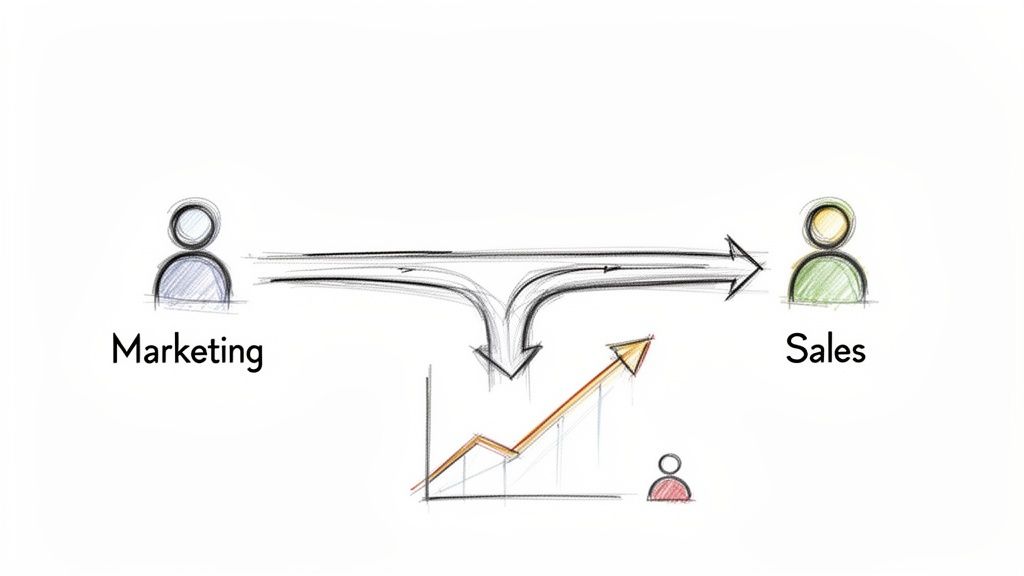
The Results of Alignment
When your teams share the same goals, the business wins. The results include:
A Healthier Pipeline: You get higher-quality leads, which leads to better conversion rates.
Faster Deals: The sales cycle gets shorter because prospects are already educated.
Higher Customer Lifetime Value: A seamless buying experience builds trust and sets the stage for a long-term relationship.
Getting this right is crucial in a crowded market. For example, Brazil's e-commerce sector hit US$274.5 billion in 2023, a 27% increase from the previous year. In such a competitive environment, a disjointed strategy will fall behind competitors who offer a better customer experience.
A unified strategy turns random marketing and sales activities into a predictable system for growth. It replaces blame with shared data and mutual accountability. This ensures every effort focuses on attracting and closing the right customers.
Building Your Cohesive Revenue Engine
This guide provides a roadmap to build that system. We will walk through defining your ideal customer, setting up your process, and putting your strategy into action. We'll show you how tools like Samskit can capture customer intelligence from every conversation.
We will also cover how to sync your inbound vs outbound marketing for maximum impact. By the end, you will have a clear, actionable plan to align your teams and drive predictable growth.
Laying the Groundwork for Your Strategy
A unified strategy starts with a shared definition of the customer. Without it, marketing may target one type of lead while sales pursues another. This wastes budget and creates frustration. To fix this, you need a single source of truth that guides both teams.
This foundation relies on two documents: the Ideal Customer Profile (ICP) and Buyer Personas. The ICP defines the perfect company to sell to. Buyer personas describe the people within that company you need to persuade.
Start with the Ideal Customer Profile (ICP)
Your ICP describes the type of company that gets the most value from your product. This is not a vague wish list. It is a specific, data-driven definition. It focuses your efforts on companies you are built to serve.
Creating a solid ICP requires specific details about the organizations you target. The goal is to build a filter. Marketing uses this filter for campaigns. Sales uses it to qualify prospects.
An Ideal Customer Profile is a strategic decision about who you don’t sell to. This focus stops your team from wasting time on poor-fit deals that will churn. It frees them up to pursue high-potential accounts.
To build your ICP, have your marketing and sales leads define these core attributes:
Firmographics: Company size (by employee count or revenue), industry, and location.
Technographics: Current technology stack. Are they using a specific CRM like Salesforce or a marketing platform like HubSpot?
Business Triggers: Recent changes, such as a hiring spree, new funding, or a merger.
Pain Points: The operational or financial problems your product solves for these companies.
From ICP to Actionable Buyer Personas
Once you define the ideal company, you need to understand the people who work there. This is where buyer personas help. A persona is a realistic representation of a decision-maker or influencer in your target accounts.
The ICP focuses on the organization; the persona focuses on the human. It helps marketing write relevant copy and gives sales context for personalized outreach. You should create a persona for each key player, such as the User, the Manager, and the Executive.
A useful buyer persona includes details like:
Role and Responsibilities: Their job title and what defines success for them.
Goals and Motivations: What they are trying to achieve professionally.
Challenges and Frustrations: The problems your product can solve in their daily work.
Watering Holes: Where they find information, such as industry blogs, conferences, or online communities.
Ideal Customer Profile (ICP) vs. Buyer Persona
The ICP tells you where to look for business. The Buyer Persona tells you how to talk to the people you find there.
Attribute | Ideal Customer Profile (ICP) | Buyer Persona |
|---|---|---|
Focus | The Company/Organisation | The Individual Person |
Scope | Macro-level view of the entire account | Micro-level view of a key stakeholder |
Data Points | Firmographics (industry, revenue, size), Technographics (tech stack), Business Triggers (funding) | Demographics (age, role), Goals, Challenges, Motivations, Watering Holes |
Purpose | To identify and qualify the right accounts to target | To craft resonant messaging and personalise outreach for the right people |
Example | A UK-based SaaS company with 200-500 employees and £50M+ in annual revenue, using Salesforce and AWS. | "Marketing Mary," a 35-year-old Head of Demand Gen, motivated by hitting MQL targets and proving ROI. |
Defining your ICP and personas creates a documented agreement between marketing and sales. Marketing knows which companies to attract and what message to use. Sales gets a clear framework for identifying and engaging the best opportunities. This shared understanding is the most important first step.
Building Your Sales And Marketing Alignment Framework
True alignment requires more than just good teamwork. It needs clear, documented agreements. A solid marketing and sales strategy requires a framework that defines who does what, and when. This framework is called a Service Level Agreement (SLA).
An SLA is the official rulebook for your revenue teams. It removes guesswork and prevents blame when leads get lost. It creates a shared language and a set of commitments for both marketing and sales.
Defining Your Core SLA Components
A strong SLA begins with clear definitions. You must define the Marketing Qualified Lead (MQL) and the Sales Qualified Lead (SQL). Without a shared understanding of these terms, your entire funnel is weak.
Marketing Qualified Lead (MQL): A lead that marketing identifies as interested and a good fit. This definition should be tied to specific actions, like requesting a demo or downloading a pricing guide.
Sales Qualified Lead (SQL): An MQL that the sales team has reviewed and confirmed as a high-potential opportunity. The criteria are often based on BANT (Budget, Authority, Need, Timeline).
With these definitions, you can set up a lead scoring system. You assign points to leads based on their profile and actions. When a lead's score reaches a set threshold, for example 100 points, it becomes an MQL and is passed to sales.
An SLA is your operational blueprint for accountability. It makes the handoff process transparent and measurable. Marketing is accountable for lead quality, and sales is accountable for prompt follow-up. This is the foundation for a predictable revenue engine.
This process starts with your ideal customer profile and buyer personas. The chart below shows how to move from identifying a target company to understanding the individual buyer.
As you can see, the process narrows the focus from broad company traits to the motivations of an individual. This insight informs every part of your SLA.
Mapping The Handoff Process
Once you lock in your definitions, you need to map the lead handoff workflow. This part of the SLA focuses on speed and clarity. It must answer two questions: When does a lead go to sales? And what happens next?
Your handoff protocol should include these steps:
The Trigger: A lead reaches the MQL score threshold. It is automatically assigned to a sales rep in your CRM.
The Timeline: Sales commits to following up with every MQL within a strict timeframe, such as 24 hours. This must be non-negotiable.
The Action: The SLA must specify what "follow-up" means. It could be a personalized email, a phone call, or a LinkedIn message.
The Disposition: The sales rep must update the lead's status in the CRM. They either accept it as an SQL or reject it with a clear reason (e.g., "no budget," "wrong contact").
This disciplined process, supported by clean CRM data, improves your bottom line. It ensures no lead is left behind, creating a smoother customer journey and a more predictable pipeline.
For more technical details on managing these processes, read our guide on how CRM helps inside sales.
Creating Your Core Marketing and Sales Playbooks
A strategy needs to be put into practice. Playbooks bridge the gap between your goals and the daily actions of your teams. Think of them as a coach's game plan, providing a framework for consistent execution.
A playbook is your recipe for success. It outlines the steps, messages, and tools for various situations. This ensures every prospect receives a high-quality, predictable experience. Standardization is essential for scaling your revenue engine.
The Marketing Content Playbook
A marketing playbook delivers the right content to the right person at the right time. It maps your assets—blog posts, ebooks, webinars—to specific stages of the buyer's journey. This focuses your team on creating content that moves a prospect from awareness to a sales conversation.
Here is a sample content-to-journey map:
Awareness Stage: Prospects are identifying a problem. Your content should be educational and helpful.
Assets: Blog posts on industry challenges, webinars, or research reports.
Consideration Stage: Prospects are researching solutions. Introduce your approach and explain how you are different.
Assets: In-depth ebooks, solution comparison guides, or case studies with tangible results.
Decision Stage: Prospects are ready to choose. Your content should build trust and remove hesitation.
Assets: Customer testimonials, a free trial or live demo, and clear pricing pages.
A great marketing playbook ensures that when a lead gets to sales, they are educated and engaged. Sales receives a prospect who already understands your value.
The Sales Engagement Playbook
Once marketing hands over a lead, the sales playbook begins. This toolkit guides reps through every conversation, from the first email to the final negotiation. It removes guesswork, freeing them to build relationships and close deals.
A solid sales playbook must include these components:
1. Email Templates For Common Scenarios
Provide proven templates for key moments so reps don't have to write every email from scratch. Examples include:
The initial follow-up after a lead downloads an ebook.
A nudge to re-engage a quiet prospect.
The post-demo summary that reinforces value.
2. Discovery Call Scripts And Question Checklists
A good discovery call is about listening, not pitching. Provide a framework of questions to uncover a prospect's pain points, buying criteria, and timeline. This ensures every rep qualifies leads consistently against your ICP.
3. Objection Handling Checklist
Salespeople hear the same objections about price, timing, and competitors every day. Document the best, field-tested responses to these challenges. This builds confidence and helps your team handle difficult conversations.
Linking Your Playbooks For Seamless Execution
The best results happen when your marketing and sales playbooks are connected. The handoff should feel like a continuous journey for the customer. Your CRM and automation tools are essential here.
Here’s how it works:
Marketing Trigger: A prospect matching your ICP downloads your "Solution Comparison Guide" (a Consideration Stage asset).
Automated Action: Your CRM increases their lead score, making them an MQL. The system assigns the lead to a sales rep.
Sales Playbook Activated: The rep gets a notification. They use the "Post-Ebook Download" email template and reach out within 24 hours, per the SLA.
Consistent Experience: The email is relevant and personal. It references the guide the prospect just read, bridging the gap between marketing and sales.
By creating and connecting these playbooks, you standardize your best practices. You build a system that ensures every lead gets the right attention and every team member knows the next step. This turns your strategy into a predictable growth machine.
5. Measuring What Matters With The Right KPIs
You cannot improve what you do not measure. A unified marketing and sales strategy requires tracking the right numbers to see if it is working. Focus on Key Performance Indicators (KPIs) that directly impact revenue.
Group your KPIs into three categories: marketing-owned, sales-owned, and shared goals. This structure builds accountability and provides a complete view of your revenue engine's health.
Core Marketing KPIs
Marketing’s goal is to provide sales with a steady flow of high-quality leads at a reasonable cost. These two metrics show if they are on track.
Marketing Qualified Lead (MQL) Volume: The number of leads that meet the criteria defined in your SLA. This shows if your top-of-funnel efforts are attracting the right people.
Cost Per Acquisition (CPA): How much you spend to get each new customer. The formula is CPA = Total Marketing Spend ÷ Number of New Customers. A rising CPA can indicate inefficient campaigns or poor targeting.
Essential Sales KPIs
Once a lead is passed to sales, success depends on speed and efficiency. These KPIs measure how well your sales team turns leads into opportunities and customers.
SQL-to-Opportunity Rate: The percentage of Sales Qualified Leads that become active deals in your pipeline. A low rate suggests a disconnect between marketing and sales on what defines a "good lead."
Sales Cycle Length: The average time from first contact to a signed contract. A lengthening sales cycle may point to friction in your sales process.
A well-defined set of KPIs creates a shared language for your revenue teams. When marketing and sales review the same dashboard, conversations shift from blame to problem-solving. This shared data is the foundation of a successful marketing and sales strategy.
Shared Revenue KPIs
These KPIs are the ultimate measure of success because they tie directly to revenue. Hitting them requires both teams to work in sync.
Customer Lifetime Value (CLV): The total revenue you expect from a customer over their entire relationship with you. Calculated as CLV = (Average Purchase Value) x (Average Purchase Frequency) x (Average Customer Lifespan), it helps determine how much you can spend to acquire a new customer.
Pipeline Velocity: This measures how quickly deals move through your pipeline and become revenue. A high velocity indicates your entire revenue engine is running smoothly.
Essential Revenue Team KPIs
Here is an overview of the essential KPIs every revenue team should monitor.
Category | KPI (Key Performance Indicator) | What It Measures |
|---|---|---|
Marketing | Marketing Qualified Leads (MQLs) | The number of leads ready for sales engagement. |
Marketing | Cost Per Acquisition (CPA) | The total cost to acquire one new customer. |
Sales | SQL-to-Opportunity Rate | The percentage of sales leads that become pipeline deals. |
Sales | Sales Cycle Length | The average time it takes to close a deal. |
Shared | Customer Lifetime Value (CLV) | The total predicted revenue from a single customer. |
Shared | Pipeline Velocity | The speed at which deals move through the sales funnel. |
Tracking these metrics is an ongoing discipline. It provides the clarity to see what works, what doesn't, and where to adjust your strategy for continued growth.
Rigorous measurement is vital in fast-moving markets. In Brazil, the digital advertising market is worth around USD 14.2 billion. With 78% of Brazilian companies using content marketing, you need a strategy built on measurable business outcomes. You can discover more insights about the Brazilian market's influence on strategy.
How To Weave Your Strategy into Your Daily Operations with Tech
A great strategy is useless until you put it into practice. Technology turns your strategic goals into consistent, daily execution. It makes your plan a part of your team's workflow.
This approach makes your Service Level Agreement (SLA) a living part of your operations. Your tech stack, including your CRM and conversation intelligence tools, should enforce your plan automatically.
Set Up Your CRM to Run on Autopilot
Your CRM, like Salesforce or HubSpot, is the command center for your strategy. The first step is to configure it to enforce the rules from your SLA.
Build automated workflows to handle the MQL-to-SQL handoff. When a lead's score hits the MQL threshold, the CRM should instantly assign it to the correct sales rep. This process eliminates delays and prevents leads from falling through the cracks.
The CRM also acts as an accountability partner. Set up timers that track follow-up times. The system can flag any MQL that has not been contacted within the agreed-upon window, such as 24 hours. This gives leaders a real-time view of SLA compliance without manual follow-up. To learn more about analyzing this data, read our guide on forecasting with Power BI.
Automatically Capture What’s Really Happening in Deals
Your CRM manages the workflow, but you need other tools to capture details from customer conversations. Conversation intelligence platforms like Samskit provide the "why" behind your CRM data.
A meeting capture tool eliminates the need for reps to fill out endless fields and write call summaries. Manual data entry is often incomplete or inaccurate. Instead, technology can capture crucial deal context, freeing up sellers to focus on selling.
By automating the capture of conversation data, you create a single source of truth for every deal. This ends disagreements and ensures everyone has the full story.
The process is simple but powerful. An automated assistant, like the one from Samskit, joins your sales calls on Zoom or Google Meet. It records and transcribes the entire conversation. This turns raw talk into structured data that powers your revenue engine.
Turn Raw Conversations into Actionable CRM Data
After a call is transcribed, AI analyzes the conversation to identify important moments. It extracts specific information that can influence a deal. This makes your strategy measurable down to the individual conversation.
The system automatically identifies details like:
Buyer Intent Signals: Direct quotes showing the prospect has a problem you can solve.
Key Objections: The main concerns the buyer raised.
Action Items: The next steps agreed upon by the seller and buyer.
Competitor Mentions: Any time a competitor's name is mentioned.
This structured information is then used to automatically update the correct fields in your CRM. For example, if the AI detects an objection, it can update the "Deal Risks" field in Salesforce. If it identifies next steps, it can create a new task for the rep with a due date.
This automation transforms your CRM from a simple database into an intelligent system. It ensures your marketing and sales strategy is a living process, constantly refined with unfiltered intelligence from your customers.
Frequently Asked Questions
A well-planned marketing and sales strategy can still face challenges. Answering common questions helps your teams avoid problems and gain buy-in. Here are direct answers to frequent issues.
How Can We Get Sales And Marketing Leadership To Agree On One Strategy?
Start with shared data, not competing opinions. Present an unbiased view of your current funnel. Identify points of friction, like a high volume of MQLs that do not convert to SQLs, and connect that friction to lost revenue.
Frame the conversation around a shared goal, such as shortening the sales cycle or lowering customer acquisition costs. This shifts the focus from "us vs. them" to collaborative problem-solving.
Propose a small pilot project instead of a complete overhaul. For example, run a joint campaign targeting one customer segment with a shared SLA for one quarter. Measure the results.
A successful pilot is your most powerful argument. A tangible win, even a small one, builds trust and overcomes skepticism more effectively than any presentation.
What Is The Biggest Mistake Companies Make When Creating This Strategy?
The biggest mistake is creating a strategy and then not using it. A plan is useless if it is not integrated into the daily workflows and tools your teams use. Many companies define their ICP and SLAs, but the document gets forgotten in a shared drive.
To make a strategy effective, you must operationalize it:
Set up your CRM: Configure it to reflect your SLA by automatically routing leads and tracking follow-up times.
Create practical playbooks: Build useful guides for sales and marketing teams.
Enforce the rules: Use tools to monitor and automate the agreed-upon rules of engagement.
Without these practical steps, teams will revert to old habits, and the strategy will fail.
How Often Should We Review And Update Our Strategy?
Your strategy should be a living document. Plan a major review once or twice a year to ensure it still aligns with your company's goals. This is the time to re-evaluate your ICP and make significant changes.
However, do not wait a year to check in. Hold monthly or quarterly meetings between sales and marketing leaders to review core KPIs. Monitor metrics like the MQL-to-SQL conversion rate and sales cycle length. If these numbers decline, revisit your strategy immediately.
We Have A Small Team—Where Should We Start?
For a small team, focus is key. The most important first step is to have marketing and sales jointly define your Ideal Customer Profile (ICP) and what constitutes a Sales Qualified Lead (SQL).
This single exercise forces both teams to agree on who you are selling to and what a "ready-to-buy" prospect looks like. It builds the foundation for everything else and has an immediate impact on lead quality and sales efficiency, even before you add complex processes or new technology.
Samskit is a sales assistant that turns customer meetings into reliable CRM updates and clear next steps, ensuring your strategy is powered by real-world customer intelligence. Learn how Samskit can automate your data capture and keep your teams aligned.