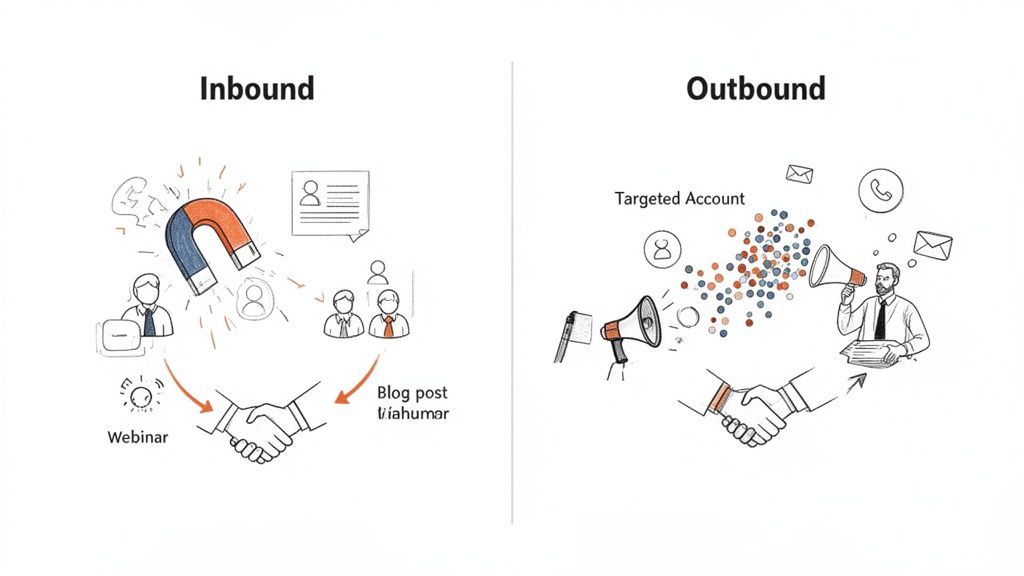
The difference between inbound and outbound sales comes down to direction. Inbound attracts customers with useful content. Outbound pushes your message out to find them. The right choice depends on a simple question: Do you want to attract prospects who are already looking for a solution, or do you need to go find specific accounts yourself?
Inbound vs Outbound: A Quick Comparison For B2B
Choosing between an inbound or outbound strategy is a major decision for any B2B sales team. There is no single correct answer. The best approach depends on your business goals, target customer, and revenue timeline.
The inbound model focuses on creating helpful resources that solve problems for your ideal customers. You earn their attention instead of buying it.
Practical Content: The foundation is useful information. Think of blog posts, step-by-step guides, and webinars that address your audience's challenges.
Search Engine Optimisation (SEO): You optimize your content so people find you when they search for solutions on Google.
Permission-Based: Leads come to you because they are already looking for answers. This makes them more open to a conversation when you connect.
Outbound sales is about proactive, direct outreach. Instead of waiting for prospects to find you, your team starts the conversation.
The core principle of outbound is control. You define the target audience and the message. This gives you direct influence over who enters your pipeline.
This approach is often the faster way to start conversations. It is useful for targeting high-value accounts or entering a new market where your brand is unknown. While inbound builds a long-term asset that generates leads over time, outbound delivers more immediate results through direct action.
Core Differences In Inbound And Outbound Strategies
This table provides a high-level summary to help you see which model fits your current needs.
Attribute | Inbound Sales | Outbound Sales |
|---|---|---|
Methodology | Attracts prospects with helpful content (blogs, SEO) and guides them through their journey. | Actively pursues prospects through direct outreach like cold calls and emails. |
Customer Intent | High. Prospects actively research a solution and find your business. | Low to none. Prospects are typically unaware of your solution before you contact them. |
Sales Cycle | Often longer. It requires building trust and authority before a sales conversation begins. | Can be shorter. It directly initiates sales conversations with decision-makers. |
Cost Structure | Upfront investment in content and technology, with a lower long-term cost per lead. | Ongoing investment in sales talent, outreach tools, and data lists. |
The two strategies are nearly mirror images. Inbound is a long-term play based on attraction. Outbound is a short-term, direct-action strategy.
A Look at the Core Sales Workflows
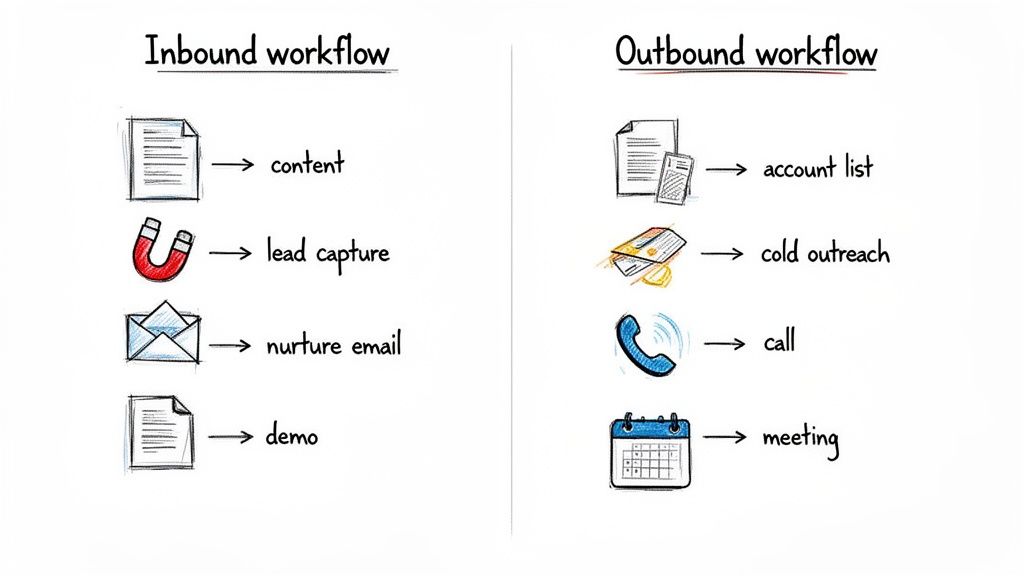
The daily routines, tech stack, and team responsibilities for inbound and outbound differ greatly. They shape your entire go-to-market motion. Let's map out the practical, step-by-step processes for each strategy.
An inbound workflow is a system built to attract, engage, and convert prospects organically. It's a long-term play, like building a magnet to pull in ideal customers and guide them from curiosity to a sales-ready state without aggressive interruption.
An outbound workflow is all about proactive, direct engagement. Your team initiates conversations with a hand-picked list of accounts. It is a process built around control, precision, and repeatable action.
The Inbound Sales Workflow in Action
The inbound journey starts long before a lead speaks to a salesperson. It is a multi-stage process where marketing and sales must work together.
Content Creation and Distribution: First, create genuinely valuable content. This can be blog posts optimized for search engines, in-depth whitepapers, or practical webinars that solve a real problem for your audience. For example, a SaaS company targeting project managers might write an article titled "5 Steps to Reduce Scope Creep in Agile Projects."
Lead Capture: Once someone visits your site, the goal is to turn that anonymous visitor into a known lead. This usually happens through a form on a landing page. You offer a piece of gated content, like an e-book, in exchange for their contact details.
Lead Nurturing and Scoring: A new lead is rarely ready to buy. Marketing automation systems nurture them with targeted email sequences. These emails share more relevant content based on the lead's behavior. A lead scoring system adds points for actions like opening an email or visiting the pricing page.
Marketing to Sales Handoff: When a lead's score reaches a set number, they become a Marketing Qualified Lead (MQL). At this point, they are passed to a sales development representative (SDR) for qualification.
Sales Qualification and Conversion: The SDR contacts the MQL to confirm they are a good fit and have a genuine interest. If everything checks out, the lead becomes a sales opportunity. It is then handed to an Account Executive who runs the demo and closes the deal.
The Outbound Sales Workflow Step-by-Step
The outbound process is more direct and sales-led. It focuses on starting conversations with specific, high-value targets.
An outbound workflow trades the broad appeal of inbound for the precision of targeting. Success depends on the quality of your list, the relevance of your message, and the discipline of your follow-up.
Here is a typical operational checklist:
Build the Target List: First, define your Ideal Customer Profile (ICP). Sales teams then use data providers and tools like LinkedIn Sales Navigator to build targeted lists of companies and key decision-makers.
Craft the Outreach Sequence: Next, SDRs map out a multi-touch sequence of emails, calls, and social media interactions. Each message should be personalized to the prospect’s role, industry, and likely challenges. For example: "Hi [Name], saw your post on LinkedIn about scaling your engineering team. Our platform helps VPs of Engineering at companies like [Competitor] cut onboarding time by 30%."
Execute the Outreach: SDRs use a sales engagement platform to launch their sequences. The software automates email sends and creates a daily task list for manual activities like cold calls and LinkedIn connection requests.
Handle Responses and Book Meetings: The main goal is to get a positive response and book a discovery call. SDRs handle objections, answer questions, and get meetings on the calendar for the Account Executives.
Conduct the Meeting and Close: Once a meeting is booked, the Account Executive takes over. They run the discovery call, deliver the demo, and manage the deal through the pipeline to close.
Costs, KPIs, and Time to Value: A Head-to-Head Comparison
When weighing inbound versus outbound, you are also choosing a financial model. Each approach has its own cost structure, timeline to return, and key metrics for success. Understanding these economic realities is critical before you commit your budget.
Inbound is about building assets, like investing in property. You have a significant upfront spend on creating quality content and optimizing your website. These assets, such as a well-ranking blog post, will continue to provide value long after you have paid for them.
Outbound is more like renting. The costs are ongoing and tied directly to activity. You pay for the people, tools, and data needed to start conversations daily. When you stop paying, the outreach stops.
How The Investment Breaks Down
Inbound demands patience and investment in foundational work. Outbound requires a consistent operational spend to keep the engine running.
What You're Paying for with Inbound:
Content Creation: This includes high-quality articles, videos, and whitepapers that solve problems for your audience. This requires skilled writers, designers, and strategists.
The Tech Stack: You need the right tools. A marketing automation platform like HubSpot, a CRM, and SEO software are essential.
Specialized Talent: You need people with expertise in SEO and content marketing.
What You're Paying for with Outbound:
Sales Talent: Your largest cost will likely be salaries and commissions for your Sales Development Representatives (SDRs). They drive your outreach.
Data and Tools: Your SDRs need access to reliable contact databases (e.g., ZoomInfo), sales engagement platforms, and dialers.
Paid Channels: If you use LinkedIn ads or sponsor events, this becomes a direct and ongoing budget item.
Time to Value: The Slow Burn vs. The Quick Win
The time it takes to see a return on investment is a major factor when choosing between inbound and outbound. It depends on whether you need revenue now or are building for the long term.
Inbound ROI is a slow process that gathers momentum. It can take six to twelve months or more before your content and SEO efforts generate a steady stream of good leads. But once the flywheel starts spinning, the returns compound. A single blog post can bring in leads for years.
Inbound marketing is a long-term investment in a lead generation engine. Outbound is a direct expense for immediate pipeline activity. One builds an asset, the other rents attention.
Outbound is built for speed. A targeted cold email sequence or calling campaign can start booking meetings in weeks, not months. This is useful for businesses that need to fill their pipeline fast, test a new market, or pursue a specific list of clients without waiting for them to find you. The catch is that results are directly tied to your continuous effort and spending.
The Key Performance Indicators That Actually Matter
You cannot measure an apple with a ruler meant for oranges. Applying outbound metrics to inbound efforts (or vice versa) will give you a distorted view of your performance. You must track the right Key Performance Indicators (KPIs) for each motion.
This table shows the different metrics for each stage of the funnel.
Metric Type | Inbound KPIs | Outbound KPIs |
|---|---|---|
Top-of-Funnel | Organic Traffic, Keyword Rankings, Content Downloads | Dials Made, Emails Sent, Open Rates |
Mid-Funnel | Marketing Qualified Leads (MQLs), Visitor-to-Lead Conversion Rate | Positive Reply Rate, Meetings Booked |
Bottom-of-Funnel | Cost Per Lead (CPL), Customer Acquisition Cost (CAC) | Pipeline Generated, Sales Cycle Length |
For example, an inbound team would see a 25% increase in organic traffic as a strong sign of future leads. An outbound team is focused on the number of meetings they book each week, as that is their direct contribution to the sales pipeline. Each set of metrics tells a vital, but very different, story.
Choosing The Right Strategy For Your Business
Deciding between an inbound vs outbound approach is about diagnosing your situation and choosing the right tool for the job. The best strategy depends on your product's complexity, your market's maturity, your ideal customers, and how quickly you need revenue. There is no single right answer, only a series of trade-offs.
A common mistake is to see this as a binary choice. The most successful go-to-market strategies combine both. The skill is knowing when to lead with one over the other and how they can support each other to create a more powerful sales engine.
This decision tree illustrates the core choice: the need for immediate pipeline versus the goal of sustainable, long-term growth.
Teams needing fast, predictable results often lean on outbound. Those building a foundational asset for the future invest in inbound.
When To Prioritise An Inbound Strategy
An inbound-first approach works best when your target audience is already actively searching for solutions to problems you can solve. If search demand for your offer already exists, inbound helps you capture it.
Consider leading with inbound if you meet these criteria:
You're in a Defined Niche: Your ideal customers know they have a problem and are using specific keywords in search engines to find answers. This search intent is the fuel for an inbound engine.
Your Product Has a Shorter Sales Cycle: For products that buyers can research and understand on their own, content can do most of the work before a sales conversation is needed.
You're Building a Long-Term Brand: Inbound marketing is an investment in a compounding asset. The articles and guides you create today can generate leads for years, building brand equity.
Your Budget is Limited for Headcount: While inbound requires investment in content and technology, it can be less expensive than hiring and training a large team of outbound SDRs.
An inbound strategy works well when you can align your expertise with existing buyer curiosity. You are not creating demand; you are channeling it.
For instance, a company selling project management software for small creative agencies would benefit from an inbound approach. Their audience searches for "best project tools for designers" or "how to manage client feedback." By creating helpful content on these topics, they attract qualified leads who are already aware of their problem.
When An Outbound Strategy Makes More Sense
An outbound-led strategy is essential when your audience is not looking for you. This might be because you are creating a new category, targeting large enterprise accounts, or entering a market with no brand presence.
An outbound-first model is the logical choice when:
You Target Enterprise Accounts: Large organizations rarely find solutions through a Google search. Reaching the right decision-makers requires precise, proactive outreach, often as part of an account-based marketing (ABM) strategy.
You're Entering a New Market: When no one knows who you are, you cannot wait for them to find you. Outbound allows you to introduce your brand directly to a hand-picked list of ideal prospects.
Your Solution is a "Vitamin," Not a "Painkiller": If your product solves a problem that prospects do not know they have, you need outbound to educate the market and create initial demand.
You Need Predictable Pipeline, Fast: A well-run outbound team can generate a predictable number of meetings each month. This speed is critical for early-stage companies needing to secure their first customers.
Creating A Powerful Hybrid Model
The most sophisticated B2B teams integrate both inbound and outbound. A hybrid model uses the strengths of each strategy to fill the gaps in the other. This creates a system where the whole is greater than the sum of its parts.
Here is a simple workflow for a hybrid approach:
Use Inbound to Identify Engaged Accounts: Your inbound content acts as a signal. When multiple people from a single target account download a whitepaper or attend a webinar, that is a strong buying signal.
Trigger Outbound for Warm Outreach: Instead of letting that lead cool off in a generic email sequence, a workflow can immediately alert an SDR.
Execute a Targeted Outbound Sequence: The SDR can then reach out with a relevant message, directly referencing the content the prospect engaged with. This turns a cold outreach into a warm, contextual conversation and increases the chance of booking a meeting.
Building Your Team and Tech Stack
Deciding between an inbound or outbound strategy shapes your entire operational structure. You must build a team and tech stack designed for the mission. You cannot just add a new strategy; you have to build the infrastructure to support it.
An inbound motion is built to attract an audience. An outbound motion is built to hunt for one. This distinction changes everything, from the skills your people need to the software they use daily.
Assembling Your In-House Team
The roles for inbound and outbound teams are different. They require distinct mindsets and expertise. An inbound team has creators and analysts. An outbound team has prospectors and communicators.
Key Roles for an Inbound Team:
Content Marketer: Creates blog posts, whitepapers, and webinars that attract your audience by addressing their pain points.
SEO Specialist: Handles keyword research and site optimization to ensure your content ranks on Google.
Marketing Automation Manager: Builds lead nurturing workflows, scoring models, and email sequences to guide prospects from visitor to qualified lead.
Key Roles for an Outbound Team:
Sales Development Representative (SDR): Focuses on prospecting, personalizing outreach, and booking meetings for Account Executives. It is a high-activity, results-driven role.
Account Executive (AE): Takes qualified meetings set by SDRs, runs demos, and manages the sales cycle to close deals.
Sales Operations: Manages the tech stack, refines processes, and analyzes performance data to fix bottlenecks in the sales process.
Choosing The Right Technology
Your tech stack powers your sales motion. A central CRM is necessary for both. The specialized tools that connect to it are different. Inbound tech is for attracting and nurturing at scale. Outbound tools are for high-volume, personalized outreach.
Your tech stack should remove friction from your core workflow. For inbound, that means automating lead nurturing. For outbound, it means streamlining prospecting and follow-ups.
Here is a comparison of essential software for each approach.
Technology Category | Inbound Stack Example | Outbound Stack Example |
|---|---|---|
Core Platform | Marketing Automation (e.g., HubSpot) | Sales Engagement (e.g., Outreach) |
Lead Source | SEO Tools (e.g., Ahrefs) | Data Providers (e.g., ZoomInfo) |
Primary System | Customer Relationship Management (CRM) | Customer Relationship Management (CRM) |
Performance Tool | Web Analytics (e.g., Google Analytics) | Conversation Intelligence (e.g., Samskit) |
Your goal is to create a seamless flow of information. For example, a tool that automatically captures meeting notes and syncs them to your CRM can save reps hours of manual data entry, whether they are inbound or outbound.
To see how Samskit can automate this step for your team, you can join the waitlist for early access. This ensures that valuable buyer information is never lost, regardless of how the lead entered your pipeline.
How Samskit Lifts Both Sales Motions
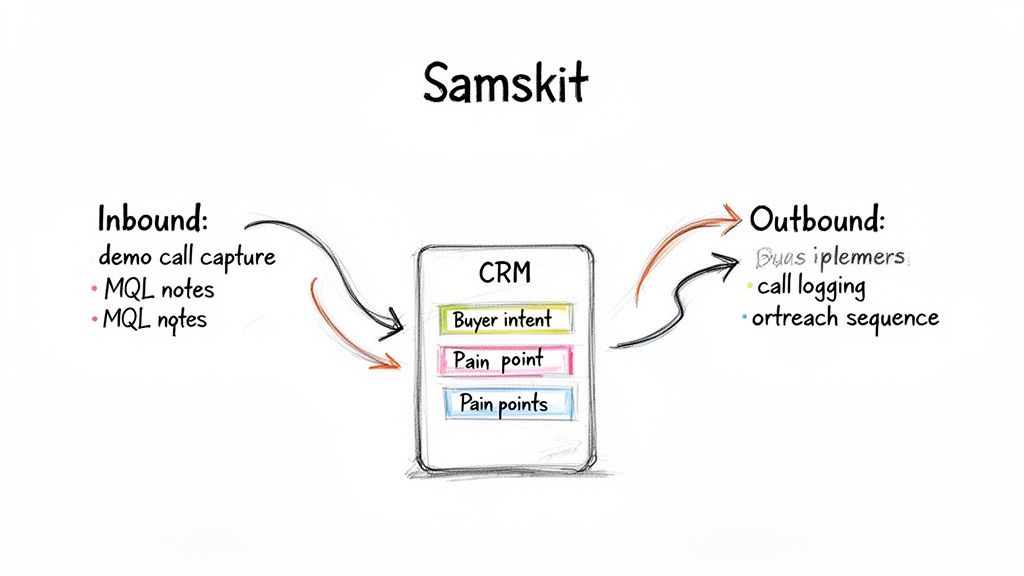
Whether your team uses an inbound or outbound strategy, success depends on one thing: how well you capture, understand, and act on customer information. Even the best strategy will fail if reps are busy with manual data entry instead of selling. Automating administrative tasks can be a game-changer for any sales motion.
The right technology should support your team's workflow, not hinder it. The goal is to get every valuable piece of information from every call—whether a cold discovery call or a warm inbound demo—into your CRM accurately and efficiently. This keeps momentum going and helps your team make smarter decisions.
Supercharging Outbound Sales Workflows
For outbound teams, volume is key. Reps need to move from one call to the next. The constant need to stop and update the CRM after each call creates a major bottleneck. This administrative work takes time away from finding and booking new meetings.
Samskit addresses this by joining sales calls and handling post-call admin automatically.
Automated CRM Updates: After a discovery call, Samskit drafts a concise summary. It flags key prospect details, objections, and agreed next steps. The rep only needs to review and approve it. This eliminates manual note-taking.
More Time for Prospecting: By reducing data entry, which can take up 20% of a rep's day, teams can reinvest that time into high-value work like personalizing outreach and making more calls.
This turns the CRM from a chore into a reliable source of information, kept up to date without slowing down the prospecting engine.
The core value for outbound is efficiency. Automating the least profitable part of the sales process—the admin—directly increases the time reps spend on the most profitable part: selling.
Nailing Inbound Sales Handoffs
For inbound teams, the challenge is different. They deal with marketing-qualified leads (MQLs) who have done their research and have high expectations. The context they provide is valuable but is often lost during the handoff from marketing to sales.
Samskit acts as a safety net to ensure this crucial information is never lost. When an inbound lead books a demo, the tool listens to the conversation, captures the details, and ensures a smooth handoff for a faster sales cycle.
Capturing Buyer Intent: Samskit automatically identifies and logs the specific pain points, goals, and buying signals a prospect mentions during a demo call.
Structuring Deal Context: It organizes these details into a structured update that syncs directly to your CRM. This gives the Account Executive a clear, actionable summary of what matters to the prospect.
This automation ensures that every inbound lead gets a follow-up that speaks directly to their needs, which can improve conversion rates. The structured data also helps leadership see which marketing campaigns are generating the most valuable conversations.
Ultimately, a tool like Samskit bridges the gap. It ensures that whether a lead came in cold or warm, the vital context from their first conversation is captured, saved, and used to move the deal forward.
Frequently Asked Questions
It is normal to have questions when comparing inbound and outbound sales. Here are answers to some of the most common ones that B2B teams ask.
Can A Small Business Really Succeed With Outbound Sales?
Yes. It is a myth that outbound is only for large companies. For a small business, success is about precision, not volume.
Instead of a broad approach, focus on a very specific Ideal Customer Profile (ICP). This lets you create personalized messages that connect with a select group of high-value prospects. You can achieve better conversion rates without a large budget or team.
How Long Does An Inbound Strategy Take To Show Results?
Inbound is a long-term strategy, so patience is important. Realistically, it can take between six and twelve months to see a steady stream of quality leads.
This time is spent creating valuable content, gaining visibility in search engines, and ranking for keywords your customers use. You are building an asset—a library of blog posts, guides, and resources that will provide value for years.
The ROI from inbound builds momentum over time. Unlike the instant feedback of an outbound call, inbound creates a long-term lead-generation machine that works for you long after the initial effort.
How Do I Measure The ROI Of A Hybrid Sales Model?
Measuring a hybrid model means tracking how your two strategies interact. You need to see how they support each other.
A good starting point is to measure the conversion rate of leads that came in through inbound but were then nurtured with an outbound sequence. Also, compare the sales cycle length for these "hybrid" leads against purely inbound or outbound ones. You will often find it is shorter.
Finally, attribute revenue correctly. Did the first touchpoint (inbound) or the touchpoint that booked the meeting (outbound) have more impact? Understanding this helps you see the true value of each approach. We take data handling very seriously; you can find out more by reviewing our privacy policy, which is available at https://www.samskit.com/privacy-policy.
Ready to eliminate manual data entry and give your sales team more time to sell? Samskit turns your customer meetings into accurate CRM updates automatically, supporting both inbound and outbound motions. Discover how it works at https://samskit.com.