
Lead qualification is the process of checking if a potential customer is a good fit for your product and is likely to buy. It's a filter that separates curious visitors from serious buyers. This ensures your sales team spends time on leads that can turn into revenue. When done right, it builds an efficient growth engine. When done wrong, it wastes time and resources.
Why Your Current Lead Qualification Process Is Inefficient
Many lead qualification processes create friction instead of growth. The problem is usually a disconnect between marketing and sales. These teams often operate with different goals and different definitions of a "good" lead. This misalignment has real business consequences.
When marketing is measured only by the number of leads generated, quality often suffers. The sales team receives contacts who have no budget, authority, or immediate need. As a result, they waste hours on calls with people who were never going to buy. This inefficiency hurts morale and erodes trust between two teams that should work together.
The Real Cost of Unaligned Teams
When marketing and sales are not aligned, the entire revenue process slows down. Marketing might celebrate hitting its lead target, while sales complains that the leads are poor quality. This conflict directly impacts your bottom line.
Consider the wasted resources:
Lost Sales Productivity: Every hour a salesperson spends on an unqualified lead is an hour they could have used to nurture a promising deal.
Lower Team Morale: Forcing salespeople to chase dead-end leads is demoralizing and leads to burnout.
Inaccurate Forecasting: A pipeline filled with unqualified leads creates a false sense of security. Revenue targets are missed at the end of the quarter.
An inefficient lead qualification process wastes time and hurts your ability to grow. It creates a cycle of blame, where marketing feels unappreciated and sales feels unsupported. This prevents effective collaboration.
A Look at the Numbers
This problem is widespread. In Brazil's competitive B2B SaaS market, for example, lead qualification is a major bottleneck. Data shows that 77% of leads generated by marketing in the region do not meet basic qualification criteria. You can read more about the challenges in Brazil's competitive market.
This situation is common in many B2B organizations. Without a clear, shared definition of a qualified lead, marketing and sales work against each other. One team generates leads using one set of rules, while the other evaluates them with a different set.
A collaborative, well-defined lead qualification marketing strategy is essential for efficient growth. It helps shift your teams from friction to collaboration. It ensures every lead passed to sales is an opportunity worth pursuing. The following sections will provide a step-by-step guide to building this process.
How to Define Your Ideal Customer and Qualification Criteria
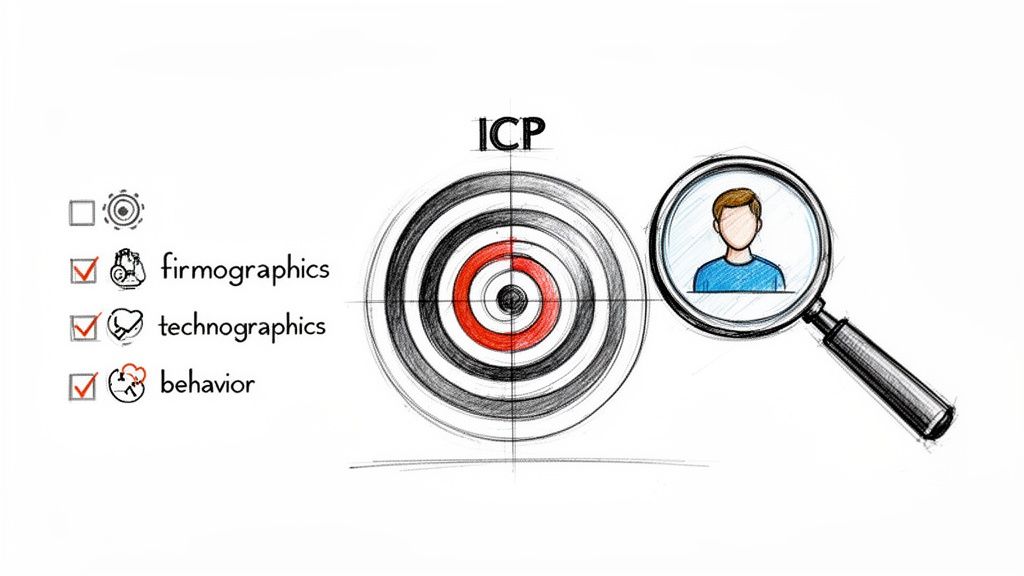
Before you qualify leads, you must define what a "good" lead looks like. This requires creating a data-driven Ideal Customer Profile (ICP). Your ICP is a detailed description of the perfect company for your product. Without it, your marketing and sales efforts will lack direction.
When marketing's definition of a quality lead does not match what sales needs, you get wasted budget and conflict. A clear ICP is the first step to solving this problem.
Start with Your Best Customers
To define your ideal customer, first analyze your successful customers. Your best customers provide valuable information.
List your top 10-15 customers. Focus on those who get the most value, are the most profitable, and are the happiest with your product.
Identify common characteristics. Look for patterns across their company profiles, the technology they use, and their behavior before they became a customer. Use this evidence to build your profile.
Build an ICP Checklist Template
Document the patterns you find in a checklist. This will form your official ICP.
Firmographics (Company Data):
Industry/Vertical: (e.g., FinTech, healthcare, retail)
Company Size (Employees): (e.g., 50-500)
Annual Revenue: (e.g., $10M-$50M)
Geography: (e.g., North America, EMEA)
Technographics (Technology Stack):
CRM System: Do they use Salesforce, HubSpot, or another platform?
Marketing Automation: Is Marketo a common tool?
Complementary Tools: Do they use software that integrates well with your solution?
Behavioral Data (Actions and Intent):
Content Consumed: Did they download a specific report or case study?
Website Engagement: Did they visit your pricing page or view multiple product demos?
Buying Triggers: Did a key event, like a funding round or new executive hire, precede their purchase?
The most effective ICPs combine explicit data (like company size) with implicit behavioral data (like website activity). Focusing on only one provides an incomplete picture and weakens your qualification process.
Turn Your Profile into Practical Rules
Now, translate your ICP into a set of clear qualification rules. This creates a practical checklist for your marketing automation platform and your sales team.
Here is a practical example for a B2B SaaS company:
Company must be in the UK or EU. (Firmographic)
Company must have 200-2,000 employees. (Firmographic)
Company must use Salesforce as their CRM. (Technographic)
Primary contact must be Director-level or higher. (Demographic)
With these rules, a lead from a 50-person company in Australia is automatically disqualified. This eliminates wasted time and manual reviews.
Choose a Qualification Framework
Use a recognized framework to structure your criteria. BANT and MEDDPICC are two popular options. They help you ask the right questions.
BANT vs. MEDDPICC Framework Comparison
Criterion | BANT (Budget, Authority, Need, Timeline) | MEDDPICC (Metrics, Economic Buyer, Decision Criteria, Decision Process, Identify Pain, Paper Process, Champion, Competition) |
|---|---|---|
Best For | Simpler sales cycles, smaller deals, and teams new to formal qualification. | Complex, high-value enterprise sales with multiple stakeholders and long cycles. |
Focus | Quickly identifying if a lead is sales-ready based on basic purchasing power. | Deeply understanding the customer's buying process, internal politics, and the business value of your solution. |
Example Question | "What budget is allocated for this project?" | "What metrics will the economic buyer use to judge this project's success?" |
Key Advantage | Fast and easy to implement. | Thorough, reducing the risk of deals falling through late in the process. |
Choose the framework that fits your business model. BANT is good for speed, while MEDDPICC is built for precision in complex sales.
The goal is to layer your ICP criteria over behavioral signals. This ensures you talk to the right companies at the right time. Aligning your marketing and sales strategy around this documented process makes it effective.
How to Build a Lead Scoring Model That Works
A lead scoring model is a system that assigns points to leads based on their profile and actions. Its purpose is to objectively identify high-potential prospects, so your sales team can focus their efforts.
Start with a simple model and refine it over time. The model acts as a filter, translating your ICP and qualification rules into a numerical score. This score tells your marketing platform when a lead is ready for a sales conversation.
Set Up a Simple Points System
A good lead scoring model uses both explicit and implicit data. Explicit scoring is based on facts the lead provides. Implicit scoring tracks their online behavior. You need both. A lead might fit your ICP perfectly but show no buying intent. Another might download every resource but work for a company you can't sell to. Combining both types of data gives you a complete view.
Here is a simple way to assign points:
Explicit Scoring (Profile Fit): Assign points for firmographic and demographic data that matches your ICP.
Job Title: A 'Director of Sales' is more valuable than an 'Intern'. Assign points accordingly (e.g., Director: +15, Manager: +5, Intern: -10).
Industry: If you sell to FinTech, give leads from that industry more points (e.g., +10).
Company Size: If your ideal company has 100-500 employees, award points to leads in that range (e.g., +10).
Implicit Scoring (Behavior): Assign points for actions that signal buying intent.
High-Intent Actions: Requesting a demo or visiting the pricing page are strong buying signals. Give these actions a high score (e.g., Demo request: +20).
Medium-Intent Actions: Downloading a case study or attending a webinar shows research interest (e.g., +5 per action).
Low-Intent Actions: Subscribing to a newsletter is a good start but not a strong signal of intent (e.g., +1 or +2).
Use negative scoring to filter out poor-fit leads. A lead using a personal email address or from a country you don't serve should lose points (e.g., -20). This helps keep your system clean.
Establish Your MQL Threshold
Next, determine the Marketing Qualified Lead (MQL) threshold. This is the score a lead must reach to be passed from marketing to sales. Setting this threshold requires balance. If it's too low, sales will get unqualified leads. If it's too high, you might miss good opportunities.
To start, analyze your past successful deals. Look at the leads in your CRM that became customers. What was their average score when sales first contacted them? Use that as your benchmark. For example, you might find that a score of 75 is a good starting point.
A Practical Lead Scoring Example
Imagine your ICP is a Marketing Director at a UK-based B2B SaaS company with 200-1,000 employees. Your MQL threshold is 75 points.
Here’s how different leads would be scored:
Lead A: An intern from a 20-person startup in the wrong industry.
Job Title (Intern): -10 points
Company Size (<200): 0 points
Downloads a blog post: +2 points
Total Score: -8. This lead is automatically filtered out.
Lead B: A Marketing Director from a 500-employee UK SaaS company.
Job Title (Director): +15 points
Company Size (200-1,000): +10 points
Industry (SaaS): +10 points
Downloads a case study: +5 points
Views pricing page: +10 points
Total Score: 50. This lead is interesting but not yet an MQL.
Lead C: The same Marketing Director, but they also request a demo.
Previous Score: 50 points
Requests a demo: +25 points
Total Score: 75. This lead meets the MQL threshold and is sent to a sales rep.
This rule-based system provides an objective filter. It ensures reps spend their time on Lead C, not Lead A. This focus is critical. Recent findings on lead qualification accuracy in Brazil show that only 34% of leads are properly qualified, and misqualified leads cause 51% of stalled sales pipelines.
Building this model forces marketing and sales to agree on the definition of a "good lead." This shared understanding is the foundation of an effective lead qualification marketing process.
How to Manage the Handoff from Marketing to Sales
A strong lead scoring model is not enough. Your lead qualification marketing process can fail at the handoff from marketing to sales. What happens after a lead reaches the MQL threshold determines if it becomes a real opportunity. A slow or disorganized handoff can kill a deal. A prospect's interest fades quickly. If your sales team does not follow up promptly with the right context, the lead's engagement will disappear.
Define the Rules of Engagement with an SLA
Establish a formal Service Level Agreement (SLA) to prevent leads from being lost. An SLA is a documented agreement between marketing and sales that clarifies each team's responsibilities.
Your SLA should clearly define:
Lead Follow-Up Time: How quickly must a sales rep contact a new MQL? A common standard is within 24 hours. For high-intent leads, like demo requests, the response should be within one hour.
Follow-Up Procedure: What does "contact" mean? Define the exact steps. For example, the process might be one phone call and two emails over the first three days. This prevents a lead from being marked as "contacted" after a single, unanswered email.
This agreement creates accountability. Marketing agrees to deliver quality leads, and sales agrees to work them with a specific process and urgency.
Provide Sales with the Full Context
When a sales rep receives an MQL, they need more than a name and email. A smooth handoff includes the lead's complete history. Your CRM should automatically provide a full activity log. This context allows for a personalized conversation instead of a generic call.
The sales rep should be able to see:
Which pages the lead viewed on your website.
The content they downloaded (e.g., case studies, whitepapers).
Why they became an MQL (e.g., their score from job title and a demo request).
With this information, a rep can start a call with, "I saw you were looking at our case study on..." instead of, "What do you know about us?" This makes the interaction more relevant and effective. You can learn more about how to set up your inside sales reps for success with the right tools and context.
This diagram shows how different attributes and actions contribute to a lead's score before it reaches sales.
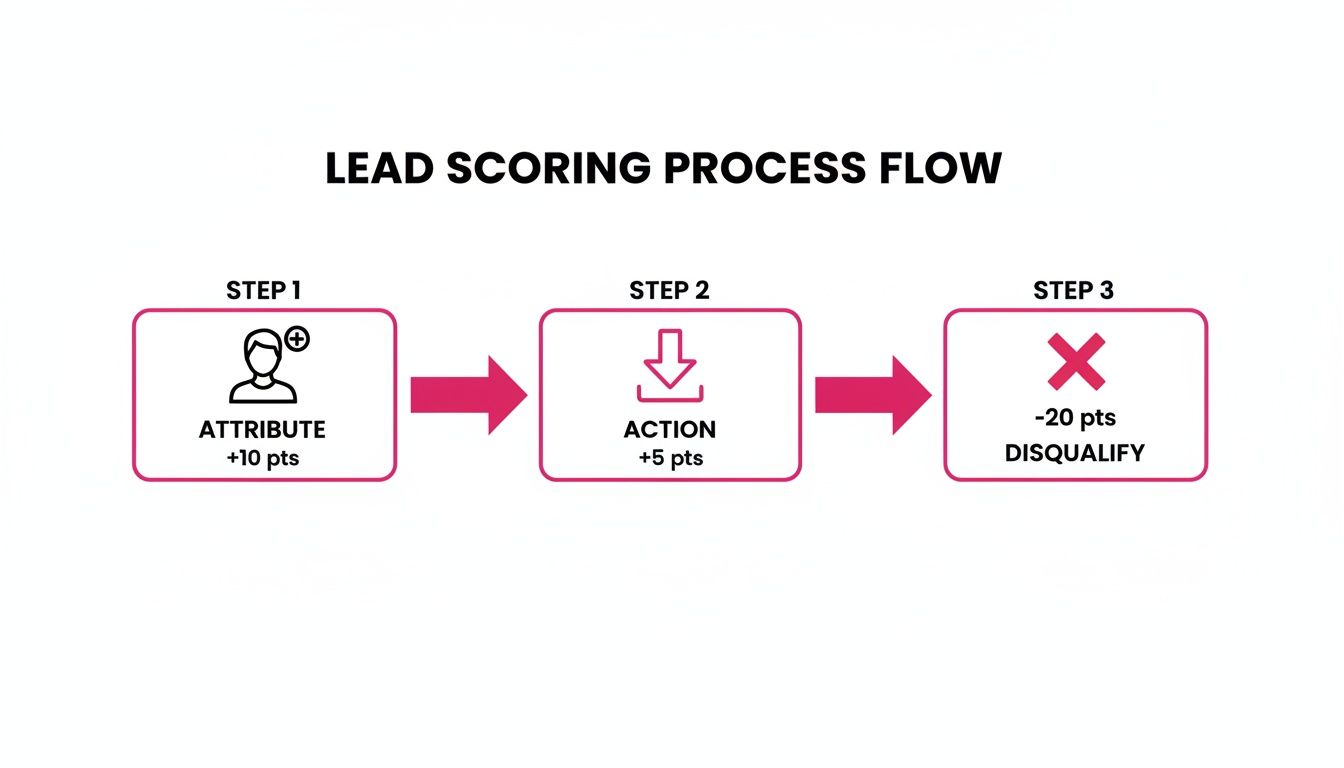
This visual flow demonstrates how positive signals increase a lead's score, while negative attributes reduce it, creating a simple and effective filter.
Create a Closed-Loop Feedback System
Not every MQL will be a perfect fit. The problem is when sales discards a lead without explaining why. This is a missed opportunity to improve the process.
Implement a feedback loop in your CRM. Give sales reps an easy way to disqualify a lead by selecting a specific reason from a dropdown menu.
Your disqualification reasons are a valuable source of data. They provide the most important feedback for refining your lead scoring model and marketing targeting.
Here is a sample checklist of disqualification reasons:
Not a decision-maker
No budget
Unresponsive after multiple attempts
Chose a competitor
Bad timing (re-nurture in 6 months)
This data is essential. If marketing sees many leads disqualified for "no budget," they can adjust ad targeting or add budget-related questions to forms. This feedback loop turns the handoff into a continuous improvement cycle.
How to Use Automation and Analytics to Refine Your Process
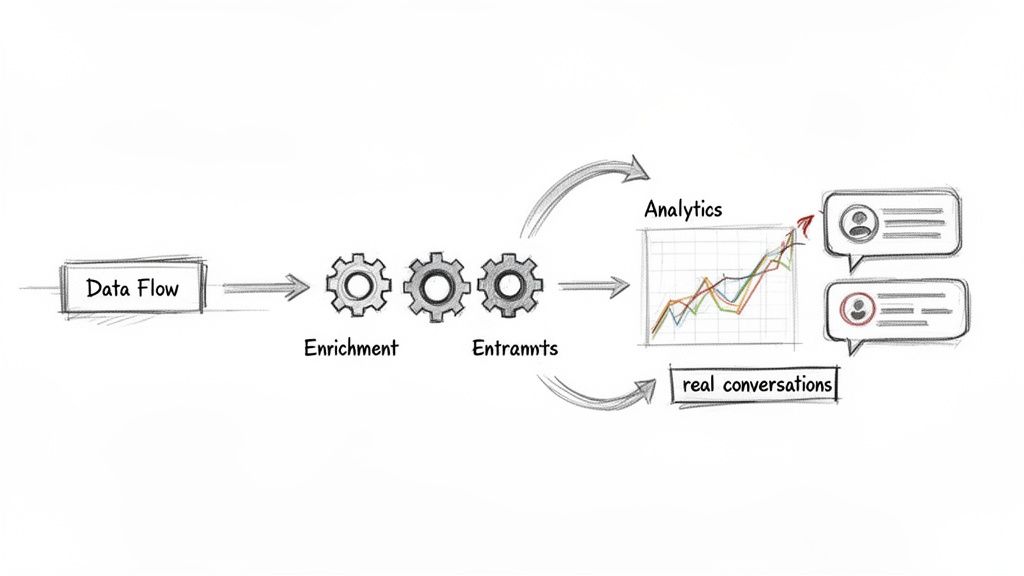
An effective lead qualification marketing strategy uses automation and analytics to improve over time. The goal is to implement practical workflows that support your team and validate your assumptions.
Lead enrichment is a quick win for automation. It automatically adds missing company and contact details to your leads. This saves your sales team from hours of manual research. Instead of spending 15 minutes on LinkedIn to confirm a lead's company size, an enrichment tool like ZoomInfo or Clearbit can add that data in seconds. This allows reps to focus on conversations with qualified prospects.
Automate Repetitive Tasks
The goal of automation is to handle the repetitive, low-value tasks that consume a sales team's day. This frees up your reps to focus on building relationships and closing deals.
Here are a few practical automation workflows to implement:
Instant Data Enrichment: When a new lead enters your CRM, a workflow automatically adds key data like employee count, annual revenue, and technology stack.
Intelligent CRM Updates: Automation can assign leads to the correct sales rep, create follow-up tasks, and update their lifecycle stage based on their score and attributes.
Smart Routing Logic: Route high-intent leads who request a demo directly to a sales executive’s calendar. Place lower-scoring leads into a long-term nurturing campaign.
These simple automations create a more efficient and consistent process, ensuring every lead is handled correctly and quickly.
Use Sales Conversations to Validate Your Model
Your lead scoring model is based on assumptions about what makes a good lead. The only way to know if those assumptions are correct is to analyze real sales conversations. Call and meeting analytics tools are essential for this. Recording and transcribing sales calls provides qualitative insights that raw data cannot.
Sales calls are the ultimate source of truth. They show whether your definition of a 'qualified lead' matches market reality. Analyzing these conversations is the fastest way to improve your qualification process.
By analyzing these interactions, you can identify patterns that confirm or challenge your criteria. You might discover that leads from a certain industry consistently mention a pain point you hadn't considered. Or you might find that leads with a particular job title rarely have purchasing power.
Turn Insights into Actionable Steps
Analyzing calls closes the loop between your qualification theory and real-world results. It helps you answer key questions and make improvements.
For example, you can get concrete answers to questions like:
What are real intent signals? Identify specific words or phrases your best prospects use. Add these keywords to your scoring model.
What are common objections? Note the most frequent points of friction. This helps marketing create content that addresses these issues.
How do qualified buyers discuss budget? Use these insights to refine your BANT criteria to be more realistic.
This qualitative feedback makes your lead qualification marketing strategy dynamic. It allows you to move beyond static rules and build a system that adapts to buyer behavior. To learn more about building a data-first strategy, read our guide on forecasting with Power BI.
Key Metrics to Track for Lead Qualification
Monitor a few essential KPIs to keep your process on track. These numbers will show you what’s working and where you need to make adjustments.
Metric | What It Measures | Industry Benchmark (B2B SaaS) | How to Improve It |
|---|---|---|---|
MQL to SQL Conversion Rate | The percentage of MQLs that sales accepts as sales-qualified. | 10% - 20% | Refine MQL criteria, improve lead scoring, and ensure sales/marketing alignment. |
SQL to Opportunity Conversion Rate | The percentage of SQLs that become active sales opportunities. | 20% - 30% | Improve sales follow-up speed, provide better sales enablement content. |
Lead Velocity Rate (LVR) | The month-over-month growth in the number of qualified leads. | 10% MoM | Increase top-of-funnel marketing, optimize website conversion points. |
Time to Conversion | The average time for a lead to move from MQL to a closed deal. | ~84 days | Streamline the handoff process, automate follow-ups, identify sales cycle bottlenecks. |
Cost Per MQL/SQL | The marketing spend required to generate one qualified lead. | Varies widely | Optimize ad spend, focus on high-converting channels, improve landing page performance. |
Benchmarks can vary, but these provide a good starting point. Establish your own baseline and focus on consistent improvement. By combining smart automation with analysis of real conversations, you can build a powerful, self-improving qualification process.
Frequently Asked Questions About Lead Qualification
Every lead qualification marketing process encounters challenges. It is normal for questions to arise as you implement your strategy. Getting practical answers helps keep your project on track. Here are some of the most common questions.
How often should we review our lead scoring model?
Do not set up your lead scoring model and forget it. Treat it as a living system. Your market, product, and ideal customer can change. A deep review every quarter is a good practice.
However, act sooner if you notice problems. If sales reports a drop in lead quality or a campaign generates poor MQLs, investigate immediately.
Here is a quick checklist for a health check:
Analyze recent wins: Review your last 10-20 new customers. What do they have in common? Does your current scoring model reflect what a great lead looks like today?
Review disqualification reasons: Is there a sudden increase in leads disqualified for the same reason? This signals a problem with your scoring rules.
Talk to your sales reps: Numbers provide only part of the story. Ask the sales team what they are hearing on calls. Their feedback can help you identify problems quickly.
What is the difference between an MQL and a PQL?
MQLs and PQLs are both qualified leads, but they signal different levels of intent.
An MQL (Marketing Qualified Lead) shows interest based on marketing interactions. They have downloaded an ebook, attended a webinar, or visited your pricing page. Their engagement is with your marketing content.
A PQL (Product Qualified Lead) is qualified based on their actions within your product. This is important for companies with a free trial or freemium model. They have started using your product and have reached key activation milestones, like inviting a teammate or using a core feature.
An MQL says, "I'm interested in the problem you solve." A PQL says, "I'm trying to see if your product can solve my problem." PQLs are almost always higher-intent leads because their qualification is based on direct product experience.
Should we disqualify leads or nurture all of them?
It is important to disqualify leads who are a bad fit. Chasing prospects who will never buy wastes your team's time and energy. The key is to separate "bad fits" from leads with "bad timing."
Disqualify bad fits immediately. These are leads who are fundamentally wrong for your business.
They are in an industry you do not serve.
Their company is too small or too large for your solution.
They are a student doing research or a competitor.
Remove them from your active pipeline to keep it clean and focused.
Nurture leads with bad timing. These prospects fit your ICP but are not ready to buy now.
Their budget is already allocated for the year.
They are in a contract with a competitor for another 12 months.
They are in the early research phase without a clear timeline.
Do not disqualify these valuable leads. Place them in a long-term nurture campaign. Send them helpful content and check in periodically. When the timing is right, you will be the first company they contact.
Ready to get more from your sales calls? Samskit is a sales assistant that turns customer meetings into reliable CRM updates and clear next steps, so your team spends less time on admin and more time selling. Find out how you can improve data accuracy and close more deals.