Lead qualification is the process of determining which prospects are likely to buy. It involves sorting through all potential customers to find those with the highest probability of closing. The goal is to focus your sales team's time and energy on the right deals.
What Is Lead Qualification and Why It Matters

Think of a fisherman sorting their catch. Not every fish is kept. Some are too small or the wrong species. A smart fisherman quickly sorts the keepers from the throwaways to focus on the valuable catch.
This same logic applies to sales. Marketing may generate hundreds of leads. Treating every lead as a top priority leads to burnout and missed targets. A solid qualification process acts as a filter. It helps you concentrate resources where they will have the most impact.
The Cost of Poor Qualification
When sales teams lack a structured way to qualify leads, the entire company feels the impact. Chasing every lead, good or bad, is inefficient. It drains resources and creates friction.
The negative effects include:
Wasted Sales Hours: Reps spend time talking to prospects who lack budget, authority, or a genuine need for your product.
Inaccurate Forecasting: A pipeline filled with unqualified leads is unreliable. It makes it impossible to predict revenue accurately.
Lower Team Morale: Constant rejection from dead-end deals demotivates salespeople.
Longer Sales Cycles: Poor-quality leads clog the pipeline. This slows down progress and prevents good deals from getting the attention they need.
A study of B2B sales reps found that only 37% of leads that entered the funnel were properly qualified. This drop-off before the demo stage highlights a significant opportunity for improvement.
The Business Case for Effective Qualification
A deliberate lead qualification process pays dividends. It transforms sales from a high-volume guessing game into an efficient revenue engine. Focusing on the right prospects from the start builds a more predictable sales motion.
The difference between a well-run qualification process and a non-existent one is clear. Here is a comparison of the business impact.
Impact of Effective vs Ineffective Lead Qualification
Metric | Ineffective Qualification | Effective Qualification |
|---|---|---|
Sales Team Productivity | Reps waste time on low-potential leads. | Time is focused on high-probability deals. |
Conversion Rates | Low win rates and inconsistent performance. | Significantly higher win rates. |
Sales Cycle Length | Clogged pipelines lead to longer cycles. | Deals move faster from discovery to close. |
Revenue Forecasting | Unpredictable and often inaccurate. | Reliable, data-backed forecasting. |
Customer Fit | High churn due to poor-fit customers. | Better customer retention and LTV. |
Team Morale | Frustration and burnout from chasing ghosts. | Higher morale and motivation. |
Effective qualification makes the sales team's job easier. It also builds a healthier, more predictable business by ensuring you always talk to the right people at the right time.
Essential Lead Qualification Frameworks You Can Use
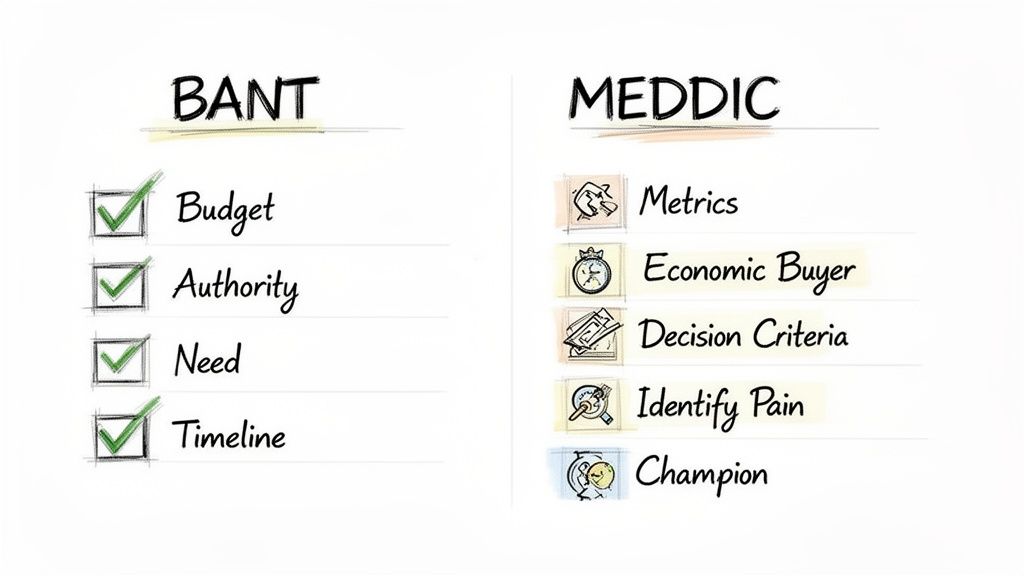
A lead qualification framework is a structured guide for your sales conversations. It ensures you ask the right questions to determine if a lead is a good fit. Think of it as a pilot's pre-flight checklist; it prevents you from missing critical steps.
Using a framework moves your team away from inconsistent, gut-feel selling. It creates a common language for evaluating opportunities. This leads to more accurate forecasting and a healthier pipeline.
The key is to choose the right framework for your sales process. A simple framework works well for straightforward sales. Complex, high-value deals require a more thorough approach.
The BANT Framework: A Simple Starting Point
BANT is a well-known qualification framework because it is simple and effective. The acronym stands for Budget, Authority, Need, and Timeline. It helps you quickly assess the four most important signs of a potential deal.
This framework is ideal for businesses with shorter, less complex sales cycles. It helps reps decide if a lead is ready for a deeper conversation or needs more nurturing from marketing.
Here is a breakdown of each component:
Budget: Does the prospect have money allocated for a solution like yours?
Authority: Are you speaking with the decision-maker who can approve the purchase?
Need: Does the prospect have a clear business pain that your product can solve?
Timeline: When do they plan to purchase and implement a solution?
A structured framework can have a significant impact. In Brazil's B2B SaaS sector, firms using structured qualification frameworks increased their lead-to-opportunity conversion rates to 45%. This is a large improvement over the 22% rate for teams relying on intuition.
BANT Questions to Ask in a Sales Call
You can put BANT into practice using a simple checklist during a discovery call.
Budget Questions:
"Have you allocated a budget for this project?"
"What is the expected ROI for a solution like this?"
Authority Questions:
"Who else on your team is involved in this decision?"
"Can you walk me through your company's typical purchasing process?"
Need Questions:
"What are the biggest challenges with your current process?"
"What is the business impact if this problem isn't solved in the next six months?"
Timeline Questions:
"What is your ideal timeline for implementing a solution?"
"Are there any upcoming deadlines driving this project?"
The MEDDIC Framework: For Complex Enterprise Deals
For larger, more complex B2B sales, you need a more robust framework. MEDDIC provides the deeper qualification needed for enterprise buying committees and long decision processes.
MEDDIC is an acronym for Metrics, Economic Buyer, Decision Criteria, Decision Process, Identify Pain, and Champion. It requires reps to dig deeper than BANT. For a detailed guide, learn how to implement the MEDDIC sales methodology.
MEDDIC Questions for Deeper Discovery
This framework helps you understand the business case, the internal buying process, and all key players in a major deal.
Metrics: What specific, measurable results does the prospect want to achieve? (e.g., "increase revenue by 15%," "reduce operational costs by 20%")
Economic Buyer: Who has the ultimate authority and financial control to approve this purchase?
Decision Criteria: What specific technical, financial, and vendor requirements will they use to evaluate solutions?
Decision Process: What are the exact steps, paperwork, and approvals required to close the deal?
Identify Pain: What are the core business pains, and what are the consequences of inaction?
Champion: Who inside the organization will advocate for your solution internally?
The choice between frameworks depends on your business model. A startup with a transactional sale can use BANT. An enterprise software company needs the rigor of MEDDIC. The goal is to give your team a process that matches the complexity of their deals.
How to Build a Practical Lead Scoring Model
Frameworks like BANT and MEDDIC structure conversations. A lead scoring model adds a quantitative layer. This system assigns points to leads based on their attributes and their engagement with your company.
The process helps you move past gut feelings. It creates a data-driven way to prioritize your pipeline, ensuring the most promising prospects get immediate attention.
Step 1: Identify Key Qualification Signals
First, determine what attributes and actions are worth scoring. Involve both your sales and marketing teams. Map out the signals that consistently correlate with closed-won deals.
These signals typically fall into three categories:
Demographic and Firmographic Data: Information about the person and their company. This answers, "Are they the right type of customer?" Examples include job title, industry, and company size.
Behavioral Data: Actions a lead takes that signal their interest. This answers, "How engaged are they?" Examples include website visits, content downloads, and email clicks.
Negative Signals: Attributes or actions that indicate a poor fit. This helps you filter out noise, such as students or competitors.
Review your past closed-won deals to identify common threads. Did your best customers hold specific job titles or work at companies of a certain size? Did they all watch a product webinar before requesting a demo? Use your historical data to build an accurate scoring model.
Step 2: Assign Point Values to Each Signal
Next, assign points to each signal. High-value signals should receive more points than passive ones.
For example, a "Request a Demo" form submission is much more valuable than opening a newsletter. Your scoring should reflect this difference in intent.
A good starting point is to define a "perfect" sales-ready lead as 100 points. Work backward from there, distributing points across the different attributes and actions you identified. This helps keep your scoring system balanced.
Start with a simple model. You can refine it later as you collect more data on what drives conversions.
Step 3: Create a Scoring Matrix
Organize this information into a scoring matrix. This should be a shared document for both sales and marketing that explains how leads are scored. It eliminates confusion about why a lead was prioritized.
Here is a basic template to get you started.
Sample Lead Scoring Template
This matrix shows how to assign points to different lead characteristics and actions to prioritize your pipeline.
Attribute/Action | Category | Points | Example |
|---|---|---|---|
Job Title "VP" or "Director" | Firmographic | +15 | VP of Sales |
Company Size 100-500 Employees | Firmographic | +10 | A mid-market tech company |
Visited Pricing Page | Behavioural | +15 | Lead viewed pricing details twice |
Downloaded a Case Study | Behavioural | +10 | Downloaded the "Enterprise Success" PDF |
Requested a Demo | Behavioural | +40 | Submitted the "Request a Demo" form |
Unsubscribed from Emails | Negative | -20 | Clicked the unsubscribe link |
Student Email Domain | Negative | -50 | Email address ends in ".edu" |
A transparent matrix ensures the entire team understands the logic behind lead prioritization. This builds trust between marketing and sales.
Step 4: Set Clear Qualification Thresholds
Finally, decide what to do with the scores. Set clear thresholds that trigger specific actions and create a smooth handoff from marketing to sales.
You will typically have two main stages:
Marketing Qualified Lead (MQL): A lead that reaches a specific point threshold (e.g., 75 points) is considered ready for sales outreach.
Sales Qualified Lead (SQL): An MQL that a sales rep has spoken with and confirmed as a legitimate opportunity. The score opens the door; the conversation confirms the fit.
These thresholds are not permanent. Continuously review your model's performance. Are leads with higher scores converting at a higher rate? Are reps disqualifying many MQLs? Use this feedback to adjust point values and thresholds. This continuous feedback loop improves your lead qualification process over time.
Using Sales Technology to Improve Qualification
A good qualification framework can fail without accurate data and efficient workflows. Manual data entry and missed details on calls can derail the entire process. Sales technology can automate tasks and bring objectivity to qualification.
Conversation intelligence tools act like an analyst on every sales call. They automatically transcribe and analyze conversations, extracting data that aligns with your qualification criteria. Instead of relying on a rep to remember to log budget details, the system flags it automatically. This also works for mentions of competitors or key decision-makers.
This approach turns qualification from a subjective process into a data-driven one. Syncing these insights directly into your CRM ensures everyone on the revenue team works from the same information. This results in better data accuracy, faster qualification, and more time for your sales team to sell.
Automating Data Capture and CRM Syncing
Manual CRM updates are a common complaint among sales reps. They spend hours re-listening to calls, typing notes, and logging information. This process is time-consuming and prone to human error, which can undermine qualification efforts.
Automation solves this problem. A sales assistant can automatically join calls, record them, and push structured updates directly into your CRM. This ensures every piece of qualification data is captured accurately and efficiently. A well-maintained CRM is crucial for a successful sales operation and helps your inside sales process thrive.
By automating data capture, you create a complete history of every customer interaction. Every detail is captured in the customer's own words, providing a clear record for sales and success teams.
This diagram shows a simple flow for using this data to improve scoring and qualification.
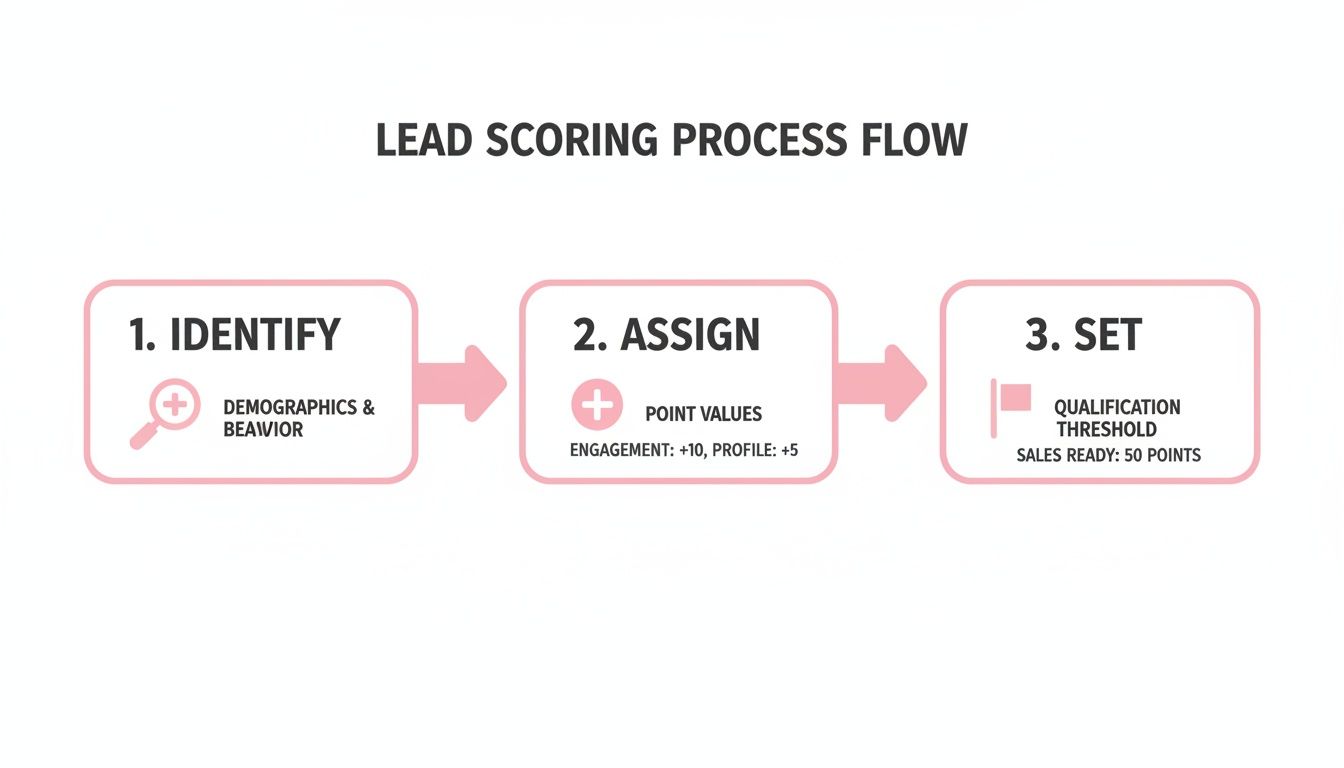
The technology helps you identify key signals, assign them a value, and set a clear threshold for what makes a lead sales-ready.
Uncovering Hidden Buying Signals with AI
Sales conversations contain many subtle details. A prospect might mention a pain point, a competitor, or a budget constraint. These are valuable details but are easy to miss during a live call. AI-powered systems can detect these moments and turn them into qualification data.
The technology scans call transcripts for keywords and phrases that map to your qualification framework, like BANT or MEDDIC.
Budget: It flags terms like "price," "cost," "investment," and specific numbers.
Authority: It identifies job titles like "CEO" or phrases like "I need to check with my boss."
Need: It captures descriptions of challenges, problems, or desired outcomes.
Timeline: It highlights mentions of deadlines, quarters, or phrases like "we need a solution in six months."
This level of analysis is difficult for a person to replicate consistently across many calls. One survey showed that only 37% of leads entering the funnel were properly qualified. Teams that used AI transcription and intent analysis increased that number to 68%. This change helped them shorten their deal cycles by an average of 22 days.
By automatically flagging these signals, the technology provides objective evidence to score and qualify leads. It removes guesswork and ensures every rep qualifies leads consistently.
Tailoring Qualification by Role and Responsibility
Effective lead qualification is a team effort. Each person on the revenue team has a specific role. When everyone understands their part, the system runs smoothly. Qualification becomes a continuous process throughout the customer journey.
Different roles contribute at each stage, from the first contact to the final contract.
The SDR Playbook for Frontline Qualification
Sales Development Reps (SDRs) are the gatekeepers. Their job is to conduct initial discovery and decide if a lead is worth an Account Executive's time. They are the first line of defense against a low-quality pipeline.
An SDR's focus is on gathering key information quickly.
Confirm ICP Fit: Does the company and contact match your ideal customer profile? This is the first and most basic check.
Identify Initial Pain: Is there a real business problem that your solution can address? The goal is to confirm the pain exists, not solve it on this call.
Document Key Signals: Log any mention of budget, authority, or timeline in the CRM. This information is critical for the next conversation.
Set Clear Next Steps: A qualified lead has agreed to a concrete next step, typically a meeting with an Account Executive.
Data highlights the importance of this role. In B2B SaaS, SDRs once spent 44% of their time on unqualified leads. With AI tools assisting in qualification and data capture, that figure has dropped to 19%. This shift increased booked meetings by 62% and grew revenue by 24%. You can learn more about the evolving role of SDRs in modern sales.
The AE Strategy for Continuous Qualification
Qualification does not end when a lead is passed to an Account Executive (AE). The AE's job is to go deeper. Most deals that fail late in the process do so because of an earlier qualification gap.
Continuous qualification is the AE's insurance policy against last-minute surprises. They must constantly re-validate the initial discovery and dig deeper into the business case to ensure the deal remains viable.
AEs should build on the SDR's foundation, not just accept it.
Map the Buying Committee: Identify everyone involved in the decision, not just the initial contact.
Build the Business Case: Quantify the financial impact of the prospect's problem and calculate the potential ROI of your solution.
Uncover the Political Landscape: Understand the internal dynamics. Identify your champion who supports the deal and any potential detractors who might block it.
The Manager and RevOps Role in Process Optimization
Sales Managers and Revenue Operations (RevOps) teams design and manage the qualification process. They provide the team with the coaching and tools needed for execution.
Sales Managers focus on coaching and performance. They use tools like call analytics to review discovery calls and provide specific feedback to SDRs and AEs. Their job is to ensure the team uses the qualification framework consistently.
RevOps professionals own the infrastructure. They design lead scoring models, set up CRM workflows for smooth handoffs, and build dashboards to track qualification metrics. Their goal is to create a scalable, data-driven process for the entire revenue organization.
Measuring the Success of Your Qualification Process
Implementing a new lead qualification process is a great start, but you must measure its impact. Tracking the right Key Performance Indicators (KPIs) connects your qualification efforts to revenue goals.
Monitoring these metrics shows you what is working and where you need to make adjustments. The data helps you refine your lead scoring, coach your reps, and build a reliable sales engine.
Key Metrics to Track
You don't need dozens of metrics to measure the health of your qualification process. Focus on a few high-impact KPIs that tell the story of your sales funnel.
Your core dashboard should include:
Lead-to-Opportunity Conversion Rate: This is the most direct measure of qualification quality. It tracks the percentage of qualified leads that become real sales opportunities. A rising rate indicates your team is getting better at identifying genuine potential.
Sales Cycle Length: Effective qualification should shorten the sales cycle. When reps receive better-fit leads, they waste less time on deals that stall and can close good deals faster.
Win Rate: This metric tracks the percentage of opportunities that you win. An increasing win rate shows that your process is filtering out poor-fit leads and focusing the team's efforts on winnable deals.
Customer Lifetime Value (CLV): This is a long-term metric. When you qualify for customer fit, not just a quick sale, you retain customers longer. An increasing CLV indicates that your qualification criteria are identifying your ideal customers.
Building Your Qualification Dashboard
The best way to track these metrics is with a dedicated dashboard in your CRM. This creates a single source of truth for the entire revenue team. A well-designed dashboard makes it easy to spot trends and understand performance.
Your CRM dashboard is your command center for sales performance. It turns raw data into actionable insights, showing you how lead qualification impacts the bottom line.
When setting up your dashboard, visualize each KPI effectively. A line graph is great for tracking the lead-to-opportunity rate over time. Bar charts can compare sales cycle length before and after implementing your new process.
This continuous loop of measuring and refining turns a static strategy into a dynamic system that improves over time. It allows you to make smart, data-driven decisions that fuel growth.
Got Questions? We’ve Got Answers
We've covered the frameworks, models, and technology for smart lead qualification. Here are answers to some of the most common questions.
What’s the Real Difference Between an MQL and an SQL?
Think of it as a handoff in a relay race. A Marketing Qualified Lead (MQL) is a lead that marketing has identified as promising based on a scoring threshold or specific actions, like requesting a demo.
That lead becomes a Sales Qualified Lead (SQL) only after a sales rep speaks with them. The rep confirms that there is a real business pain, budget, and authority to purchase. This conversation turns a promising lead into a genuine sales opportunity.
How Often Should We Tweak Our Lead Scoring Model?
Your lead scoring model is not a "set it and forget it" tool. Markets, customer profiles, and products change. Your scoring model must adapt.
As a general rule, review your lead scoring model every quarter. This provides enough data to identify trends and make informed changes, rather than reacting to short-term fluctuations.
Maintain open communication with your sales team. If they report that "hot" leads are consistently poor fits, it is time to review and adjust your scoring criteria.
What Should We Do with Leads That Don’t Qualify?
"Disqualified" should not mean "deleted." A lead may be a poor fit now for temporary reasons, such as a frozen budget or a longer project timeline.
Do not discard these leads. Create a "nurture" track for them. Send them valuable content like newsletters, case studies, or industry reports. When their situation changes, your company will be top of mind.
Stop chasing context and start closing deals. Samskit turns your sales calls into accurate CRM updates, so your team can focus on what matters. Learn how it works.