The difference between an SDR and an inside sales rep is simple: one starts the conversation, and the other closes the deal.
Think of it as a relay race. The Sales Development Representative (SDR) runs the first leg. They find and qualify potential customers to get a strong start. When they identify a real opportunity, they pass the baton to the Inside Sales Representative, who takes it across the finish line.
Understanding SDR and Inside Sales Roles
Some businesses merge these roles into one "full-cycle" rep. This seems efficient on paper. In practice, it often leads to burnout. When one person juggles prospecting, qualifying, running demos, and closing deals, top-of-funnel work usually suffers.
Separating the roles allows each person to specialize. This focus helps you build a predictable and scalable sales process.
The SDR: The Opportunity Scout
An SDR's main job is to fill the pipeline with qualified opportunities for the sales team. They act as frontline filters. They ensure prospects are a good fit before anyone else invests time.
SDRs operate at the top of the sales funnel. Their daily activities include:
Prospecting: Finding potential customers who match the company’s Ideal Customer Profile (ICP).
Outreach: Contacting prospects through cold calls, emails, and social media.
Qualification: Asking questions to verify a prospect's needs, budget, and authority.
Setting Appointments: Booking qualified meetings or demos for an Inside Sales Representative.
SDR success is not measured by revenue. It is measured by the number of quality meetings they book and the pipeline value they create.
SDRs focus on prospecting and qualification. This ensures closers spend their time on conversations that are likely to convert. The process cuts wasted effort and shortens the sales cycle.
The Inside Sales Rep: The Deal Closer
An Inside Sales Representative takes over after an SDR qualifies a lead. They manage the opportunity from the first meeting to the signed contract. They focus on the middle and bottom of the sales funnel.
Their key responsibilities include:
Conducting Demos: Showing how the product or service solves the prospect's problem.
Nurturing Relationships: Building trust with key decision-makers.
Handling Objections: Addressing concerns that could block a deal.
Negotiating Terms: Finalizing pricing and contract details to close the sale.
The Inside Sales Rep is directly measured by revenue. Their performance depends on quota attainment, average deal size, and win rate.
This clear separation of duties works. Each role has a distinct mission. This leads to a more focused and efficient sales organization.
SDR vs. Inside Sales Representative at a Glance
This table breaks down how the two roles compare.
Aspect | Sales Development Representative (SDR) | Inside Sales Representative |
|---|---|---|
Primary Goal | Generate qualified meetings and opportunities. | Close deals and generate revenue. |
Key Activities | Prospecting, cold outreach, lead qualification. | Product demos, negotiation, objection handling. |
Funnel Focus | Top of the Funnel (Awareness & Interest). | Middle to Bottom of the Funnel (Consideration & Decision). |
Core Metrics | Meetings booked, opportunities created, pipeline value. | Quota attainment, win rate, deal size. |
Relationship | Starts the sales conversation. | Finishes the sales conversation. |
The table shows how each role contributes to the sales process. They have unique goals and metrics but work together in the same system.
Core SDR Responsibilities and KPIs
To understand an SDR team, you must look at their daily work and the numbers that measure it. An SDR’s day is a structured process of outreach and follow-up. The goal is effectiveness, not just activity.
An SDR's job is to build a reliable pipeline of qualified opportunities. They ensure only prospects with real potential reach the inside sales reps. This requires a structured approach.
An SDR's Daily Workflow
SDRs often work in time blocks. They focus on one activity at a time to maintain momentum. This prevents them from getting stuck in their inbox while their call list waits.
A typical daily checklist includes:
Prospect Research (1-2 hours): Use tools like LinkedIn Sales Navigator to find new companies and contacts that match the Ideal Customer Profile (ICP).
Cold Calling (2-3 hours): Connect with prospects to ask qualifying questions and book a first meeting. This remains a core activity.
Email Management (1-2 hours): Add prospects to email sequences and manage replies from ongoing conversations.
Social Selling (1 hour): Engage with prospects on LinkedIn by sharing content, commenting on posts, and sending connection requests.
CRM Updates (30-60 minutes): Log all calls and emails. Set follow-up tasks to ensure no lead is forgotten.
This multi-channel approach helps reach busy decision-makers. In Brazil, for example, e-commerce has grown rapidly. B2B SDRs now handle 70% of initial outreach through calls and emails. With 90% of B2B meetings in Brazil now online, tools that automate CRM updates are essential. You can dive deeper into Brazilian e-commerce trends here.
KPIs That Measure Results, Not Just Effort
Tracking daily activities is useful for coaching, but results are what matter. Many teams focus on "vanity metrics" like the number of calls made or emails sent. These numbers show effort but do not measure effectiveness.
High-performing SDR teams focus on KPIs that connect directly to revenue. The goal is to generate high-quality opportunities, not just activity.
The right KPIs provide a clear view of performance. They show you exactly where to make improvements.
Essential SDR KPIs
To measure an SDR's impact, use a balanced set of metrics. Look at both their activity and the outcomes.
Qualified Appointments Set: This is the primary metric. It tracks the number of meetings an SDR books that meet pre-defined criteria (like BANT or MEDDIC).
Opportunity Conversion Rate: This KPI measures lead quality. It is the percentage of appointments that the inside sales team accepts and converts into a sales opportunity.
Pipeline Value Generated: This metric assigns a dollar value to an SDR's work. It is the total potential deal value from the opportunities they sourced.
Sales Cycle Contribution: This measures how quickly an SDR's leads move through the sales process. Faster cycles often indicate better-qualified prospects.
By focusing on these KPIs, managers can set clear goals. They can offer coaching that targets specific skill gaps and turns daily effort into a healthy sales pipeline.
How to Build a High-Impact Sales Playbook
A sales playbook is your team's single source of truth. It is a practical guide that maps out your sales process. It tells every rep what to do, how to do it, and why it works.
Without a playbook, your team relies on individual talent and luck. This leads to inconsistent results and makes scaling difficult. Building a playbook forces you to define the specific actions that lead to predictable wins.
The workflow below shows the journey every SDR takes. Your playbook should support each step.
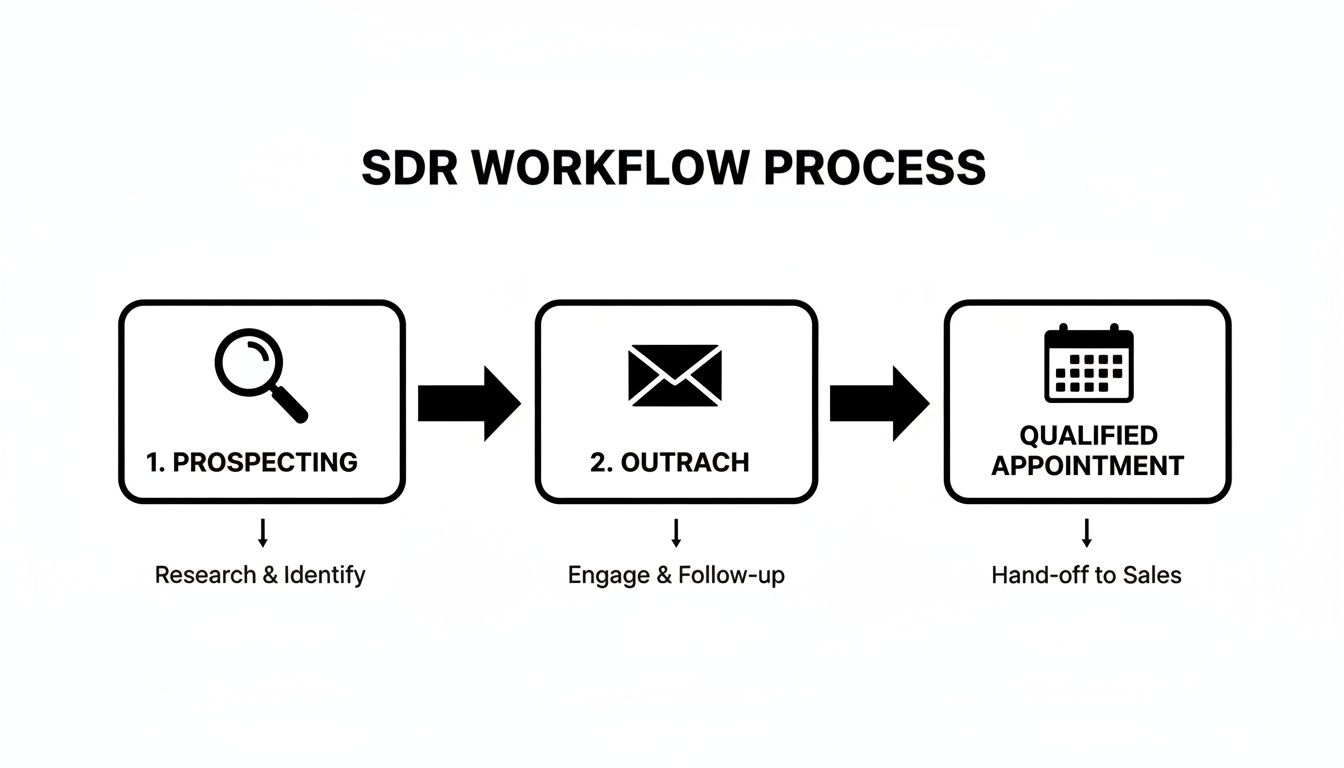
Your playbook must provide clear instructions for each stage, from finding prospects to booking meetings.
Step 1: Define Your Ideal Customer Profile
Before any outreach, you must know who you are targeting. Your Ideal Customer Profile (ICP) is a clear description of the perfect company for your product. This is a mandatory first step.
Build your ICP on data, not assumptions. Analyze your best current customers. Identify what they have in common.
Your ICP definition should include firmographic data:
Industry/Vertical: Which sectors benefit most from your solution?
Company Size: Do you target startups or large enterprises? Define the range.
Geography: Where are your most successful customers located?
Technology Stack: What other software do your best customers use?
A clear ICP acts as a guide. It prevents your team from wasting time on leads that will not close.
Step 2: Create Actionable Buyer Personas
The ICP defines the right company. Buyer personas define the right people within that company. You need to understand their roles, challenges, and goals.
A buyer persona is a composite sketch of your target buyer. It is built from interviews and data. This helps your SDR team communicate effectively with prospects.
A persona is not a fictional character. It's a tool based on real-world data that helps your sdr inside sales team understand your prospects' needs.
Define these points for each persona:
Role and Responsibilities: What does their typical day look like?
Goals and Objectives: What are they trying to achieve in their role?
Challenges and Pain Points: What problems keep them up at night?
Information Sources: What blogs, publications, or influencers do they follow?
This information helps SDRs offer a relevant solution to a real problem, not just push a product.
Step 3: Craft Scripts and Objection Handling Guides
With your target audience defined, you can build your messaging. Create scripts, email templates, and objection-handling guides. Treat these as flexible frameworks, not rigid rules.
A good script ensures reps cover key talking points and ask important qualifying questions. It should still allow their personality to come through.
For handling objections, a simple two-column guide is effective:
Common Objection: List common pushbacks like "We don't have the budget," "We already use a competitor," or "Just send me an email."
Proven Response: For each objection, write a tested response that addresses the concern and moves the conversation forward.
This tool prepares your team for tough conversations. It builds their confidence and helps them turn objections into opportunities. A solid playbook is a key part of scalable sdr inside sales success.
Choosing the Right Tech Stack for Your Sales Team
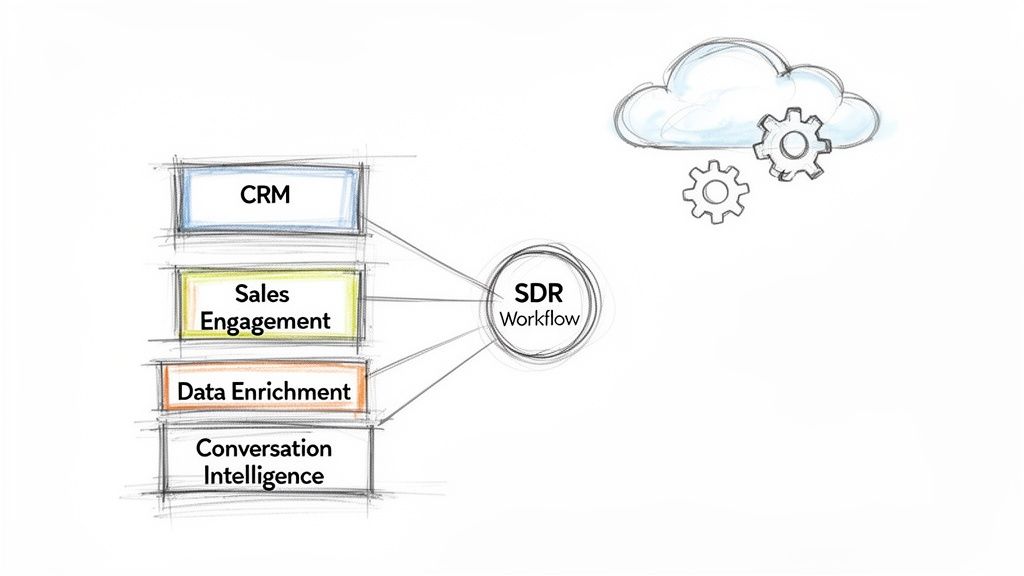
The right technology helps an SDR team work smarter, not just harder. A well-integrated tech stack automates administrative tasks and provides clear insights. The goal is to build a system that allows reps to spend more time talking to potential customers. When tools are connected, data flows smoothly, and your team can focus on selling.
Core Components of a Modern Sales Stack
A modern sales stack has a few essential components. Each one solves a specific problem for an SDR.
Customer Relationship Management (CRM): This is the central database for all prospect and customer interactions. It should be the single source of truth for your sales process.
Sales Engagement Platforms (SEP): These tools automate outreach sequences of emails, calls, and social media touches. They help ensure consistent follow-up.
Data Enrichment Tools: Bad data wastes time. These tools clean contact lists and add accurate phone numbers, email addresses, and company details.
Conversation Intelligence: These platforms record, transcribe, and analyze sales calls. They identify buyer objections, competitor mentions, and key buying signals.
Integrating Tools for a Seamless Workflow
Connecting these tools creates a seamless workflow. Proper integration eliminates manual data entry that slows teams down. The goal is a closed-loop system where every action and insight is captured automatically.
Consider this workflow: An SDR uses a sales engagement tool to contact a prospect found with a data enrichment tool. The prospect agrees to a meeting. A conversation intelligence bot joins the call. A tool like Samskit can automatically capture key buyer insights from the call.
An integrated stack means crucial information—like a buyer's main objection or their stated next steps—is captured from the call and synced directly to the correct opportunity field in your CRM, all without manual data entry.
This saves time and improves data quality. Managers get a clear view of the pipeline. Coaching becomes more effective because it is based on actual conversations, not incomplete notes.
Data accuracy is becoming a standard. In Brazil, the data monetization market is projected to grow from USD 102.5 billion in 2025 to USD 355.5 billion by 2034. This trend fuels personalized outreach based on buyer signals. In 2025, Brazilian SaaS teams found that data-driven strategies increased their pipeline coverage by 35%. A full 60% of their qualified leads came from analyzed call data synced to their CRM. You can discover more about Brazil's data monetisation market.
Building the right tech stack involves choosing tools that work together. This creates an intelligent, streamlined system that supports your sdr inside sales team.
Hiring and Developing Top SDR Talent
Building a strong SDR team starts with hiring for the right attributes. Your tech stack and playbook provide the process, but your people drive the results. Success starts with knowing what to look for and committing to a new hire's growth from day one. A winning team is built on core attributes, not just a resume.
Identifying Core SDR Attributes
While sales experience can be helpful, the most successful SDRs share a few key traits. These qualities help them handle daily rejection, learn from feedback, and connect with prospects.
Screen for these three non-negotiable characteristics during interviews:
Resilience: Can they recover from a "no" without losing motivation? SDRs face frequent rejection, so persistence is essential.
Coachability: Are they open to feedback? The best SDRs constantly look for ways to improve their approach. They view constructive criticism as a tool for growth.
Curiosity: Do they show a genuine interest in a prospect’s business? This trait separates script-readers from consultants who ask insightful questions.
Use situational and behavioral questions to identify these traits. Ask candidates to share real-world examples.
Here are some sample questions:
To test resilience: "Tell me about a time you faced repeated setbacks while pursuing a goal. How did you stay motivated?"
To test coachability: "Describe a time you received difficult feedback from a manager. How did you respond, and what did you change?"
To test curiosity: "Imagine you were researching our company. What are the first three questions you would ask our CEO?"
Creating a Structured Onboarding Program
After hiring people with the right attributes, you need to get them productive quickly. A structured onboarding program is critical. Giving a new hire a phone and a contact list is not enough.
A good onboarding plan is a step-by-step roadmap. It builds their confidence and competence over time.
An effective onboarding process turns raw talent into a productive team member. A 30-60-90 day plan provides the structure needed to ensure new SDRs absorb knowledge, practise skills, and start delivering results methodically.
This phased approach prevents new hires from feeling overwhelmed and sets clear expectations.
A 30-60-90 Day Plan Template
A 30-60-90 day plan breaks the learning curve into manageable parts. It gives both the SDR and their manager a clear framework to track progress.
First 30 Days: Focus on Learning
Goal: Absorb product knowledge, understand the ICP and buyer personas, and learn the tech stack.
Activities: Shadow top SDRs, complete product training, and listen to call recordings.
Metric: Pass a certification test on the product and sales playbook.
Days 31-60: Focus on Application
Goal: Apply knowledge with support and feedback.
Activities: Begin making calls and sending emails. Participate in role-playing sessions and daily check-ins with a manager.
Metric: Hit 50% of the full activity quota and book their first qualified appointments.
Days 61-90: Focus on Execution
Goal: Operate independently and consistently hit performance targets.
Activities: Manage their own daily schedule, refine outreach techniques, and contribute in team meetings.
Metric: Consistently achieve 80-100% of their qualified appointment quota.
Finally, show SDRs a clear path for advancement. Define the requirements for promotion to a Senior SDR, Account Executive, or Team Lead role. This builds a motivated team that sees a long-term future with your company.
Common SDR & Inside Sales Hurdles
The life of an SDR or inside sales rep can be a grind. They deal with high-volume outreach and frequent rejection. This leads to common challenges. These hurdles are normal and solvable with a clear plan.
Low Response Rates and Gatekeepers
Every SDR has experienced sending hundreds of emails and making dozens of calls with little response. This frustration often means the outreach is not effective. The solution is to focus on value over volume.
The Problem: Generic, one-size-fits-all messages get ignored in a crowded inbox.
The Solution: Personalize your outreach. Before contacting a prospect, find a specific "hook," such as a recent company announcement, a LinkedIn post, or an industry challenge. A single, relevant sentence can increase response rates.
Treat gatekeepers with respect. Do not try to trick them. Be clear about who you are, who you need to speak with, and the value you can provide. A confident and direct approach is more effective.
Motivation and Data Hygiene
The SDR role requires mental stamina. Daily rejection can affect motivation. The administrative task of updating the CRM can also feel like a burden.
These two problems are connected. When reps are busy with manual data entry, their energy for high-impact activities like talking to prospects decreases. This can lead to sloppy data, missed opportunities, and lower performance.
The Problem: An inaccurate or incomplete CRM means follow-ups lack context, handoffs are difficult, and forecasting is unreliable.
The Solution: Use technology to automate administrative work. Tools like Samskit can automatically record and transcribe calls. It can pull key details like buyer objections or next steps and sync them directly into the CRM. This frees up your team from manual data entry and creates a reliable source of information.
Efficiency is critical in competitive markets. In Brazil, for example, SDRs are key to B2B growth. With economic indicators like a 2.3% year-over-year increase in retail sales in November 2025, competition is high. Brazilian companies with efficient inside sales operations have seen an 18% higher pipeline velocity. This is largely due to adopting digital tools that reduce manual data entry and improve coaching. You can explore more on Brazil's retail sales growth insights.
Frequently Asked Questions
When building an SDR and inside sales team, questions will arise. Here are answers to some of the most common ones.
What is the ideal ratio of SDRs to Account Executives?
A good starting point is one SDR for every two or three Account Executives (AEs). However, this is not a strict rule. The right ratio depends on your average deal size, sales cycle length, and the volume of inbound leads.
Start with a 1:2 or 1:3 ratio. Monitor your AEs' calendars. If they have too much free time, you may need another SDR. If they are overwhelmed with meetings, you may need another AE.
How long should an SDR stay in the role before promotion?
An SDR typically spends 12 to 18 months in the role before being ready for a promotion. This provides enough time to master prospecting, lead qualification, and objection handling.
Promotion should be based on performance, not just time. An SDR is ready for the next step when they consistently hit their quota for qualified opportunities and demonstrate a strong understanding of the full sales process. A clear career path helps retain top talent.
When hiring a new SDR, focus on core attributes over resume experience. Coachability, resilience, and curiosity are better predictors of long-term success than a few years in a previous sales role.
Should SDRs be compensated for meetings booked or deals closed?
Compensate SDRs based on metrics they can directly control. A common structure is a base salary plus a commission tied to the number of qualified meetings or opportunities they generate. This keeps them focused on their primary role: filling the top of the sales funnel.
Tying SDR compensation to closed deals can be counterproductive. SDRs do not control the final stages of a deal; that is the AE's responsibility. Making their commission dependent on another person's performance can lead to frustration and lower motivation. Align their incentives with their specific duties for better results.
Ready to eliminate manual CRM updates and give your team more time to sell? Samskit turns every sales conversation into accurate data and clear next steps, automatically. Learn how Samskit can boost your sales team's productivity.