Marketing lead qualification is a filtering process. It separates interested people from likely buyers. This helps your sales team focus their time on the best opportunities. A clear set of criteria turns marketing efforts into predictable revenue.
Why Marketing Lead Qualification Is Crucial for Growth
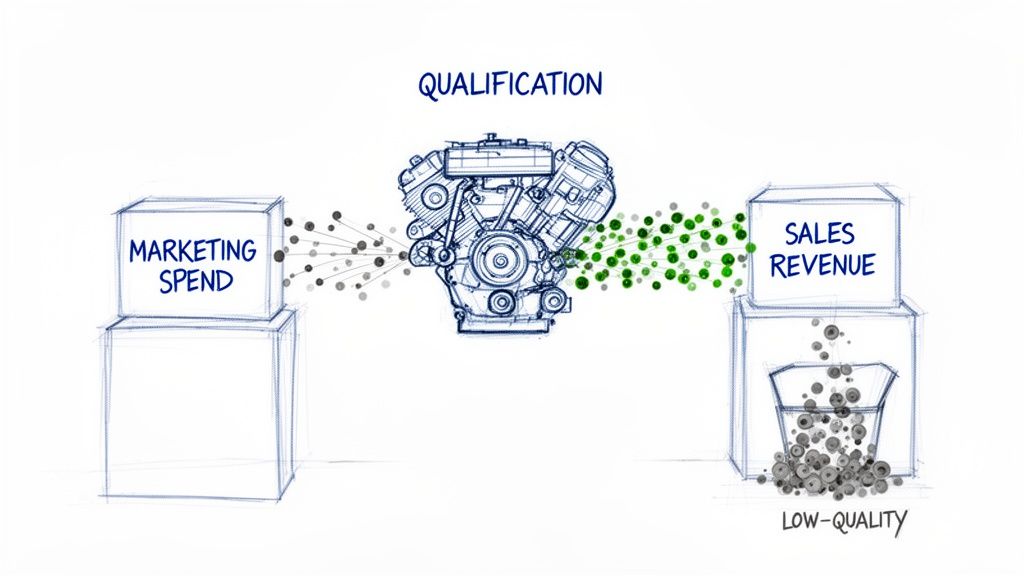
Does this sound familiar? Marketing generates a high volume of leads. But the sales team says the leads are low quality. They spend hours on calls that go nowhere. This disconnect is a common problem. It wastes resources and stalls revenue growth.
The problem is often a lack of a structured marketing lead qualification system. Not every person who downloads a guide is ready to buy. Treating them all the same is inefficient and expensive. Poor qualification at the start causes you to lose potential sales.
Connecting Marketing Spend to Sales Results
A good qualification process acts as a filter. It sits between your marketing activities and your sales team. Only promising leads pass through to sales. This system directly links your marketing investment to sales outcomes.
First, marketing and sales must agree on the definition of a "good lead." This shared understanding is critical. When marketers know what sales needs, they can adjust campaigns to attract better prospects. To learn more, read our guide on creating a unified marketing and sales strategy.
A strong lead qualification system stops sales teams from wasting time on dead-end leads. This leads to a more efficient pipeline, higher morale, and better conversion rates across the board.
What an Effective Qualification System Achieves
A formal qualification process directly impacts your bottom line. It helps your teams shift from reacting to opportunities to proactively managing them.
Here are the core parts needed to build your own system.
Table: Core Components of a Qualification System
Component | Description | Key Benefit |
|---|---|---|
Ideal Customer Profile (ICP) | A detailed definition of your perfect customer, including company size, industry, and pain points. | Focuses marketing on attracting the right type of company. |
Qualification Framework | A structured set of criteria (like BANT) to evaluate a lead's fit and intent. | Provides a consistent method for assessing every lead. |
Lead Scoring Model | A system that assigns points to leads based on their attributes and actions. | Prioritizes leads automatically so sales knows who to call first. |
CRM Stage Mapping | Clearly defined stages in your CRM to track a lead's journey from MQL to SQL. | Creates a shared understanding of pipeline status. |
Automation Rules | Workflows that move leads between stages or trigger actions based on set criteria. | Reduces manual work and ensures qualified leads are not missed. |
Building these components provides several advantages:
Increases Sales Efficiency: Your sales team spends less time vetting leads. They spend more time talking to people who can buy.
Improves Conversion Rates: Focusing on high-quality leads increases the chance of closing a deal.
Provides Data-Driven Insights: The process generates useful data. You see which marketing channels deliver the best leads. This helps you optimize your marketing budget.
Creates Predictable Revenue: A steady flow of qualified leads makes revenue forecasting more accurate. This builds a scalable business.
How to Choose a Lead Qualification Framework
After you define your ideal customer, you need a tactical plan. A lead qualification framework provides a structured, repeatable set of criteria to evaluate each lead. It ensures everyone on the team uses the same language and standards.
Without a framework, qualification is inconsistent. One sales rep might focus on company size, while another focuses on need. This chaos means good leads might be rejected for the wrong reasons. It also makes it impossible to measure and improve your process.
A good framework aligns marketing and sales. It makes sure that leads passed to sales are ready for a sales conversation.
BANT: A Simple, Direct Approach
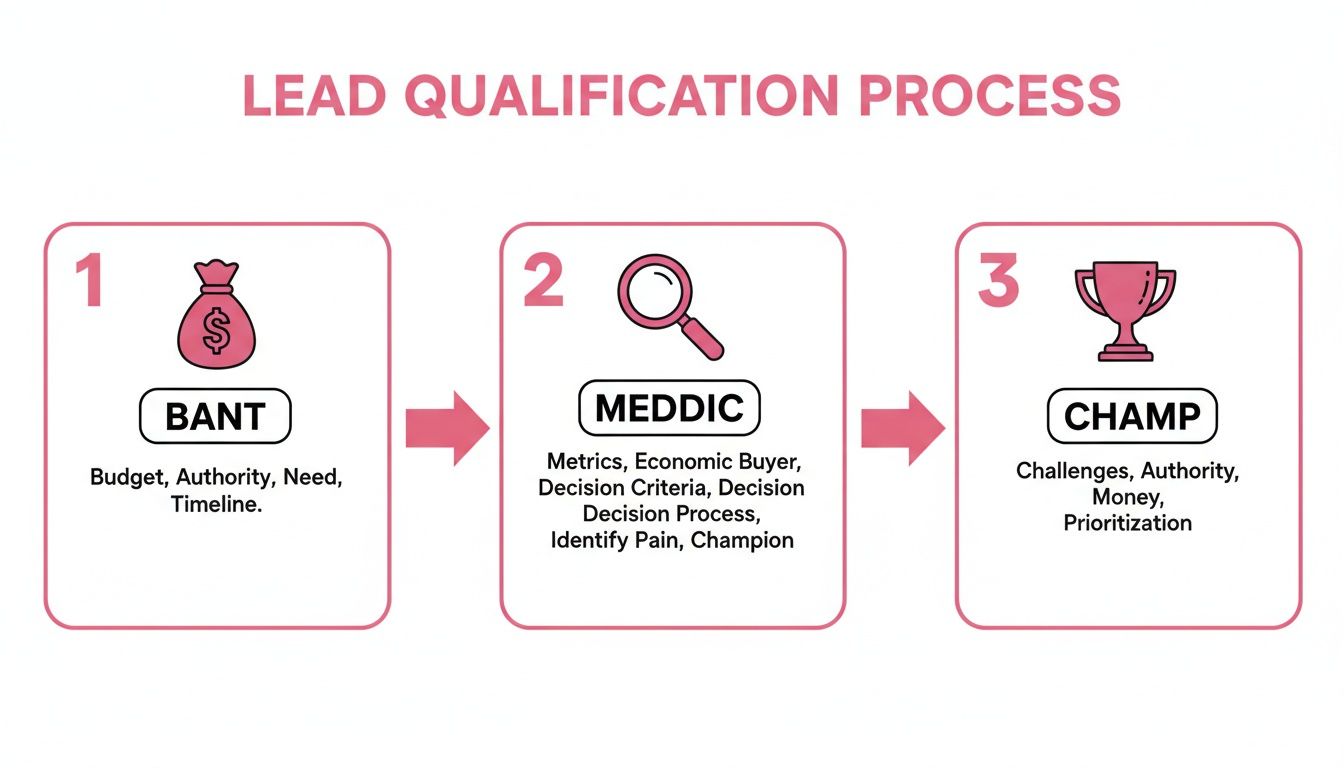
BANT is a well-known qualification framework. It is straightforward and effective. It stands for:
Budget: Can the prospect afford your solution?
Authority: Is this person the decision-maker, or can they influence the decision?
Need: Do they have a business problem that your product solves?
Timeline: Do they have a specific timeframe for making a purchase?
BANT works well for businesses with shorter sales cycles and less complex products. For example, a company selling a project management tool can use BANT effectively. The budget is clear, the buyer is often a team lead, the need is defined, and the timeline is short. BANT helps quickly identify if a lead is worth pursuing.
MEDDIC: For Complex Enterprise Sales
For high-value, complex sales with multiple stakeholders, you need a more detailed framework. MEDDIC helps you understand the internal dynamics of a large organization. MEDDIC stands for:
Metrics: What measurable results does the prospect expect? (e.g., "increase revenue by 15%")
Economic Buyer: Who has the final authority to approve the purchase?
Decision Criteria: What specific technical and financial requirements must be met?
Decision Process: What are the exact steps the organization follows to approve a purchase?
Identify Pain: What is the business pain forcing them to act now? What happens if they do nothing?
Champion: Who is your internal advocate who will sell on your behalf?
MEDDIC requires deeper discovery. It is ideal for enterprise software or large service contracts where demonstrating a clear return on investment is essential.
CHAMP: A Customer-Focused Alternative
CHAMP prioritizes the prospect's problems. This consultative approach helps build trust. It stands for:
Challenges: What are the prospect’s biggest business challenges?
Authority: Who are the people involved in the decision?
Money: What is the financial cost of their challenges, and is a budget allocated to solve them?
Prioritisation: How important is solving this challenge compared to their other priorities?
Starting with challenges positions your team as problem-solvers. This is a powerful way to stand out in a crowded market. CHAMP is flexible and works well for businesses that need to educate prospects on the value of their solution.
The right framework is a strategic tool. It guides conversations, helps your team ask better questions, and improves forecast accuracy.
The need for a strong framework is clear in competitive markets. In Brazil's fast-growing digital advertising market, for example, poor lead qualification is a major issue. A Brazil digital advertising market report on kenresearch.com shows that companies can see customer acquisition costs rise by 35% without a solid process.
How to Select the Best Framework for Your Team
The right framework depends on your business model, customer base, and sales process. There is no one-size-fits-all answer.
BANT vs. MEDDIC vs. CHAMP Framework Comparison
Framework | Best For | Core Focus |
|---|---|---|
BANT | Simple, transactional sales with short cycles. | The buyer's purchasing power and timeline. |
MEDDIC | Complex, high-value enterprise sales. | The internal buying process and proving ROI. |
CHAMP | Consultative sales focused on solving problems. | The customer's primary business challenges. |
Use this checklist to guide your decision:
Analyze Your Sales Cycle: Is it weeks (BANT) or months (MEDDIC)?
Evaluate Deal Complexity: How many people are involved in a purchase? More than two suggests MEDDIC.
Define Your Sales Approach: Is it transactional (BANT) or consultative (CHAMP)?
Consider Team Experience: BANT is easier for new teams to adopt. MEDDIC requires more experienced sellers.
The best framework is the one your team will use consistently.
How to Build a Practical Lead Scoring Model
A qualification framework provides the strategy. A lead scoring model provides the operational workflow. It assigns a numerical score to each lead based on their profile and actions. This score tells your sales team who to contact first.
A good model uses two types of information to create a complete picture.
Explicit vs. Implicit Data
Explicit data is information a lead gives you directly, such as on a form. It includes job title, company size, and industry. This data tells you if they fit your Ideal Customer Profile (ICP).
Implicit data is information you gather from a lead's behavior. It includes website pages visited, emails opened, and content downloaded. This data helps you gauge their interest and buying intent.
A strong lead scoring model weighs both who the person is (explicit fit) and what they do (implicit intent). A perfect-fit lead with no engagement is not ready for a sales call.
How to Assign Points
Assign points based on how strongly an attribute or action correlates with a closed deal. Analyze your past sales. What are the common job titles and company sizes of your best customers? What actions did they take before becoming a customer?
Use historical data to guide your point values. High-value attributes and actions should receive more points.
Here is a simple template to get you started.
Example: Explicit Scoring (Fit)
Job Title:
C-Level/VP: +20 points
Director/Manager: +15 points
Individual Contributor: +5 points
Company Size (Employees):
501-5,000 (Ideal): +15 points
51-500: +10 points
Industry:
Technology (Primary Target): +15 points
Financial Services (Secondary Target): +10 points
Example: Implicit Scoring (Intent)
High-Intent Actions:
Requested a Demo: +30 points
Viewed Pricing Page: +20 points
Viewed a Case Study: +15 points
Medium-Intent Actions:
Downloaded a Whitepaper: +10 points
Registered for a Webinar: +10 points
Low-Intent Actions:
Subscribed to Newsletter: +5 points
Opened Marketing Email: +1 point
Setting the MQL Threshold
The MQL (Marketing Qualified Lead) threshold is the total score a lead must reach to be sent to the sales team. A common starting point is 100 points, but this should be decided jointly by marketing and sales.
Marketing and sales leaders should meet to agree on the scoring model and the MQL threshold. This collaboration ensures both teams feel ownership and reduces future conflict. This is a vital step for organizing your pipeline, whether you're handling inbound vs. outbound leads.
How to Review and Refine Your Model
A lead scoring model is not a one-time project. It needs regular review to remain effective. Markets change, products evolve, and customer profiles can shift.
Review performance with marketing and sales each quarter. Ask these questions:
What is our MQL-to-SQL (Sales Qualified Lead) conversion rate?
Are low-scoring leads becoming customers? If so, what did our model miss?
Are high-scoring leads failing to close? What do they have in common?
The answers will show you where to adjust your model. You might increase the points for a high-value action or lower the points for an attribute that does not correlate with sales. Continuous analysis turns your model into an accurate predictor of revenue.
Key Qualification Questions to Ask
A framework provides a roadmap. The questions your team asks determine the success of a qualification call. The goal is to have a natural conversation, not an interrogation. Good questions uncover critical details and build trust.
Bad questions lead to bad data and wasted time. To avoid this, structure your questions around your chosen qualification framework.
Questions for the BANT Framework
BANT focuses on core purchasing criteria. Frame your questions to be conversational.
Budget: Instead of "What's your budget?", try "Have you allocated resources for this type of project?" or "To give you an accurate estimate, what investment range are you considering?"
Authority: Instead of "Are you the decision-maker?", try "Who else on your team will be involved in this evaluation?" or "What does your company's purchasing process typically look like?"
These questions open up a discussion about their process instead of demanding a simple "yes" or "no."
Questions for the MEDDIC Approach
MEDDIC requires deep discovery to understand a company's internal processes. Ask open-ended questions.
Metrics: "Six months from now, what outcomes would make this project a success for you?"
Economic Buyer: "Who has the final budget authority for this initiative?"
Decision Criteria: "As you evaluate options, what are the top three things you will look for?"
Identify Pain: "What happens if you don't solve this challenge in the next quarter? What is the daily impact on your team?"
Champion: "Is there anyone on your team who is especially motivated to solve this problem?"
A great qualification question makes the prospect think. It helps them clarify their own needs and positions your sales rep as an advisor.
Questions for the CHAMP Framework
CHAMP puts the prospect's problems first. Your questions should focus on their challenges.
Challenges: "Can you walk me through the biggest hurdles your team faces with [specific area]?"
Authority: "Besides yourself, who else is affected by this challenge?"
Money: "What is the financial cost of doing nothing about this problem for another year?" This reframes the budget conversation around the cost of inaction.
Prioritisation: "On a scale of 1 to 10, how critical is solving this issue compared to other projects?"
Organizing your questions this way helps your team navigate qualification calls effectively. They gather the necessary information and ensure leads are ready for a serious sales conversation.
How to Automate Your Lead Qualification Workflow
You have built your framework and scoring model. Now, you need to implement this strategy in your technology stack. Automation turns your plan into a scalable and efficient workflow.
Manual processes are slow and prone to error. A sales rep can get busy and forget to update a lead's status. Automation prevents qualified leads from being forgotten.
Map Lead Stages in Your CRM
Your CRM is your central hub. Before you automate, you must define the stages of a lead's journey. These stages create a common language for marketing and sales.
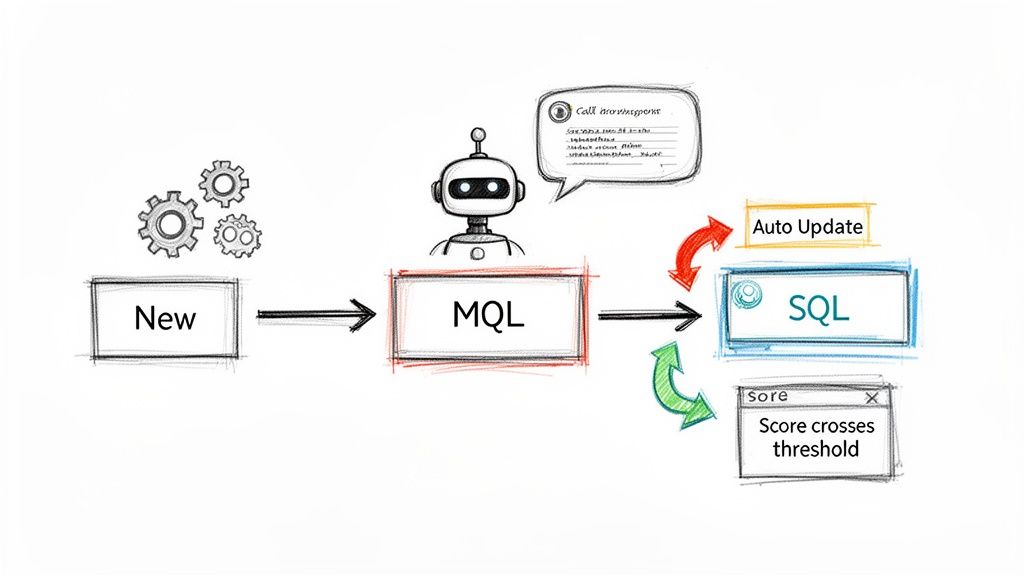
A typical progression includes these stages:
New Lead: A new contact in your system. No qualification has occurred.
Marketing Qualified Lead (MQL): The lead meets the score threshold. This is the handoff from marketing to sales.
Sales Accepted Lead (SAL): A sales rep reviews the MQL and confirms it is a valid opportunity.
Sales Qualified Lead (SQL): After a conversation, the sales rep confirms the lead meets core criteria (like BANT) and converts it to a sales opportunity.
This flow creates clear milestones in the buyer's journey.
When everyone understands each stage, your pipeline runs more smoothly.
Create Simple Automation Rules
With defined stages, you can build automation rules in your CRM, such as HubSpot or Salesforce. These rules reduce manual work for your team.
For example, you can create a workflow: "IF a lead's score exceeds 100 points, THEN change their status to 'MQL' and assign a task to a sales rep for follow-up."
Here are a few other practical examples:
Fast-Track Hot Leads: Notify a sales manager if a lead from a target account visits the pricing page twice in one day.
Recycle Inactive Leads: If an MQL is not contacted by sales within 48 hours, automatically add them back to a marketing nurture campaign.
Route Leads Intelligently: Assign new MQLs to the correct sales rep based on territory, company size, or industry.
Automation is not about replacing people. It handles repetitive tasks so your team can focus on building relationships and closing deals.
Use Tools to Improve Your Qualification Process
Standard CRM automation is a great start. To further improve, you can use data from sales conversations. An intelligent sales assistant like Samskit can help.
Samskit joins sales calls on platforms like Zoom or Google Meet. It records, transcribes, and analyzes the conversation to identify qualification signals.
The tool listens for your defined criteria. Did the prospect mention a budget? Did they confirm a timeline? Samskit captures these details automatically.
After the call, it prepares a pre-filled CRM update that aligns with your pipeline stages. The sales rep only needs to review and approve it. This workflow solves two major problems:
It eliminates manual data entry, saving your reps hours of administrative work.
It ensures your CRM data is accurate and consistent, reflecting what was actually said on the call.
This turns your CRM for inside sales into a reliable source of truth. By connecting conversation intelligence to your CRM, you free up your team to sell more.
How to Measure and Improve Your Qualification Process
A marketing lead qualification process needs metrics to be effective. You must track what works and what does not. This creates a feedback loop for continuous improvement.
Focus your measurement on a few key performance indicators (KPIs). These numbers provide a clear view of your pipeline's health.
Key Metrics for Qualification Success
Start by tracking these three essential metrics.
MQL-to-SQL Conversion Rate: This is the most direct measure of lead quality. It shows what percentage of leads that marketing qualifies are accepted by sales. A low rate indicates a disconnect between marketing and sales on what defines a "good lead."
Pipeline Velocity: This measures how quickly a deal moves from the first contact to a closed sale. A faster velocity suggests your qualification criteria effectively identify prospects with urgent needs.
Marketing-Sourced Revenue: This tracks how much closed revenue originated from marketing-generated leads. It is the ultimate proof of the financial impact of your qualification efforts.
Monitoring these KPIs helps you make data-driven decisions. If your MQL-to-SQL rate drops, it is time for marketing and sales to review the lead scoring model.
One study found that 67% of lost sales result from reps not properly qualifying prospects. This shows how crucial accurate measurement is to prevent wasted time and resources.
Turning Data into Actionable Improvements
Use data to start focused conversations between your marketing and sales teams.
For example, you may notice that leads who downloaded a specific case study have a higher close rate. The action is to increase the lead score for that download. This ensures similar high-intent leads are prioritized.
Or, sales might consistently reject leads from a certain industry. It may be time to adjust your Ideal Customer Profile (ICP) and add negative scoring for that segment. This type of continuous refinement ensures your team focuses only on opportunities that are likely to become customers.
Frequently Asked Questions
Here are answers to common questions about implementing a marketing lead qualification process.
How often should we review our lead scoring model?
A quarterly review is a good starting point. This schedule provides enough time to collect meaningful data without letting your criteria become outdated.
During the review, analyze which MQLs became customers and which did not. Look for common characteristics among your closed-won deals. Use these insights to adjust point values to better reflect buying intent. This iterative process makes your system smarter over time.
What's the biggest mistake in lead qualification?
The most common mistake is a lack of alignment between marketing and sales. Marketing sends leads they believe are qualified, but sales disagrees and disqualifies them.
This disconnect creates friction, wastes resources, and hurts team morale. The solution is to build your qualification framework and scoring model together. When both teams help define a "good lead," everyone is invested in the process.
Can a small business do lead qualification?
Yes. You do not need a complex system to qualify leads effectively. For a small business, focusing energy on the right opportunities is even more important.
Start with a simple checklist for discovery calls based on a framework like BANT. Consistency is more important than complexity. Asking the same key questions on every call ensures you spend your time on deals with the highest chance of closing. You can develop a more formal process as your business grows.
Stop letting valuable deal context disappear after every call. Samskit turns your customer conversations into accurate, reliable CRM updates automatically, freeing your team to focus on selling, not on manual data entry. See how it works at https://samskit.com.