What is sales prospecting? It is the process of finding potential customers and starting a conversation. The goal is to see if your product can solve their problem. This is the first step in building a healthy sales pipeline. Effective prospecting is not sending mass emails. It is a focused search for qualified buyers who fit your ideal customer profile.
This one activity separates top performers from the rest. It guarantees a steady flow of new business opportunities.
Uncovering Opportunities: The Core of Sales Prospecting
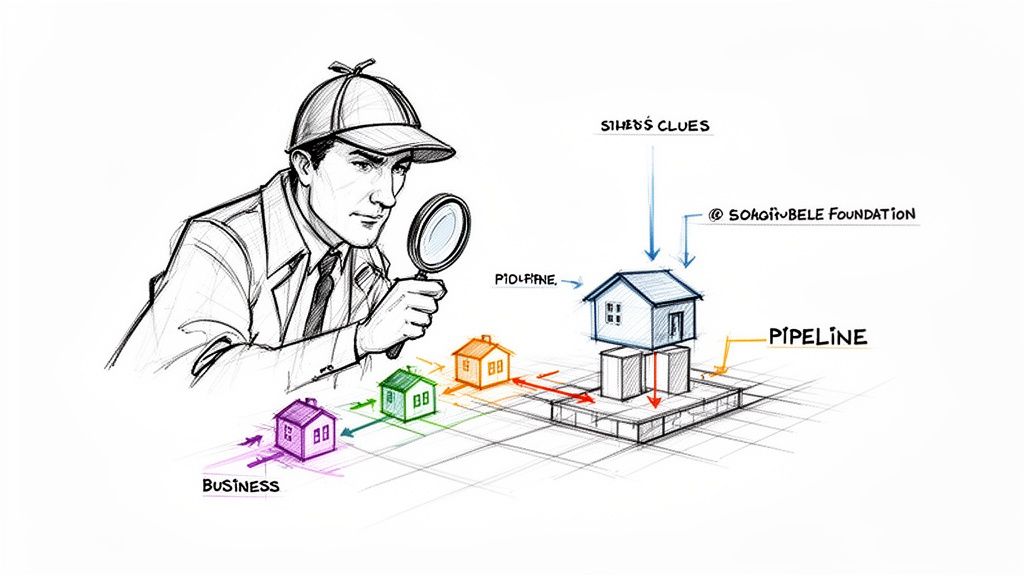
Think of a sales professional as a detective. They search a large territory full of companies and people. They look for specific clues: a new hire, a funding announcement, or a public complaint. These clues point them to the right individuals. These people have a problem your product is built to solve.
This investigative work is the essence of prospecting in sales. It is more than making a list of names. It is a disciplined system for finding ideal buyers and starting meaningful conversations.
Why Prospecting Matters More Than Ever
If you stop prospecting, your pipeline dries up. It is that simple. Without a consistent effort to find new opportunities, sales teams face a "feast or famine" cycle. They have one great month closing old deals. Then they have a terrible month with nothing new in the works.
A disciplined approach to prospecting creates a predictable revenue engine. It is the proactive work that fills the top of the funnel. This ensures there are always deals moving forward.
Mastering this skill directly impacts your success. Data shows that top-performing salespeople secure an average of 52 sales meetings for every 100 target contacts they reach. In contrast, average sellers book only 19. This gap shows how vital good prospecting is to hitting your sales targets.
Prospecting vs. Lead Generation
People often confuse 'prospecting' and 'lead generation'. They are two different functions. Understanding the difference clarifies where marketing's job ends and the sales team's role begins.
Lead generation is a marketing function. It attracts interest from many people at once. Prospecting is a focused, one-to-one sales activity.
Here’s a quick breakdown to make the difference clear.
Prospecting vs Lead Generation: A Quick Comparison
Aspect | Prospecting | Lead Generation |
|---|---|---|
Primary Activity | A targeted, one-to-one manual effort by a sales rep. | A broader, one-to-many automated effort by marketing. |
Initiator | The salesperson initiates contact (outbound). | The potential customer shows interest first (inbound). |
Focus | Finding highly qualified individuals who fit a specific profile. | Attracting a large volume of potential leads. |
Example | A sales rep researches a company and contacts its VP of Operations. | A company publishes a white paper and collects emails from downloads. |
This distinction is important. Marketing's lead generation casts a wide net to capture a large pool of potential leads. Prospecting is the salesperson's job of finding the individuals in that pool who are most likely to become customers.
Define Your Ideal Customer Profile
You cannot hit a target you cannot see. Before you pick up the phone or write an email, you must know who you are looking for. This means creating a detailed, written picture of your Ideal Customer Profile (ICP).
Your ICP acts as a homing beacon for your sales team. It is a specific definition of the perfect-fit company for your solution. Without an ICP, you are guessing. You will waste time and energy on leads that will never close.
Go Beyond Basic Demographics
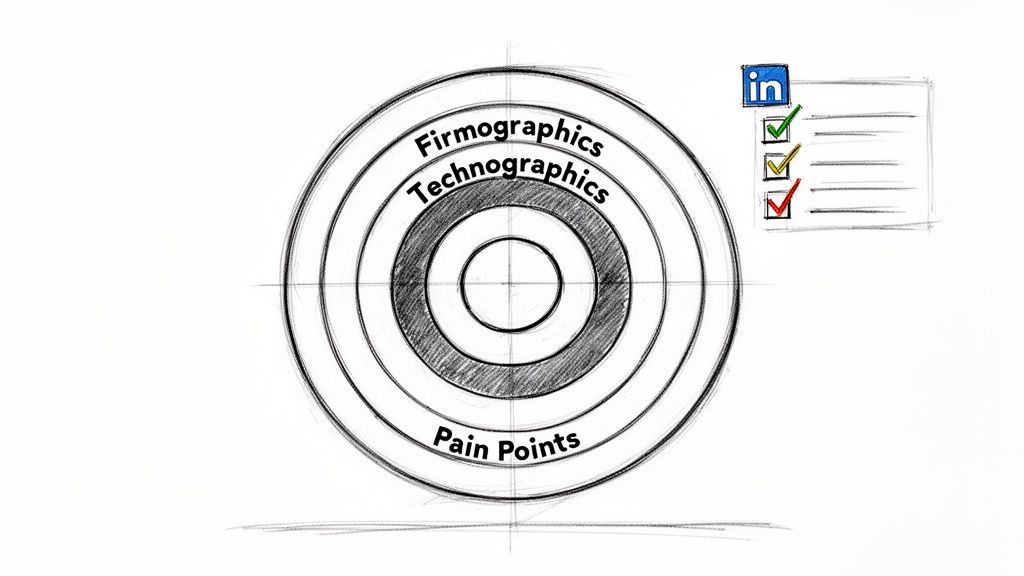
A strong ICP is more than a company’s size or location. It is a multi-layered profile that combines different data types. This gives you a complete view of your target. It's about building a composite sketch of your best possible client.
Here are the four layers to consider:
Firmographics: These are the basic facts. This includes industry, annual revenue, employee count, and location. For example: "B2B SaaS companies in Brazil with 50-250 employees."
Technographics: This is about the technology they use. Knowing their tech stack, like their CRM, reveals their operational maturity. For example: "Companies using Zoho CRM but lacking a call intelligence platform."
Behavioral Data: This looks at a company's actions. Are they hiring a new sales team? Did they just get funding? These actions are buying signals. They often flag an urgent need for new tools.
Pain Points and Goals: This is the most critical piece. What business challenges do they face? What are their strategic goals for the next quarter? When you understand their pain, you can position your product as the solution.
Create Your ICP: A Practical Checklist
Building your first ICP does not have to be a huge project. Start by looking at your ten best current customers. Find the common threads that tie them together.
Use this checklist to guide your analysis and build a working profile:
Industry/Vertical: Which specific market do they serve? (e.g., Financial Technology, E-commerce Logistics)
Company Size: How many people are on their team? (e.g., 100-500 employees)
Annual Revenue: What’s their typical revenue bracket? (e.g., R$20M - R$100M)
Geography: Where are they based? (e.g., São Paulo, Rio de Janeiro)
Technology Stack: What essential software do they use? (e.g., HubSpot, Salesforce, Pipedrive)
Key Trigger Events: What recent event makes them a good fit now? (e.g., Hired a new VP of Sales, announced expansion plans)
Critical Pain Points: What problems do you know they have? (e.g., "Our CRM data is a mess," or "We have no visibility into our sales calls.")
Once documented, your ICP becomes the single source of truth for your team. Marketing, sales, and customer success can align to attract and keep the right kind of customer.
Find Your Prospects Where They Live
With a clear ICP, you can find these companies. The guesswork is gone. Now you can use your ICP criteria to build targeted lists from the right sources.
Here are a few effective sources for finding ideal prospects:
LinkedIn Sales Navigator: This is the best tool for B2B prospecting. Its advanced filters let you search by company size, industry, job titles, and keywords. You can pinpoint the exact people at your target accounts.
Niche Industry Directories: Every industry has its own online directories. These are goldmines filled with key players and contact info for companies that fit your profile.
Company News and Funding Announcements: Monitor websites that track business news. A company that just received funding likely has the budget to invest in new tools.
Defining your ICP first transforms your prospecting in sales from a game of chance into a precise, strategic operation.
Implement Proven B2B Prospecting Frameworks
You have your Ideal Customer Profile (ICP). You know who to talk to. What's next? You need to start a conversation that leads somewhere.
This is where a prospecting framework helps. Think of it as a GPS for your sales conversations. It gives you a roadmap to gather the right information. This helps you qualify or disqualify an opportunity.
Without a framework, you are just winging it. A structured approach helps you understand the buyer's situation, diagnose their problems, and decide if your solution fits. It removes guesswork and brings discipline to your process.
BANT: A Simple Framework for Quick Qualification
The BANT framework is a classic method for qualifying deals quickly. It is an acronym that helps you check four essential boxes before investing too much time.
Your goal is to understand the prospect's position on each point.
Budget: Do they have money for a solution like yours? You don't need a precise figure, just a confirmation that funding is possible.
Authority: Are you talking to the person who can approve the purchase? If not, find out who that is.
Need: Do they have a problem your product can solve? If there is no recognized pain, there is no sale.
Timeline: Is there a deadline? A sense of urgency is a strong buying signal. A need to find a solution by the end of the quarter is a good sign.
Example BANT Questions in Action:
Budget: “Have you allocated a budget for this challenge this quarter?”
Authority: “Who else, besides yourself, is involved in evaluating this kind of decision?”
Need: “What are the consequences if you don't solve this issue in the next six months?”
Timeline: “When would you ideally need to have a new system running?”
MEDDIC: For Navigating Complex Enterprise Deals
BANT is great for speed, but it can be too simple for large, complex sales. For these, you need to go deeper. That is where MEDDIC is useful. It is a more robust methodology for strategic accounts.
MEDDIC is an acronym that requires you to gather more detailed intelligence.
Metrics: What measurable results does the prospect want? You need hard numbers, like "increase our team's meeting booking rate by 20%."
Economic Buyer: Who has the ultimate P&L responsibility for this purchase? This person can create a budget and has the final say.
Decision Criteria: What specific, formal criteria will they use to judge suppliers? This could be a technical checklist or specific pricing models.
Decision Process: What are the exact stages this deal must go through to get signed? Map out every step, from technical evaluation to legal review.
Identify Pain: What is the core business problem driving this? What are the negative consequences of doing nothing?
Champion: Who is your insider? This is the person invested in your solution's success. They will advocate for you when you are not in the room. Finding and enabling a champion is critical. To learn more about structuring these conversations, read our guide on the SPIN selling methodology.
By using a framework like BANT or MEDDIC, you conduct strategic qualification, not random chats. This discipline is the secret to a predictable pipeline.
Master Your Outreach Channels And Strategies
Defining your Ideal Customer Profile and building a list sets the stage. Real prospecting in sales begins when you reach out. Your choice of channel and approach makes a big difference.
A multi-channel approach is best. It lets you meet prospects where they are active. Some people prefer email; others prefer phone calls or LinkedIn. Mixing your outreach channels increases your chance of making a connection.
The Art Of The Cold Call
Cold calling can be intimidating. Yet, it is one of the most direct ways to engage a prospect. A successful call is a genuine conversation, not a monologue. Your goal is to build trust and uncover a need.
Here is a simple, five-step workflow for a cold call:
Introduction: State your name and company clearly.
Permission and Context: Ask, "I know you weren't expecting my call. Do you have 30 seconds for me to explain why I called?"
Value Proposition: State what you do. For example, "We help sales managers get accurate call data into their CRM without manual work."
Open-Ended Question: Ask a question to start a dialogue. For example, "How do you currently track key takeaways from discovery calls?"
Next Step: If there is interest, book a discovery call. Do not pitch on the spot.
Crafting Emails That Get Opened
Your email must be personalized and relevant to stand out. Generic emails get deleted.
The biggest mistake in prospecting emails is talking too much about yourself. A great email focuses on the prospect's world: their challenges, goals, and industry.
Here is a concise email template focused on providing value:
Subject: Quick question about [Prospect’s Company Name]
Hi [First Name],
I noticed your team is expanding its sales development function. Teams growing at this pace often struggle to keep CRM data clean and get visibility into call performance.
We automatically transcribe sales calls and push key insights into your CRM. Would a 15-minute chat next week to explore how this might support your new SDRs be useful?
Best regards,
[Your Name]
Engaging Prospects On Social Media
LinkedIn is the main B2B networking hub. A "connect and pitch" approach rarely works. It can damage your reputation.
Here is a practical workflow for social selling:
Follow First: Follow your prospects and their company pages.
Engage With Their Content: Add insightful comments to their posts.
Share Relevant Content: Post articles that help your audience.
Connect With Context: Send a personalized connection request. Reference something they shared or a mutual group.
This strategy positions you as a helpful expert. For a deeper dive, read our guide on how to use LinkedIn for social selling.
The Power Of A Warm Referral
A warm introduction from a mutual contact is prospecting gold. It provides instant credibility. Yet, many sales reps hesitate to ask for one.
Start by identifying who in your network knows your target. Then, send a concise request that is easy to forward. This is effective in Brazil’s B2B market, where retail sales volume is up by 1.6% over the year. Growth in office and IT equipment reached 3.2%. With 19 of 27 states reporting increases, regions like Espírito Santo and Rondônia are prime hunting grounds. You can read more about these Brazilian economic trends.
Here is a template for a referral request:
Subject: Intro to [Target Prospect’s Name]?
Hi [Your Connection’s Name],
I hope you’re well. I see you’re connected to [Target Prospect’s Name], [Job Title] at [Target Company]. We’ve been helping firms in their space tackle [Problem X], and I believe your introduction could be valuable.
Below is a short blurb to make it easy to forward. Would you mind sending it?
Thank you for considering this.
Thanks,
[Your Name]
Use Technology to Enhance Your Prospecting Workflow
Top prospectors work smarter, not just harder. Technology helps them turn manual, repetitive tasks into a streamlined workflow.
The right tools help you focus on what matters most. Instead of doing manual data entry, you can spend more time talking to prospects and building relationships. This shifts your role from a task manager to a strategic operator.
Automate Data Capture and Sync to Your CRM
Updating the CRM after a call can kill momentum. It is slow, tedious, and often leads to inaccurate data.
Imagine if this process was automatic. A tool like Samskit can join your calls on Zoom or Google Meet. It records, transcribes, and analyzes the conversation without you doing anything. This creates a perfect, searchable record of every interaction. You can focus on the conversation, not on taking notes.
This automation pulls actionable intelligence from the conversation. It can spot buyer intent, pinpoint objections, list needs, and capture next steps. It turns a simple chat into structured, usable data.
This means rich, accurate call summaries sync directly to your CRM. By eliminating manual note-taking, you save hours each week. You can use that time to sell. For more on this, check out how a modern CRM supports inside sales teams.
This is what a modern, multi-touch prospecting strategy looks like.
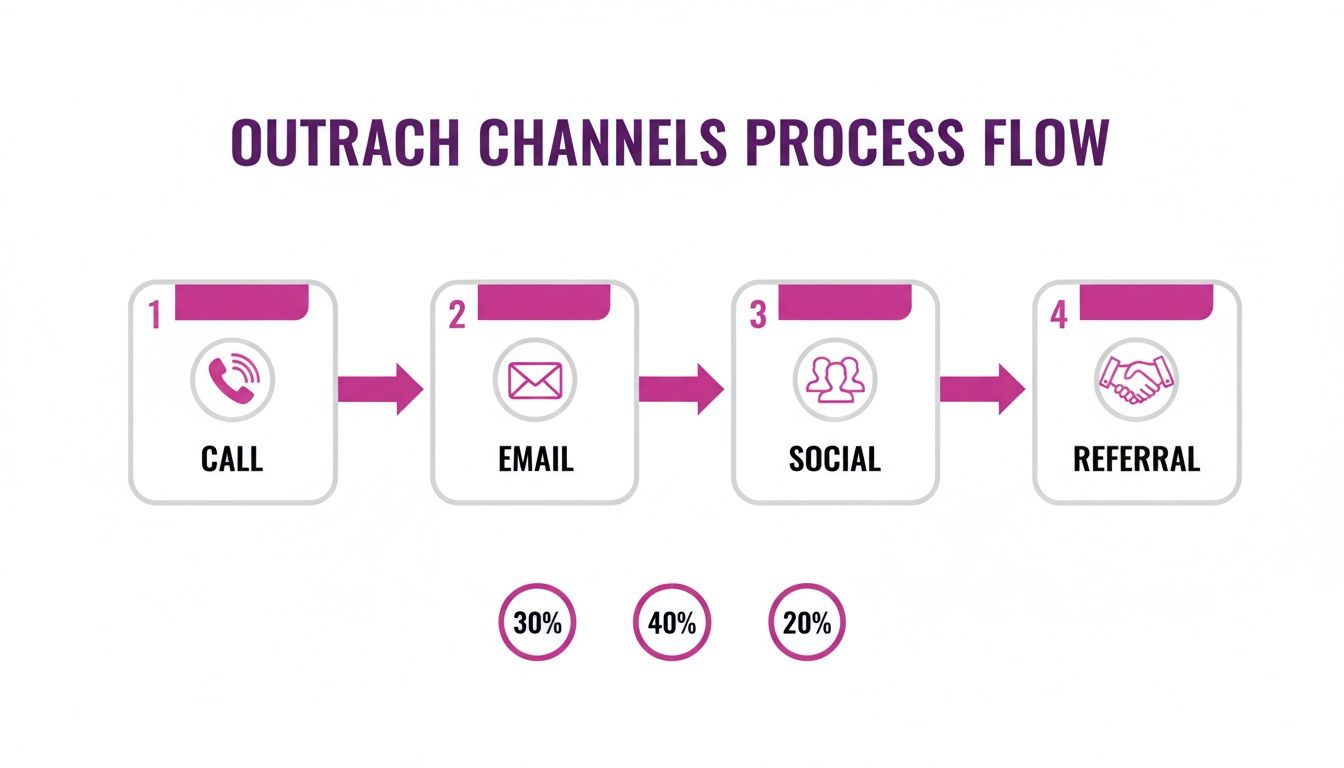
A winning strategy uses multiple channels. It integrates touchpoints, from a direct phone call to building rapport on social media.
Pinpoint High-Potential Prospects with Data
Technology also helps you find the right people to call. Consider Brazil's B2B market. Its e-commerce sector has hit US$346 billion and is projected to reach US$586 billion by 2027.
A huge driver is Pix, Brazil's instant payment system. It handled 57 billion transactions and now makes up 40% of e-commerce payments. This signals opportunities in fintech and retail tech. A smart rep uses this data to identify key players. Then, they use a tool like Samskit to analyze calls for intent signals, syncing notes and next steps to a CRM.
A Practical Tech-Enabled Prospecting Workflow
Here is a simple, repeatable workflow using technology:
Identify Target Account: Use LinkedIn Sales Navigator and market data to find a company that fits your ICP.
Book the Meeting: Use a multi-channel sequence of emails, calls, and social touches to schedule a discovery call.
Automate Call Capture: A meeting bot joins, records, and transcribes the call. You can focus 100% on the conversation.
Review AI-Generated Summary: After the call, you get a clean summary highlighting key moments, action items, and pain points.
Sync to CRM: With one click, the notes and summary are pushed to the correct opportunity in your CRM. The deal stage updates instantly.
This organized process ensures no opportunity is lost. Your pipeline data stays clean and reliable. It gives you and your manager a clear view of your progress without the administrative work.
Measure Prospecting Success with the Right KPIs
You cannot improve what you do not measure. For prospecting, this means focusing on numbers that connect your daily activities to revenue. Tracking the right metrics shows you what works and where your process has bottlenecks.
Think of it like a car's dashboard. You focus on the important gauges: speed, fuel, and engine temperature. In sales, your dashboard should show the core metrics that keep your pipeline healthy.
Key Prospecting Metrics to Track
Start with a few essential KPIs to get a clear picture of your performance. These numbers tell a story from your first outreach to a qualified opportunity.
Activities (Calls and Emails): This measures your raw effort. How many calls do you make and emails do you send each day? This is the starting point.
Conversation Rate: How many of your activities turn into a real conversation with a prospect? This KPI shows how effective your timing and messaging are. A low rate may mean you need to revise your scripts or subject lines.
Meetings Booked: How many conversations lead to a scheduled discovery call or demo? A high number here means you are sparking genuine interest and showing value early.
Qualified Pipeline Generated: This is the ultimate measure of prospecting success. It is the total potential deal value of the opportunities you have sourced and qualified. This metric directly links your work to the company's bottom line.
Tracking these four KPIs gives you a clear view of your prospecting engine. For example, you might find that 50 calls lead to 10 conversations, which result in 2 meetings and R$50,000 in qualified pipeline.
Connecting KPIs to Market Realities
Knowing your numbers helps you adapt to market trends. For instance, recent data from Brazil’s B2B sales landscape shows strong economic resilience.
Fitch Solutions notes that retail value sales grew 6.7% year-over-year, while passenger EV sales are expected to jump 28%. Meanwhile, McKinsey found that Gen Z's spending intent rose to 54%, while baby boomers' dropped to 29%.
These are not just statistics; they are clues for your outreach. By watching your KPIs against this backdrop, you can pivot your strategy. You can focus on high-growth sectors or demographics that show strong buying signals.
Got Questions About Sales Prospecting? We've Got Answers
Let's answer some common questions about the sales prospecting process. Use this as a quick reference to keep your pipeline-building efforts on track.
How Much Time Should I Actually Spend Prospecting Every Day?
There is no single magic number. The secret is consistency, not just intensity. Block out a dedicated, non-negotiable time for prospecting every day. Make it a habit.
For a Sales Development Rep (SDR): Your primary job is creating pipeline. You should dedicate 50% or more of your day to prospecting.
For an Account Executive (AE): You balance prospecting with closing deals. Aim for 20-30% of your time.
Protect this time on your calendar. Treat it like an important client meeting. It is a meeting with your future pipeline.
What's The Real Difference Between Inbound and Outbound Prospecting?
Think of it like fishing. Inbound is when the fish come to you. Outbound is when you go looking for the fish.
Inbound Prospecting: A potential customer shows interest first. They might download an ebook or sign up for a demo. They have raised their hand. Your job is to engage these warm leads.
Outbound Prospecting: You initiate the first contact. This includes cold calling, sending targeted emails, or connecting on social media with people who do not know your brand. A healthy sales strategy needs a mix of both to keep the pipeline full.
How Do I Get Over The Fear of Cold Calling?
Almost everyone feels some call reluctance. The key to overcoming it is preparation and a mental shift. First, change your perspective. A "no" is not personal rejection; it is just information. It means it is not the right person, time, or fit.
Next, be prepared. Have a clear goal and a flexible script before you dial. Focus on starting a conversation, not pitching a product. Focus on their problems, not your solution.
Finally, focus on the activity, not the outcome. Your job is to make the calls. Confidence comes from repetition. Every dial is a chance to learn something new.
Ready to streamline your sales process and get more time back for what truly matters? See how Samskit can automate your CRM updates and provide deep insights from your sales calls. Learn more about Samskit.