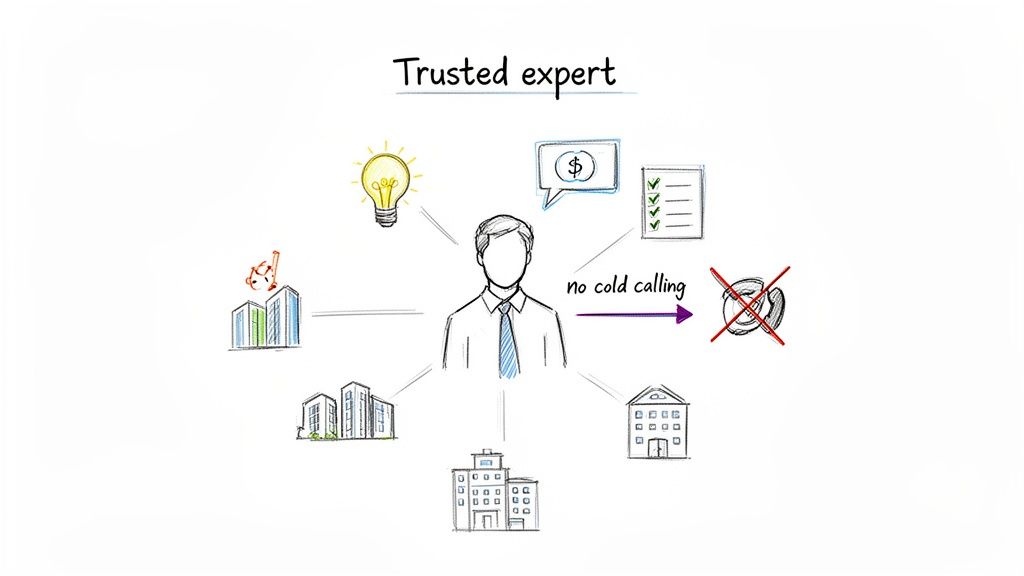
Cold calls are ineffective. LinkedIn social selling is a different approach. It uses the platform to find the right people, build relationships, and generate business.
The core idea is to provide value before you ask for anything. You are not a salesperson. You are a trusted expert in your field. This guide provides a clear workflow to get started.
Shift From Cold Outreach to Warm Relationships
Buyers today have more power. They research solutions and dislike generic sales pitches. A solid LinkedIn social selling strategy is essential for B2B teams.
Instead of interrupting a prospect's day, you earn their attention. You share content that helps them solve problems. Your goal is to be the first person they think of when they need help. This method builds the trust and credibility needed to close deals.
The opportunity is significant. For example, LinkedIn reached 68 million members in Brazil in early 2024. That is an increase of 9 million users in one year. Professionals use the platform to connect and find solutions.
Why This Workflow Suits Complex Sales
Complex B2B sales involve multiple decision-makers. Building rapport with this group takes time. Social selling lets you start that process long before they are ready to buy.
Focus on relationships first. Your sales process becomes a consultative partnership, not a transaction. This trust shortens sales cycles and increases win rates.
A good social selling workflow nurtures leads over time. When a prospect is ready to buy, you are a familiar advisor, not a stranger. To see how this fits into a larger plan, review our guide on building a marketing and sales strategy.
Build a Buyer-Centric LinkedIn Profile
Your LinkedIn profile is not your resume. It is your digital storefront. A potential buyer visits your page to see if you understand their problems and are credible. A profile that only lists your job duties is not effective.
Make your profile a resource for your ideal customer. Every section should address their pain points and goals. They should feel that you understand their challenges.
A buyer-centric profile becomes a passive lead generation tool. It works 24/7 to attract and pre-qualify prospects. It is the foundation for all your outreach. People will check your profile before accepting a connection request.
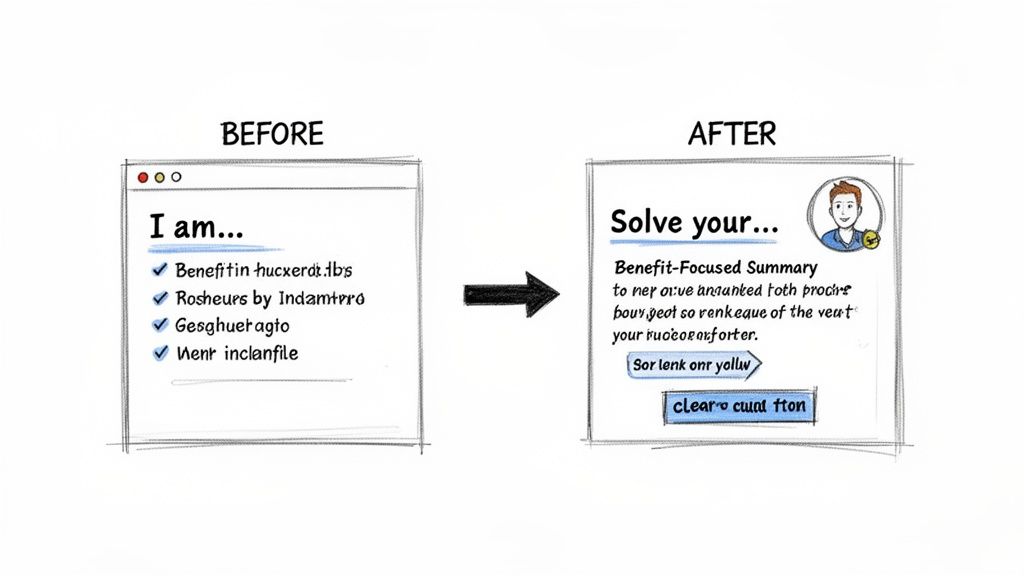
Action Step: Turn Your Resume into a Resource
Stop talking about yourself. Start talking about your customers. Frame your experience in terms of the value you deliver. This change positions you as a problem-solver, not a salesperson.
You must know your audience. In Brazil, users aged 25-34 are 51.8% of the LinkedIn audience. This demographic includes many sales reps and account executives who are actively seeking solutions. You can review the complete demographics of LinkedIn users in Brazil for more detail.
This buyer-first approach helps you connect with the right people. For more on this topic, read our guide on effective lead qualification.
Profile Optimization Checklist
This table shows how small changes can turn a standard profile into a social selling asset.
Profile Element | Before (Self-Focused) | After (Buyer-Focused) |
|---|---|---|
Headline | "Account Executive at ABC Corp" | "I Help SaaS Startups Reduce Churn with Data-Driven Onboarding" |
About Section | "Results-driven sales professional with 10 years of experience in enterprise software sales." | "Tired of watching customers slip away? I help SaaS leaders build onboarding flows that cut churn by up to 30%. I do this by..." |
Banner Image | Default LinkedIn blue banner or generic company logo. | A custom banner with a value proposition, e.g., "Stop Churn. Start Scaling," and a client testimonial. |
These changes reframe how a prospect sees you. Use this checklist to get started:
Profile Picture and Banner: Use a professional headshot where you look approachable. Use your banner to state your value proposition.
Headline: Use this formula: "I help [Ideal Customer] achieve [Result] by [Method]."
About Section: Tell a story. Start with your prospect's main pain point. Explain how you help them solve it. Use short paragraphs and bullet points to show tangible results.
Your LinkedIn profile must answer one question for your prospect: "What's in it for me?" Every section should provide a clear answer.
These practical steps turn your profile into a key part of your LinkedIn social selling workflow.
Create a Content Strategy to Build Authority
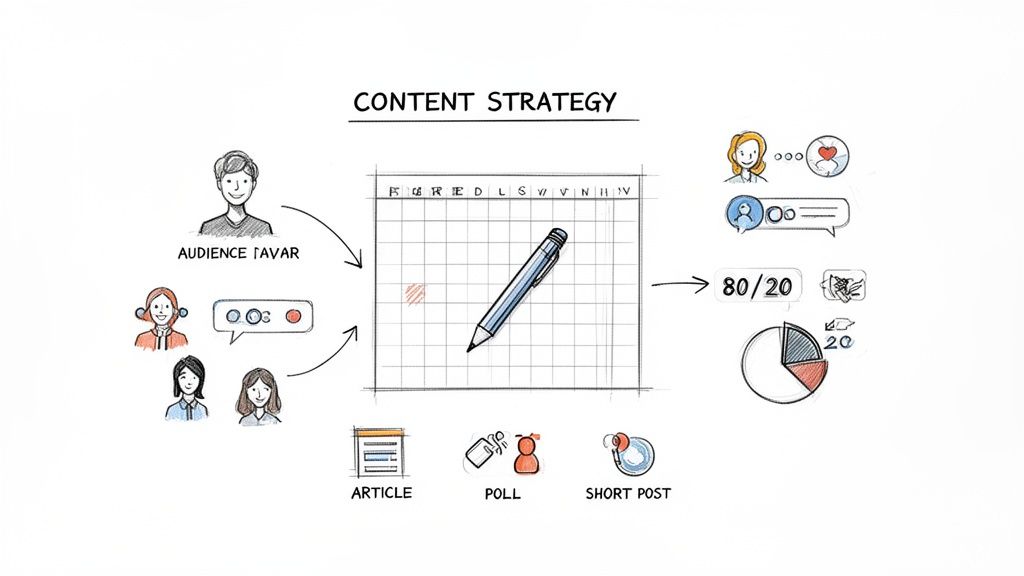
A strong profile gets attention. Your content keeps people engaged. The core of LinkedIn social selling is to give value before you ask for a sale. Your job is to help your audience, not just sell a product.
Use the 80/20 rule. Make 80% of your content helpful, such as industry insights or practical advice. Use the other 20% to discuss your company or product.
This balance changes how people perceive you. You become a credible expert, not just a salesperson. When prospects see you consistently providing value, they are more likely to listen when you mention your solution. You have earned their trust.
Content That Connects and Teaches
You do not need a large budget to create effective content. You need consistency and a focus on being helpful. Small, repeated actions create the most impact over time.
Here are simple content ideas to start with:
Share industry articles with your commentary. Add a few sentences with your opinion or a key takeaway. End with a question to encourage comments.
Write simple text-only posts. Share a story about a client success or a common industry mistake. These personal posts often perform well.
Create a poll. Polls are an easy way to boost engagement. Ask your audience about a common problem to start conversations and gather insights.
Your content's goal is not to go viral. The goal is to consistently provide relevant ideas to your target audience: your future customers.
How to Engage on Other People's Posts
Your content strategy includes how you interact with others. Thoughtful engagement on your prospects' posts is a powerful technique. Avoid generic comments like "great post!" or "thanks for sharing." They add no value.
Instead, add substance to the conversation. Show you read their post and have something meaningful to say. This helps you get on their radar in a positive way.
Use this simple framework for a value-added comment:
Acknowledge a specific point: "I agree with your point about [specific topic]."
Add insight or ask a question: "I have seen similar results, especially when [add a related idea]. Have you found that to be true?"
This approach gets you noticed and can start a real conversation. A real conversation is the first step toward a business relationship.
Implement an Outreach and Engagement Plan
A plan is useless until you execute it. This is where you start connecting with prospects in a helpful, not aggressive, manner. The goal is to build relationships through thoughtful interactions.
Effective outreach requires precision. Do not use a "spray and pray" method. Find prospects who are a good fit. LinkedIn's standard search filters are a start, but for serious LinkedIn social selling, use Sales Navigator. It helps you build targeted lists based on criteria like company size, seniority, and recent job changes.
This first step is about research. Before sending a message, spend a few minutes on their profile. Review their recent posts and company news. This context helps you make your first contact relevant and personal.
A Four-Step Engagement Sequence
Your outreach should feel natural. It should move from a public interaction to a private conversation. You earn access to their inbox by first adding value where others can see it.
Follow this simple, four-step sequence:
Engage Publicly First: Before sending a connection request, like or comment on one of their recent posts. A thoughtful comment is better. This is a low-pressure way to get their attention.
Send a Personalized Connection Request: Always add a note to your connection request. Mention a mutual connection, a piece of their content, or a common interest. Keep it short and focused on them.
Provide Value After Connecting: Do not pitch as soon as they accept. Send a message to thank them for connecting. Share something helpful, like a relevant article or case study related to their posts.
Shift to a Conversation: After a few value-based interactions, you can pivot. Ask an open-ended question about a challenge they mentioned or a company goal. Your objective is to start a dialogue.
Connection Request and Follow-Up Templates
Templates save time but must be personalized. Use these as a foundation, not a script to copy and paste.
Connection Request Template
"Hi [Prospect's Name], I saw your recent post on [Topic] and appreciated your perspective on [Specific Point]. I'm also focused on this area and would like to connect to follow your insights."
This works because it is specific, genuine, and provides a clear reason to connect. It shows you paid attention.
Follow-Up Message Template (3-5 days after connecting)
"Thanks for connecting, [Prospect's Name]. Following up on your post about [Topic], I thought you might find this article on [Related Subject] useful. It includes data on how other companies are handling [Challenge]. Hope it's helpful!"
This follow-up continues to provide value. You are giving, not asking. This builds the trust you need to eventually ask for a meeting.
For more details on approaching potential clients, see our guide on modern sales prospecting techniques. This careful, relationship-focused process turns cold outreach into a warm conversation.
How to Measure and Scale Your Social Selling Efforts
Time spent on LinkedIn must produce tangible results. To justify your investment, you must connect your daily activities to business outcomes like meetings booked and pipeline generated.
To scale your LinkedIn social selling, build a repeatable workflow. Move beyond random manual actions. Integrate your process with your main sales technology. The goal is a smooth flow of information from LinkedIn to your CRM.
This creates a closed-loop system to track your return on investment. You can see the entire journey from a connection request to a closed deal. This provides sales managers with the reliable data they need to make informed decisions.
Linking Activity to Revenue
Track two types of metrics: leading and lagging indicators. Leading indicators are daily activities you control, like sending personalized connection requests. Lagging indicators are the results that follow, like qualified meetings booked or deals sourced from LinkedIn.
To track this properly, link your LinkedIn activity to your CRM. Manual data entry is inefficient and often leads to inaccurate data. Automation is the key to scaling your social selling.
The most successful social selling programs prove their impact on revenue. Automating data capture eliminates guesswork and builds a solid, data-backed case for your efforts.
For example, after booking a meeting through LinkedIn, a tool like Samskit can automatically join, record, and transcribe the call.
The tool then analyzes the discussion to extract key information, such as buyer objections, budget details, and next steps. All of this data is automatically sent to the correct fields in your CRM. No manual entry is required. This simple workflow fuels your sales funnel.
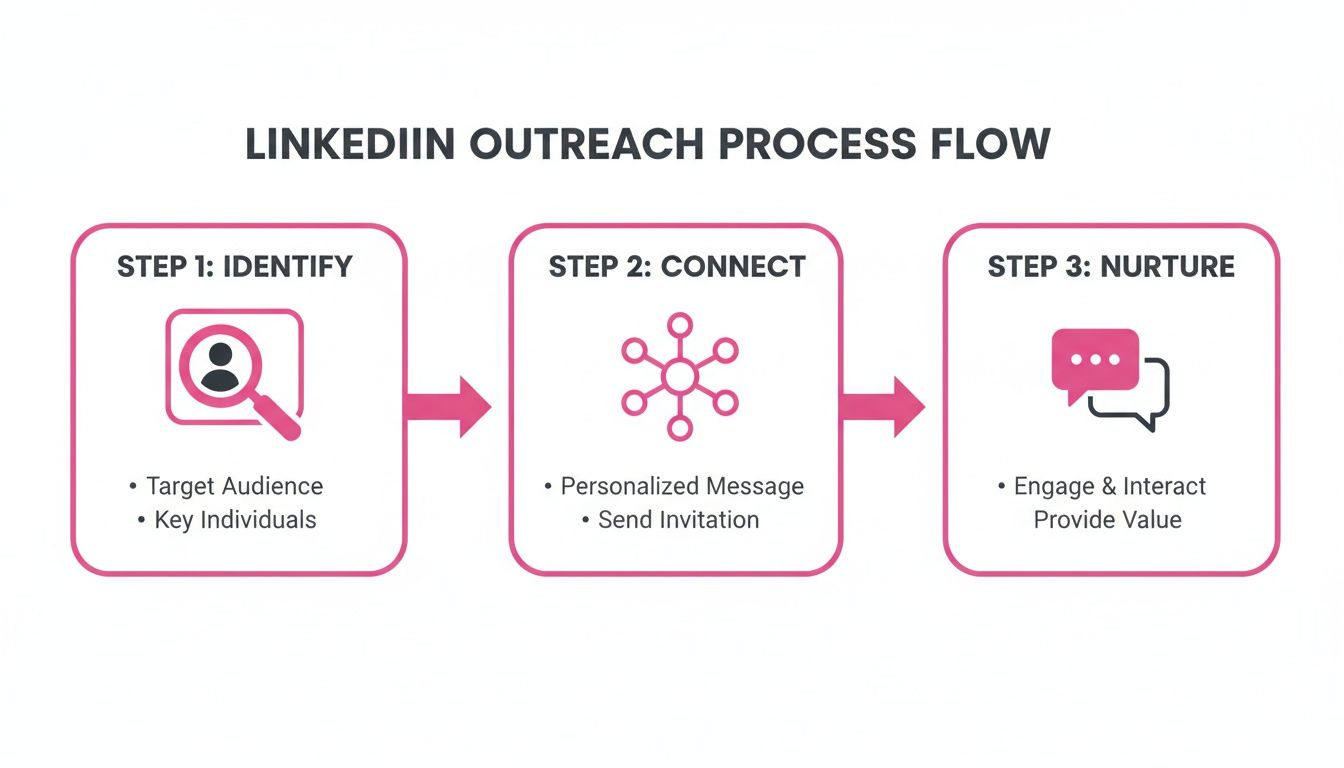
This three-step process—Identify, Connect, Nurture—is the core of your social selling. Automating what happens after the connection proves the workflow is effective.
Key Metrics to Track for Success
Focus on KPIs that directly relate to business impact, not vanity metrics. This shifts the conversation from "views" and "likes" to pipeline and revenue.
Here are the essential metrics to monitor:
Meetings Booked from LinkedIn: The number of initial meetings scheduled where LinkedIn was a key touchpoint.
Pipeline Influenced: The total value of opportunities where you engaged a key contact through social selling.
Conversion Rate (Connection to Meeting): The percentage of new, qualified connections that result in a scheduled discovery call.
Sales Cycle Length: Compare the sales cycle length for leads from LinkedIn with other channels. The trust built upfront often shortens this timeline.
By focusing on these concrete outcomes, you can demonstrate the tangible value of your LinkedIn strategy. This makes it easier to justify more resources and expand the program to your entire sales team.
Common Questions About Social Selling on LinkedIn
Even with a good plan, questions will arise. Here are answers to some common questions to help you stay on track and achieve results.
How Much Time Should I Spend on This Every Day?
Consistency is more important than intensity. You do not need to spend all day on LinkedIn. A focused 30-45 minutes per day is enough to build momentum.
Structure your time with a daily workflow:
15 minutes on content: Find a relevant article, add your commentary, and share it. Or, leave thoughtful comments on posts from key contacts in your network.
15 minutes on prospecting: Use Sales Navigator or LinkedIn's advanced search to find a few new prospects. Send them personalized connection requests.
15 minutes on conversations: Reply to messages, follow up with new connections, and keep dialogues moving forward.
This structure keeps you focused on activities that drive results, not just scrolling.
The goal is to build a habit, not to sprint and burn out. Small, consistent daily actions build the trust and visibility needed to fill your pipeline.
What are the Biggest Mistakes People Make?
The most common mistake is treating LinkedIn like a cold-calling list. Sending a generic sales pitch immediately after someone accepts your connection request is the fastest way to be ignored or blocked.
Other common mistakes include:
A "me-first" profile: Your profile should be a resource for buyers, not a digital resume. It should address their problems, not just list your achievements.
One-way communication: If you only post your own content and never interact with others, you are missing the point. It is called social selling.
Inconsistent activity: Disappearing for weeks kills your momentum. People buy from people they know, like, and trust. You cannot build trust if you are not present.
How Can I Measure the ROI?
To prove the value of social selling, you must connect your actions to business outcomes. This involves tracking two types of metrics.
First, track leading indicators—the daily activities you control, like the number of qualified connections made or meaningful conversations started. Second, track lagging indicators—the business results, like meetings booked, pipeline generated, and deals closed from LinkedIn activities.
The most reliable way to connect these dots is to integrate your LinkedIn activity with your CRM. This creates a clear line from the first LinkedIn interaction to a signed contract, providing the hard data needed to prove your impact.
By automating the bridge between your LinkedIn conversations and your CRM, Samskit turns your social selling efforts into measurable results. It captures key deal information from your calls and automatically updates your pipeline, giving you a clear picture of your ROI without all the manual data entry. Learn how to scale your sales with Samskit.